PostgreSQL and Supabase Design
Data Modeling Principles
The Blueprint of Your Data
Before you write a single line of SQL or click a button in Supabase, you need a plan. Data modeling is that plan. It's the process of creating a blueprint for your database, translating real-world needs into a structured format. Trying to build a database without a model is like building a house without a blueprint. You might end up with a functional structure, but it will likely be inefficient, hard to maintain, and prone to collapse when you try to expand.
The goal is to design a structure that minimizes redundancy and protects data integrity. A good model ensures that your data is logical, consistent, and can easily grow with your application.
Entities and Attributes
The first step is to identify the core concepts you need to store. In data modeling, these concepts are called entities. Think of them as the nouns of your system: a User, a Product, an Order, a Blog Post. Each entity represents a distinct object or idea that you need to track.
Once you have your entities, you need to define their properties. These are called attributes. If 'User' is an entity, its attributes might be user_id, email, and creation_date. If 'Product' is an entity, its attributes could be product_id, name, and price. Each attribute describes a specific piece of information about its entity.
Defining Relationships
Entities rarely exist in isolation. A user places an order. A blog post has comments. These connections are called relationships. Defining them correctly is key to building a robust database. There are three primary types of relationships.
One-to-One (1:1)
other
Two entities are linked, but only one instance of each can be part of the relationship. This is the least common type. A good example is a User and a UserProfile. One user has exactly one profile, and one profile belongs to exactly one user.
One-to-Many (1:N)
other
One instance of an entity can be related to many instances of another entity. This is the most common relationship. For example, one Customer can have many Orders, but each order belongs to only one customer.
Many-to-Many (N:M)
other
An instance of one entity can be related to many instances of another, and vice-versa. For example, a Book can have multiple Authors, and an author can write multiple books. These relationships almost always require a third table, called a junction or linking table, to be implemented in a relational database.
Visualizing with ERDs
To make sense of all these connections, we use an Entity-Relationship Diagram (). An ERD is a flowchart that illustrates how entities relate to each other in a database. It's the master blueprint we've been talking about.
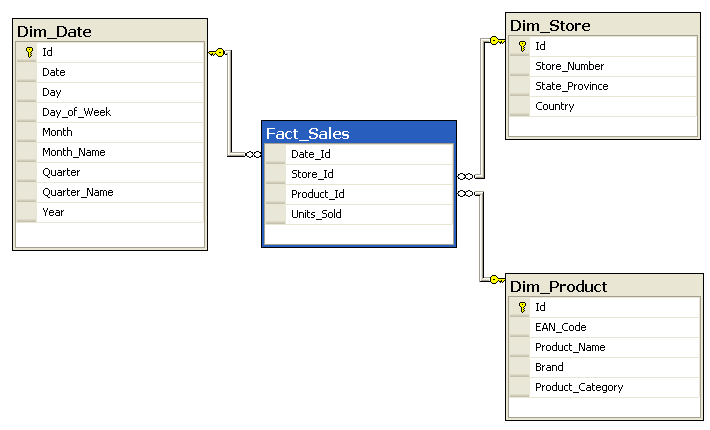
A key part of an ERD is showing the cardinality of a relationship, which defines the numerical attributes of the connection. For instance, must a customer have an order? Can an order exist without a customer? Cardinality answers these questions.
One of the most popular ways to draw these relationships is with , which uses simple graphical symbols to represent the 'one' and 'many' sides of a relationship.
This diagram clearly shows that a user can have many posts and comments. A post can have many comments. The many-to-many relationship between posts and tags is resolved through the Post_Tag linking table, which creates two one-to-many relationships.
Logical vs Physical Models
Finally, it's important to know the difference between a logical and a physical data model.
A logical model is abstract and technology-agnostic. It focuses on the business requirements, defining the entities, attributes, and relationships without considering a specific database system. The ERD we just created is a logical model. It describes what the system should do.
A physical model is the concrete implementation of the logical model for a specific database technology, like . It includes details like data types (VARCHAR, INT, TIMESTAMPTZ), indexing strategies, and table constraints. It describes how the system will do it. For example, in a physical model, you would decide that a 'username' attribute is a TEXT field and is indexed for faster lookups.
Data modeling is the process of creating a structured blueprint for organizing a system’s data, defining how entities, attributes, and relationships interact to support business operations and analytics.
Starting with a logical model allows you to focus on getting the business rules right before getting bogged down in technical details. Once the logical model is solid, you can translate it into a physical model for PostgreSQL and bring your database to life in Supabase.
What is the primary purpose of data modeling?
In a database for an e-commerce site, which of the following is an example of an entity?