Post C-Section Fitness and Weight Loss Mastery
Scar and Core Integration
Reconnecting with Your Core
At 12 weeks postpartum, your focus can shift from initial healing to active reconnection. A caesarean incision goes deeper than the skin, affecting layers of muscle and fascia that are essential for core stability. This disrupts the communication between your brain and your deep core muscles.
Think of your core as an integrated system, with the C-section scar, the transverse abdominis (TVA), and the pelvic floor as key players. The surgery temporarily interrupts their teamwork. Our goal now is to restore that connection, starting with the scar itself.
Understanding Your Scar
As your incision heals, the body creates scar tissue. Sometimes, this tissue forms adhesions, which are like internal sticky spots that bind together layers of tissue that should slide freely against each other. These adhesions can restrict movement, cause a pulling sensation, and contribute to the common 'C-section shelf' or pooch above the scar line.
Your scar isn't just on the surface; it's a three-dimensional part of your core system. Freeing it helps your deep abdominal muscles function correctly.
Scar tissue mobilisation, or scar massage, is a gentle technique to make the scar and underlying tissues more pliable. It's not about erasing the scar, but about improving its function. Start gently and listen to your body.
-
Desensitise: Begin by gently touching the area around the scar with different soft textures, like a cotton ball or silk scarf, to help your nervous system get comfortable with sensation there.
-
Skin Stretching: Place your fingers an inch above and below the scar. Gently stretch the skin by pulling your hands apart. Hold for 30 seconds. Repeat this with your hands on either side of the scar, stretching horizontally.
-
Direct Mobilisation: Once comfortable, place your fingertips directly on the scar. Gently move the scar up and down, side to side, and in small circles. Imagine you are trying to unstick a sticker without peeling it off. The goal is to move the skin and superficial layers over the deeper ones.
Rehabilitation is crucial—early mobilization prevents adhesions
Just a few minutes each day can make a significant difference in reducing restrictions and improving how your abdomen looks and feels.
Waking Up Your Deep Core
Your deepest abdominal muscle is the transverse abdominis, or TVA. It wraps around your midsection like a corset, providing stability for your spine and pelvis. A C-section cuts through the abdominal wall, which can make the brain-to-muscle signal to the TVA feel weak or disconnected.
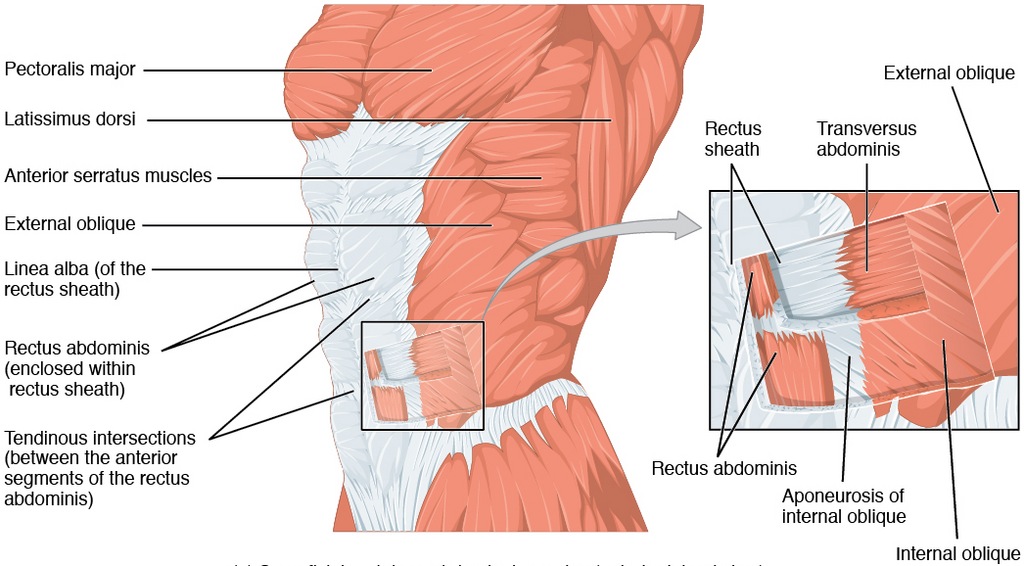
We can't just jump into crunches to fix this. The first step is to re-establish that neural pathway. The most powerful tool for this is your own breath.
Fascia
noun
A thin casing of connective tissue that surrounds and holds every organ, blood vessel, bone, nerve fibre, and muscle in place.
Diaphragmatic breathing, or '360 breathing', is the foundation for rebuilding your core. It teaches the TVA, diaphragm, and pelvic floor to work together again. Here’s how to do it:
-
Lie on your back with your knees bent. Place one hand on your chest and the other on your belly. You can also place your hands on the sides of your rib cage.
-
Inhale slowly through your nose. Feel your rib cage expand outwards to the front, sides, and back. Your belly should rise, and you should feel a gentle lengthening in your pelvic floor muscles. The hand on your chest should stay relatively still.
-
Exhale slowly through your mouth, as if you're blowing through a straw. As you exhale, feel your rib cage and belly naturally draw back in. Imagine your pelvic floor gently lifting, like a jellyfish pulsing upwards.
As you exhale, you can add a gentle cue to engage your TVA. Imagine you are lightly tensing your lower abdomen, as if you are fogging up a mirror or gently zipping up a pair of snug jeans. This isn't a forceful brace, but a subtle activation.
This coordinated breath reconnects the brain to the deep core system, reminding the muscles how to work together to create stability from within. It’s the first and most important step before moving on to more traditional strengthening exercises.
Let's check your understanding of these foundational concepts.
What is the primary goal of scar tissue mobilisation after a caesarean section?
The deepest abdominal muscle that wraps around your midsection like a corset is known as the ____.
Mastering scar mobilisation and 360 breathing creates a solid, functional base. It ensures your deep core is firing correctly, which is essential for safely and effectively returning to other forms of exercise.