Pontryagin's Maximum Principle Explained
Applications in Economics
Optimizing Over Time
Economics is all about making choices under scarcity. We have limited resources and endless wants. Optimal control theory, especially Pontryagin's maximum principle, gives us a powerful mathematical toolkit for making the best possible choices over time. It helps answer questions like: How fast should we extract a natural resource? What's the best way to save and invest for the future? How should a government manage its economy?
These aren't one-off decisions. They are dynamic problems where today's choices affect tomorrow's possibilities. This is precisely the kind of problem optimal control was designed to solve. Instead of just finding a single optimal point, we find an optimal path or policy to follow through time.
Managing Scarce Resources
A classic economic problem is managing a non-renewable resource, like oil or minerals. Let's say we want to decide the optimal rate to extract this resource over a specific period. If we extract too fast, we'll run out quickly and future generations will have none. If we extract too slowly, we miss out on the benefits today.
We can frame this using the language of optimal control. The amount of the resource available at time is our state variable, . The rate at which we extract the resource is our control variable, . Our goal is to maximize the total value, or utility, we get from the resource over time. A key economic concept here is the discount rate, , which reflects that a benefit today is worth more to us than the same benefit in the future.
Here, is the utility or profit from extracting at rate , and is the discount factor. The state of the resource changes according to how much we extract:
Using Pontryagin's maximum principle, we set up the Hamiltonian. The costate variable, , plays a fascinating role. In economics, it's called the shadow price.
Shadow Price
noun
The marginal value or worth of one additional unit of a resource. It represents the opportunity cost of consuming the resource now versus saving it for the future.
The Hamiltonian is:
The costate equation tells us how this shadow price changes over time: , so is constant.
Maximizing the Hamiltonian with respect to our control gives us the optimal extraction rule. A key result from this type of model is Hotelling's rule, which states that the net price of the resource (and thus its shadow price) must grow at the rate of interest for the extraction path to be optimal.
Consumption and Savings
Optimal control is also central to macroeconomics, particularly in models of economic growth. One of the most famous is the Ramsey-Cass-Koopmans model, which explores how a society should balance consumption today against investment for future consumption.
Imagine you are planning your consumption and savings over your lifetime. This is a dynamic optimization problem.
- State variable: Your capital or wealth, .
- Control variable: Your rate of consumption, .
- Objective: Maximize your lifetime utility from consumption.
Your capital grows from the return on your investments, , but shrinks by the amount you consume, .
The goal is to maximize total discounted lifetime utility:
Applying Pontryagin's principle to this problem gives us a fundamental equation for how consumption should change over time, known as the Keynes-Ramsey rule. It connects the growth rate of consumption to the rate of return on capital and the discount rate. This helps economists understand savings rates, interest rates, and the long-term growth of an economy.
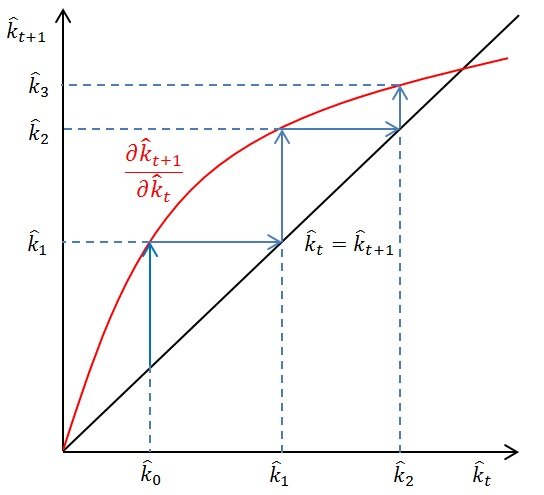
These models provide powerful insights for economic policy. For example, they can help analyze the long-term effects of changes in tax policy on investment and savings, or how government spending might impact economic growth.
By using optimal control, economists transform broad questions about policy into precise mathematical problems, allowing for rigorous analysis of trade-offs over time.
Let's check your understanding of these economic applications.
In the economic problem of managing a non-renewable resource, the rate at which the resource is extracted is an example of a:
In optimal control models of resource extraction, the costate variable (λ) is often interpreted as the 'shadow price' of the resource.
The principles we've discussed are foundational in modern economic theory, providing the dynamic backbone for everything from managing fisheries to setting monetary policy.