Poetry of the Atlanta Piedmont
Urban Canopy Ecopoetics
The City in a Forest
An urban ecopoem isn't just a nature poem with skyscrapers in the background. It's an exploration of an ecosystem where concrete and chlorophyll coexist. This kind of poetry treats the city itself as a natural environment, a habitat with its own unique cycles, tensions, and symbiotic relationships. It asks: how does a street grid interact with a root system? What is the song of a bird competing with traffic?
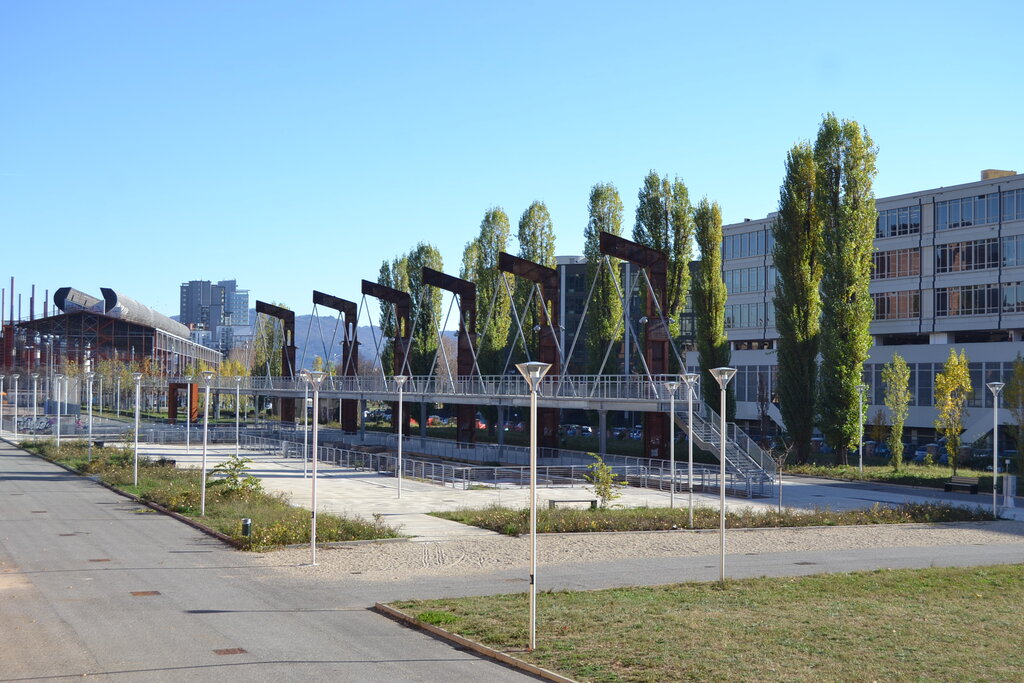
Atlanta, Georgia, is a perfect subject. With nearly half its area covered by tree canopy, it's less a city with a park and more a forest with a city inside it. The massive, interconnected canopy isn't just scenery; it's a living architecture that cools the air, manages stormwater, and dialogues with the built environment. An ecopoem about Atlanta wouldn't just mention the beauty of the oaks and pines. It would map the intricate relationship between the urban infrastructure and the underlying —a record of how one organism adapts to, and thrives within, another.
Mapping Space onto the Page
How can a poem capture this complex, layered reality? One powerful technique is a method of laying out words on the page to reflect the physical and temporal space of the subject. Instead of conforming to traditional linear stanzas, the poem's shape follows the poet's experience within the environment. Words might be scattered to represent the canopy's dappled light, or arranged in grids that mimic city blocks, with lines of text breaking through like tree roots under a sidewalk.
The page becomes a map. The line breaks, the white space, and the clusters of text all work together to represent the landscape itself.
This approach separates ecological poetry from purely decorative verse. A decorative poem might describe a tree's beauty, using it as a symbol or a pretty object. An ecological poem, using field composition, investigates the tree as part of a system. It's about function, connection, and process, not just appearance.
The aim of this project is to help local residents better understand the values of green spaces in the city (in parks, streets, and backyards!), to provide a new way of reading and understanding landscape, and to bridge individual ideas to neighbourhood-wide actions.
By seeing the city as a forest, poets can reveal the hidden ecological dramas unfolding all around us. The verse becomes a tool for understanding our urban environment not as a conquest of nature, but as a complex, and sometimes chaotic, collaboration with it.
Ready to test your understanding?
According to the provided text, what is the primary focus of an urban ecopoem?
The poetic technique of 'field composition' involves arranging words on the page to reflect the physical and temporal space of the subject.
This poetic lens allows us to see the urban landscape with new eyes, recognizing the deep ecological story told by the city's living, breathing canopy.