PMI Risk Management Professional Certification
Introduction to Project Risk Management
What is Project Risk?
Every project is a journey into the unknown. You have a plan, a map, and a destination, but you can't be certain about every step along the way. In project management, risk is simply this uncertainty. It's any unexpected event that, if it happens, could affect your project's outcome.
Risk
noun
An uncertain event or condition that, if it occurs, has a positive or negative effect on one or more project objectives.
Thinking about risk isn't about being pessimistic. It's about being prepared. A good project manager doesn't just hope for the best; they anticipate what could happen, good or bad, and get ready for it. This proactive approach is the core of risk management.
Threats and Opportunities
We often think of risk as something to avoid, like a storm on the horizon. These negative risks are called threats. A threat is an uncertain event that could harm your project. For example, a key supplier might go out of business, delaying your access to essential materials. Or a key team member could quit unexpectedly.
But not all risks are bad. Some uncertain events can actually help your project. These positive risks are called opportunities. An opportunity might be finishing a phase of the project ahead of schedule, freeing up resources. Or a new technology might become available that could cut your costs or improve your final product.
The key is to remember that risk is just uncertainty. Your job is to minimize the chances of threats and maximize the chances of opportunities.
How Risk Affects Your Project
Risks, both positive and negative, directly impact the core goals of any project. These are often called the project objectives: scope, time, cost, and quality. When a risk becomes a reality, it can push one or more of these objectives off course.
| Objective | Impact of a Threat (Negative Risk) | Impact of an Opportunity (Positive Risk) |
|---|---|---|
| Scope | Forces you to reduce features or deliverables. | Allows you to add a valuable new feature. |
| Time | A delay pushes back your completion date. | A new process lets you finish ahead of schedule. |
| Cost | An unexpected expense blows your budget. | A vendor offers a discount, saving you money. |
| Quality | Rushing to overcome a problem leads to a poorer result. | An expert's unexpected help improves the final product. |
Imagine you're building a house. A threat might be a week of unexpected, heavy rain that prevents you from pouring the foundation (impacting time and cost). An opportunity could be your lumber supplier offering you a high-quality, upgraded wood at no extra charge (impacting cost and quality).
A Framework for Managing Risk
To handle all this uncertainty in a structured way, professionals use a risk management framework. One of the most respected comes from the Project Management Institute (PMI), the organization behind the PMI Risk Management Professional (PMI-RMP) certification. Their approach turns risk management from a guessing game into a repeatable process.
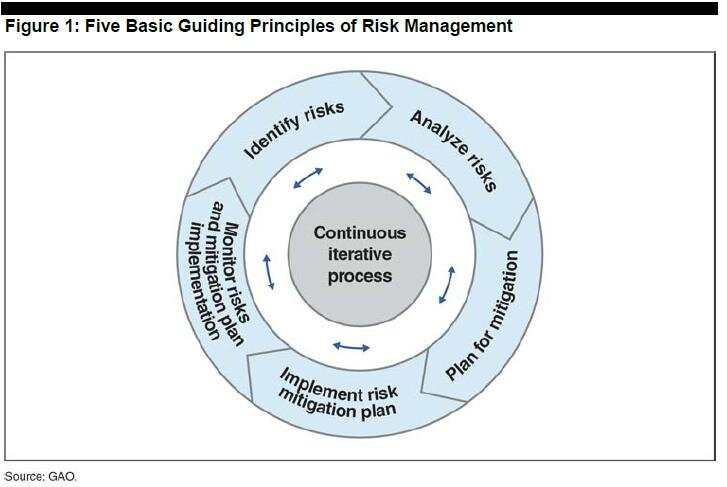
The PMI framework breaks risk management down into a series of logical steps. While the details are extensive, the basic flow is straightforward:
- Plan Risk Management: Decide how you're going to approach risk for this specific project.
- Identify Risks: Brainstorm all the potential threats and opportunities.
- Perform Qualitative & Quantitative Risk Analysis: Evaluate the identified risks to see which are the most important to address.
- Plan Risk Responses: Figure out what you'll do about the most significant risks.
- Implement Risk Responses: Put your plans into action.
- Monitor Risks: Keep an eye on your identified risks and look out for new ones as the project progresses.
This framework provides a roadmap for navigating uncertainty, helping ensure your project reaches its destination successfully.
Every project encounters risks, but proactive risk management minimizes their impact.
By understanding what risk is and the forms it can take, you've taken the first step toward managing it effectively.