Playing Classical Gas
Introduction to Fingerstyle Guitar
Welcome to Fingerstyle
Fingerstyle guitar is the technique of playing by plucking the strings directly with your fingertips, fingernails, or picks attached to your fingers, as opposed to strumming with a pick. It opens up a world of possibilities, allowing you to play bass lines, chords, and melodies all at once.
Fingerpicking—also known as fingerstyle guitar—is a timeless, expressive way to play the instrument.
Instead of a single pick doing all the work, your thumb and fingers become individual picks. This gives you incredible control over the dynamics and texture of your music. Before we dive into complex songs, we need to build a solid foundation.
Your Picking Hand Position
Proper hand position is crucial for comfort, speed, and tone. Your goal is to find a relaxed position that allows your fingers to move freely.
Start by resting your picking-hand forearm on the body of the guitar. Your hand should hover over the strings near the soundhole. Keep your wrist relatively straight, not bent at a sharp angle. A slight arch in your hand is good; it gives your fingers the space they need to pluck the strings.
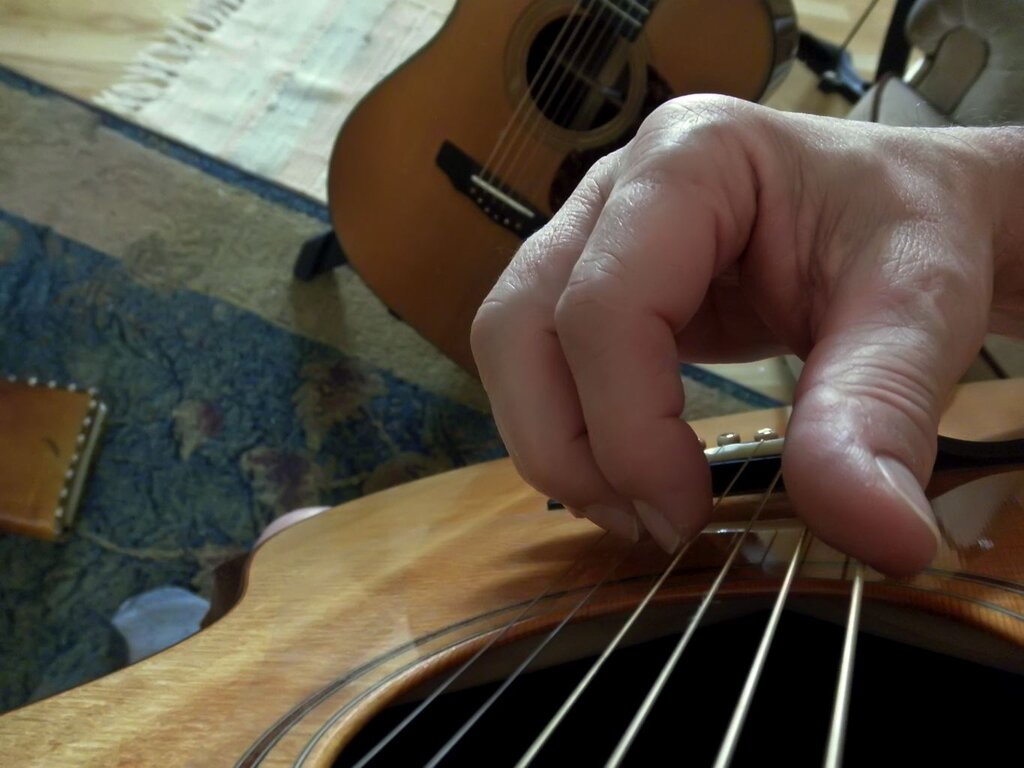
There are different schools of thought on anchoring. Some players anchor their pinky finger on the guitar's body for stability. Others prefer a 'floating' hand, which allows for more dynamic range and movement. Try both to see what feels most natural. For now, focus on keeping your hand and wrist free of tension.
In fingerstyle, we use a shorthand for the picking fingers, based on their Spanish names.
| Finger | Abbreviation | Spanish Name |
|---|---|---|
| Thumb | p | pulgar |
| Index | i | índice |
| Middle | m | medio |
| Ring | a | anular |
| Pinky | c or e | meñique |
The pinky is used less often in beginner patterns, so we'll focus on p, i, m, and a.
Basic Picking Patterns
Patterns are the heart of fingerstyle. By learning a few basic patterns, you can play thousands of songs. The general rule is that your thumb (p) handles the bass strings—the low E, A, and D strings. Your index (i), middle (m), and ring (a) fingers typically take care of the higher strings.
Beginners should start with simple fingerpicking patterns: for example, using the thumb (p) on the bass strings (E, A, D) while the index (i), middle (m), and ring (a) fingers handle the G, B, and high E strings.
Let's try a simple, common pattern. First, form a C major chord with your fretting hand. Now, assign your picking fingers like this:
- p (thumb) on the A string
- i (index) on the G string
- m (middle) on the B string
- a (ring) on the high E string
Play them one after another in a steady rhythm: p, i, m, a. This is called an arpeggio, which just means playing the notes of a chord one at a time.
Practice this pattern slowly until it feels smooth and automatic. Once you're comfortable, try switching to a G major chord and applying the same picking pattern. Your thumb will now play the low E string, but your fingers will stay on the same strings (G, B, and high E). This coordination is the first step toward finger independence.
Building Finger Independence
Finger independence is the ability to move each finger of your picking hand without affecting the others. It’s what allows for complex patterns, melodies, and bass lines to be played simultaneously. Developing this takes time and patient practice.
Practical Exercises: Reinforce your learning with hands-on exercises that strengthen your muscle memory, improve finger dexterity, and develop essential guitar skills.
Here's a simple exercise to start. Hold any chord you're comfortable with, like a G major.
- Assign your fingers: Thumb on the low E, index on G, middle on B, and ring on high E.
- Practice pairs: Play only your thumb and index finger together. Do this several times. Then, try thumb and middle. Then thumb and ring.
- Mix it up: Try more complex combinations, like p-i-m-i, or p-m-i-m. The goal isn't to create music right now, but to train your fingers to fire on command.
Remember to start slowly. Speed is a byproduct of accuracy.
Go as slowly as you need to play the pattern cleanly. If you make a mistake, slow down even more. Building the correct muscle memory is more important than speed.
With these fundamentals of hand position and basic patterns, you have the building blocks for fingerstyle guitar. Consistent, slow practice is the key to making these movements feel like second nature.
In the standard fingerstyle notation (p, i, m, a), which finger does 'a' represent?
According to the general rule of fingerstyle, what is the primary role of the thumb (p)?