Plate Tectonics Explained
Earth's Structure
A Journey to the Center
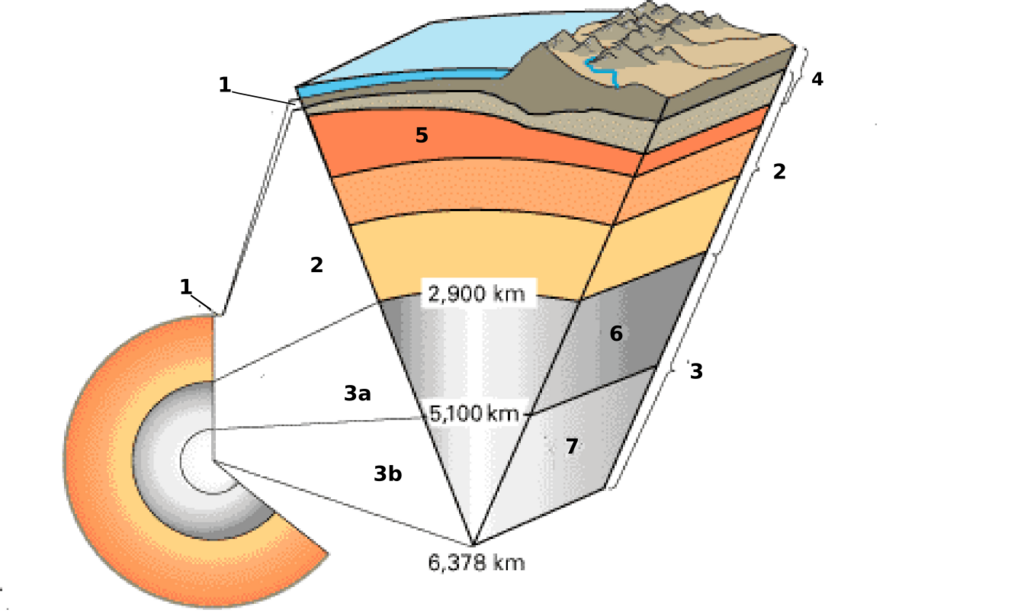
The ground beneath our feet feels solid and permanent. But if you could drill down, you'd find that our planet is structured in layers, like a giant jawbreaker. Each layer has its own unique properties, and together they create the dynamic world we live on. Understanding this structure is the first step to understanding everything from volcanoes to earthquakes.
The Crust We Live On
The crust is Earth's outermost layer, a thin, rocky shell. It's the layer we interact with every day, but it makes up less than 1% of the planet's total mass. Think of it as the skin of an apple.
There are two types of crust. Continental crust is what makes up the landmasses. It's thicker, less dense, and primarily composed of granite-like rocks. Oceanic crust, found under the oceans, is thinner, denser, and made of a volcanic rock called basalt. Because it's denser, oceanic crust sits lower than continental crust, which is why oceans form where they do.
crust
noun
The outermost solid shell of a rocky planet, dwarf planet, or natural satellite.
The Flowing Mantle
Beneath the crust lies the mantle, a thick layer of silicate rock that extends about 2,900 kilometers (1,800 miles) deep. It accounts for about 84% of Earth's volume, making it by far the largest layer.
The mantle isn't a simple solid. It's best described as a semi-solid plastic, something like extremely thick, hot asphalt. Over geologic timescales, the rock in the mantle can flow. Heat from the core causes the mantle to churn in slow-motion convection currents. Hotter, less dense rock slowly rises, cools, and then sinks back down. This constant, sluggish movement is the engine that drives activity on the surface.
The mantle is a river of rock, flowing over millions of years and shaping the world above.
The Liquid and Solid Core
At the center of the Earth is the core, which is divided into two distinct parts. It's mostly made of iron and nickel, making it incredibly dense.
The outer core is a layer of molten, liquid metal. The churning motion of this liquid iron is what generates Earth’s powerful magnetic field, which protects the planet from harmful solar radiation. Without it, life on Earth would be very different.
Deeper still is the inner core. Although it's the hottest part of the planet, the immense pressure at the center is so great that it forces the iron and nickel atoms into a solid, crystalline structure. It's a solid ball of metal spinning in the middle of a liquid ocean of the same material.
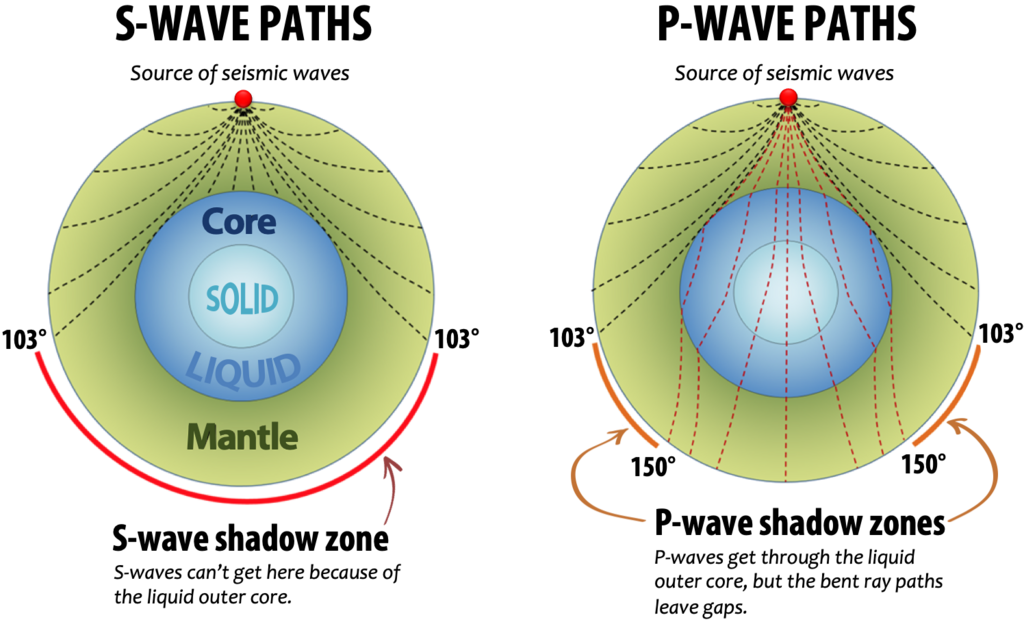
We can't drill to the core, but scientists figured out its structure by studying how earthquake waves travel through the planet. Certain types of waves, called S-waves, can't pass through liquid. Their inability to pass through the outer core was the key piece of evidence that proved it was molten.
| Layer | State | Composition | Approx. Thickness |
|---|---|---|---|
| Crust | Solid | Silicate rocks | 5–70 km (3–43 mi) |
| Mantle | Semi-solid | Silicate rocks | 2,900 km (1,800 mi) |
| Outer Core | Liquid | Iron and nickel | 2,200 km (1,367 mi) |
| Inner Core | Solid | Iron and nickel | 1,220 km (758 mi) |
Let's review these new terms before we move on.
Now, let's test your understanding of Earth's internal structure.
Which layer of the Earth is the largest by volume, accounting for about 84% of the planet's total volume?
What is the primary reason that oceanic crust sits lower than continental crust?
Each of these layers, from the thin crust to the solid core, plays a vital role in the planet's systems. Their unique properties and interactions are the foundation for the geological processes that shape our world.