Plate Tectonics
Earth Rheology
From Composition to Behavior
While Earth's layers are defined by their chemical makeup, they also move and react to pressure in unique ways that drive our planet's evolution. This chapter shifts our perspective from what the Earth is made of to how those materials actually behave under stress. We will explore the critical distinction between brittle failure and ductile flow, moving toward a clear understanding of how the rigid lithosphere glides over the plastic asthenosphere. By the end, you will grasp the mechanical forces that make plate tectonics possible.
The Shell and the Sludge
In our earlier explorations, we looked at Earth like an onion with layers of different chemistry: the light, rocky crust and the denser, metallic mantle. But if you want to understand why earthquakes happen or how continents move, chemistry isn't enough. You have to look at —the study of how stuff flows or breaks. To a geologist, the Earth isn't just a collection of minerals; it is a machine where some parts snap like glass and others stretch like warm taffy.
Deep inside the Earth, the combination of intense heat and crushing pressure changes the rules of physics. A rock that would shatter if you hit it with a hammer at the surface might actually flow like thick molasses if you buried it 100 kilometers deep for a million years. This physical personality determines the two most important mechanical layers of our planet: the lithosphere and the asthenosphere.
lithosphere
noun
The rigid, brittle outer layer of the Earth consisting of the crust and the uppermost part of the mantle.
The is the Earth's 'hard shell.' It includes the crust you walk on plus the very top, stiffest part of the mantle. This layer behaves in a brittle manner. Think of it like a cold piece of caramel: if you try to bend it, it doesn't yield; it resists until it eventually cracks and snaps. This brittle behavior is why we have faults and earthquakes. When the stresses of the moving Earth become too much for this rigid shell, it breaks, releasing energy in a sudden, violent burst.
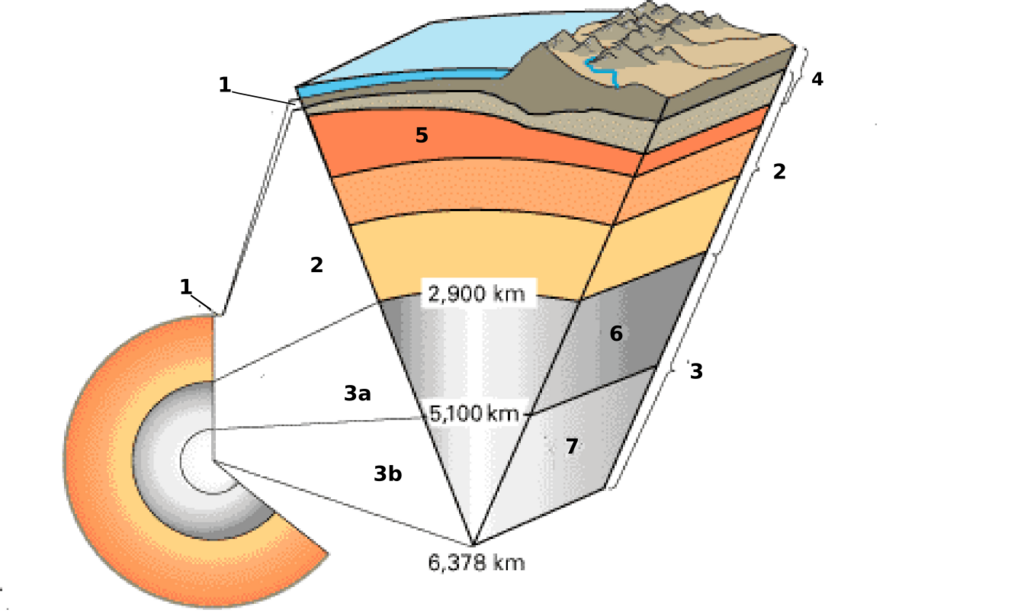
Directly beneath this rigid shell lies the asthenosphere. This is where things get weird. The asthenosphere is still technically solid rock, but it is hot enough and under enough pressure that it behaves as a layer. It doesn't snap; it flows. If the lithosphere is cold caramel, the asthenosphere is warm taffy or Silly Putty. It can deform and move slowly over vast stretches of time, acting as a lubricant for the heavy plates above.
This physical contrast—rigid on top of flowing—is the secret sauce of plate tectonics. Because the asthenosphere is viscous and yielding, the lithosphere is able to drift across it like a giant raft on a slow-moving river. Without this 'lubricant' layer, the Earth's surface would be a single, frozen shell, and we would have no volcanoes, no mountain ranges, and no shifting continents.
As we move forward, we will see how these mechanical properties allow for the recycling of Earth's crust, as old lithosphere eventually sinks back into the depths to be reheated.
Understanding these mechanical boundaries allows us to map the invisible forces shaping our world. From the snap of a fault line to the slow crawl of a continent, the relationship between the rigid lithosphere and the flowing asthenosphere is the heartbeat of our active planet.