Plant Physiology: Stomatal Function
Guard Cell Anatomy
The Stomatal Complex
Plants "breathe" through tiny pores on their leaves called stomata. Each pore is controlled by a pair of highly specialized cells known as guard cells. Together, the pore (or stoma), the two guard cells, and any associated neighboring cells form the stomatal complex. This microscopic gateway is crucial, allowing carbon dioxide in for photosynthesis while releasing oxygen and water vapor.
The magic of the stomatal complex lies in the unique anatomy of the guard cells. Unlike typical plant cells with uniformly thick walls, a guard cell's wall is uneven. The side facing the pore is thick and rigid, while the outer wall is thinner and more flexible. This structural difference is key to how the pore opens and closes.
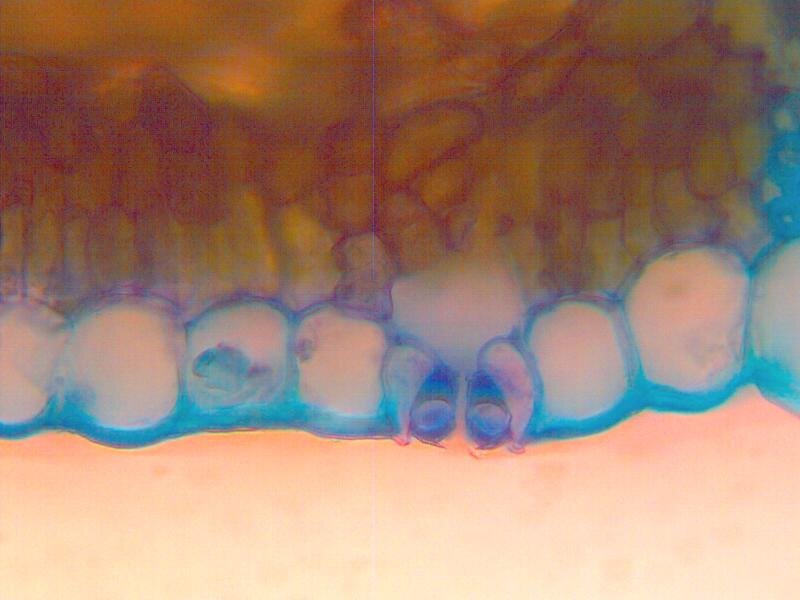
Embedded within these walls are bands of , the plant's primary structural fiber. In guard cells, these microfibrils are arranged in a specific pattern called . Instead of being randomly oriented, they radiate outwards from the pore, like the spokes on a bicycle wheel. When the guard cells fill with water, the turgor pressure pushes against the cell walls. Because the thin outer walls can stretch but the thick inner walls can't, and because the radial bands prevent the cell from getting wider, the cells are forced to bow outwards. This bowing motion pulls the thick inner walls apart, opening the stoma.
Dicot vs. Monocot Stomata
While the basic mechanism is the same, the shape of guard cells differs between the two major classes of flowering plants: dicots and monocots.
Dicots, such as beans, roses, and sunflowers, typically have kidney-shaped guard cells. These two bean-like cells curve away from each other to open the pore, creating a roughly elliptical opening.
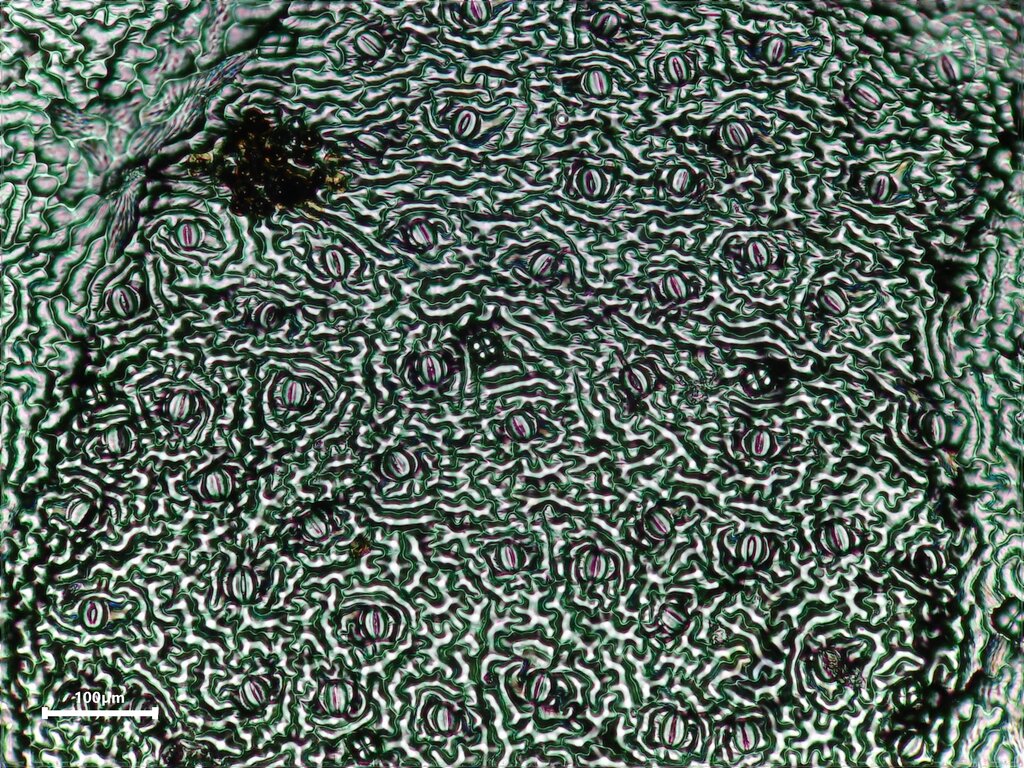
Monocots, like grasses, corn, and lilies, have a different setup. Their guard cells are dumbbell-shaped, with bulbous ends and a narrow center. These cells are flanked by a pair of . When the guard cells take on water, the bulbous ends swell, pushing against the subsidiary cells. This action levers the narrow central parts of the guard cells apart, efficiently opening the pore. This structure allows for potentially more rapid opening and closing compared to dicot stomata.
The stomatal apparatus, whether kidney- or dumbbell-shaped, is a beautiful example of how a cell's specific form directly enables its critical function in the life of the plant.
What is the primary function of the stomatal complex?
The specific arrangement of cellulose microfibrils in guard cells, radiating outwards from the pore, is called ________.
Understanding these structural details is the first step toward appreciating how plants so precisely manage the trade-off between gaining carbon dioxide and losing water.