Plant Growth and Development Physiology
Hormonal Signaling Pathways
The Growth Engine: Auxins
Plant cells are encased in rigid cell walls, which presents a challenge for growth. How does a plant cell get bigger if it's trapped in a box? It loosens the box first. This is where auxins, a class of primary phytohormones, come into play. They orchestrate cell elongation through a process known as the Acid Growth Hypothesis.
When a plant needs a cell to grow, auxins signal the cell to pump protons ( ions) from its cytoplasm into the cell wall. This lowers the pH of the cell wall, making it more acidic.
This acidic environment activates enzymes called expansins. Think of expansins as tiny molecular scissors that snip the bonds holding the cell wall's components together. This doesn't destroy the wall, but it makes it more flexible and extensible. With the wall loosened, the cell can take on water, increasing its internal turgor pressure and physically stretching to a larger size before the wall re-hardens.
But how does auxin actually turn on the genes needed for this process? At the molecular level, auxin acts like a key that removes a lock. In the cell's nucleus, growth-promoting genes are normally suppressed by proteins called Aux/IAA repressors. When auxin enters the cell, it binds to a receptor complex named an action that flags the Aux/IAA proteins for destruction. With the repressor gone, the genes for growth are switched on.
Gibberellins: Breaking Barriers
While auxins stretch existing cells, gibberellins (GAs) are crucial for processes like stem elongation and seed germination. They work by removing a molecular brake. In many plants, growth is held in check by a family of proteins known as DELLA proteins which act as repressors, blocking the transcription of genes needed for growth.
Gibberellins regulate stem elongation as well as fruit growth.
When gibberellin is present, it binds to a receptor protein called GID1. This GA-GID1 complex can then bind to a DELLA protein. This three-part interaction signals the cell to tag the DELLA protein for destruction, much like how the auxin pathway targets Aux/IAA proteins. With the DELLA brake removed, the cellular machinery can proceed with growth and development.
A practical application of this is in the malting industry. Barley seeds are intentionally germinated to produce enzymes that convert starches into fermentable sugars. To ensure rapid and uniform germination, maltsters often spray the barley with gibberellins. This externally applied hormone overcomes any dormancy signals, degrades the DELLA proteins, and kick-starts the growth process.
ABA: The Stress Architect
Unlike auxins and gibberellins, abscisic acid (ABA) is primarily a growth inhibitor. It acts as the plant's master 'stress architect,' coordinating responses to adverse conditions like drought and cold. One of its most critical roles is regulating water loss by controlling the opening and closing of stomata, the tiny pores on a leaf's surface.
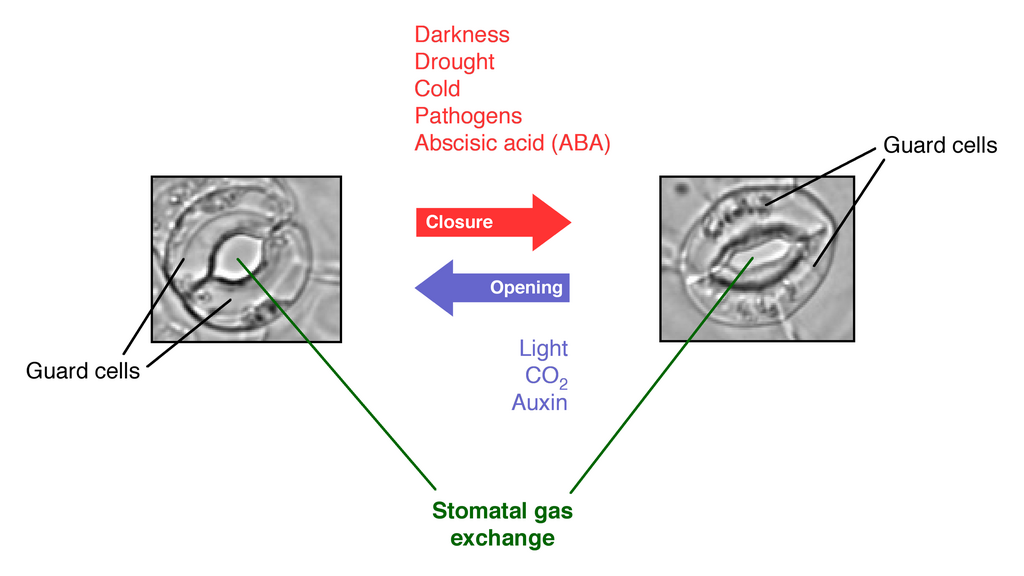
When a plant detects water scarcity, ABA levels rise. The ABA molecules bind to receptors in the guard cells that surround each stoma. This binding triggers a signaling cascade that causes ion channels in the guard cell membrane to open. Positively charged potassium ions () and negatively charged chloride ions () rush out of the cells. Water follows these ions via osmosis, causing the guard cells to lose turgor and become limp. This deflation pulls the pore closed, drastically reducing water loss through transpiration.
ABA acts as a chemical signal to close the gates, preserving the plant's precious water reserves until conditions improve.
ABA is also key in enforcing seed dormancy. Seeds must remain dormant until conditions are right for germination. ABA promotes dormancy, while gibberellins promote germination. These two hormones exist in a delicate balance. High levels of ABA prevent the seed from sprouting, often by inhibiting the very genes that gibberellins try to activate. As environmental cues like spring rains and warmth arrive, ABA levels in the seed decrease while gibberellin levels rise. This hormonal shift tips the balance, breaking dormancy and allowing the new plant to grow.
Ready to test your knowledge of how these tiny molecules command plant behavior?
According to the Acid Growth Hypothesis, what is the primary role of auxin in cell elongation?
At the molecular level, how does auxin 'switch on' growth-promoting genes?
Understanding these signaling pathways reveals the intricate and efficient systems plants use to navigate their world, responding with precision to both internal cues and external challenges.