PKPD Modeling Explained
Introduction to Pharmacokinetics
What the Body Does to a Drug
When you take a medication, its journey through your body is a complex process. Pharmacokinetics is the study of this journey. It examines how the body acts on a drug from the moment it enters until it's completely gone. Think of it as the drug's life story within you.
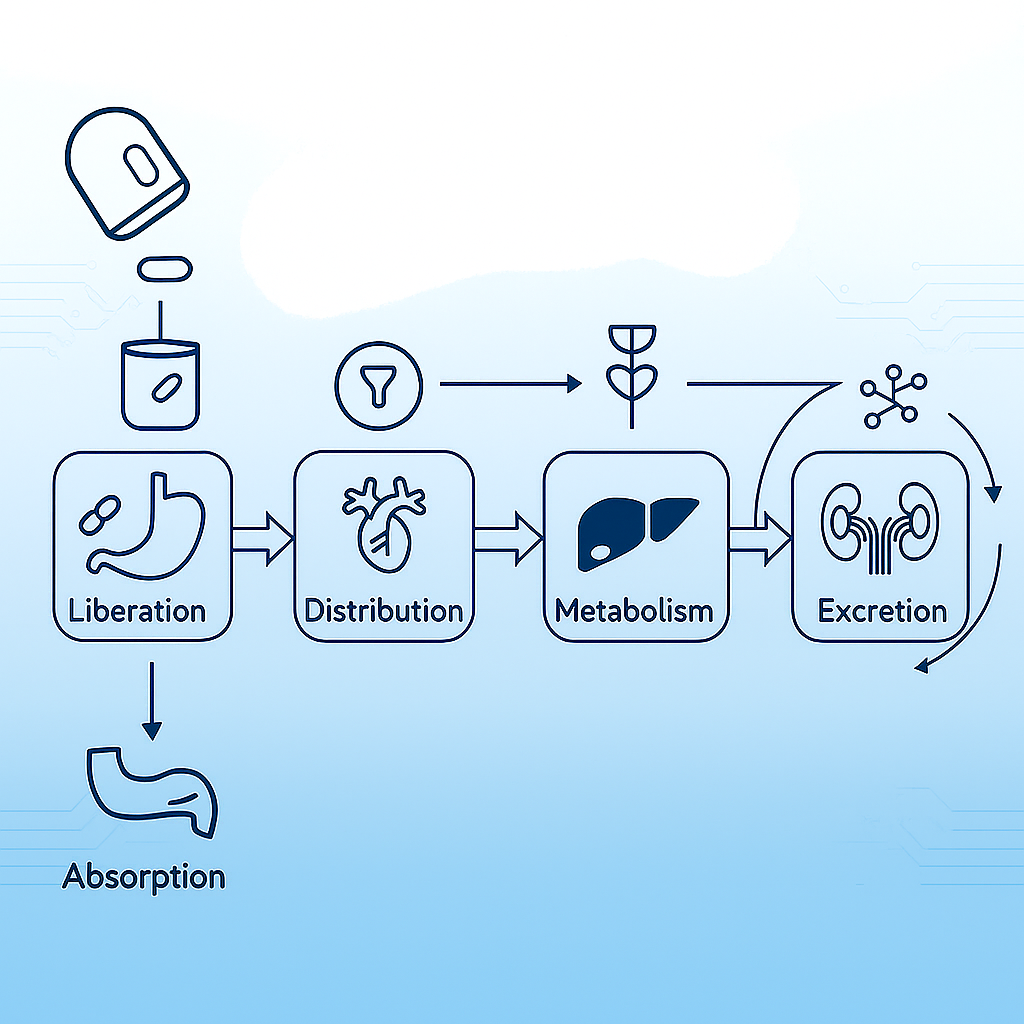
Understanding this process is crucial for healthcare professionals. It helps them decide how much of a drug to give, how often to give it, and the best way to administer it to get the desired effect safely. This entire process is often broken down into four key stages, remembered by the acronym ADME.
Pharmacokinetics is the study of how a drug moves through the body, often summarized as ADME—Absorption, Distribution, Metabolism, and Excretion.
Absorption: Getting In
Absorption is the first step, where the drug moves from the site of administration into the bloodstream. The route of administration heavily influences how quickly and completely this happens. An intravenous (IV) injection, for example, bypasses absorption entirely, delivering the drug directly into the blood for a rapid effect. In contrast, a pill taken orally must first dissolve in the stomach and then pass through the intestinal wall to be absorbed.
Several factors can affect how well an oral medication is absorbed. The presence of food in the stomach can slow down or reduce the absorption of some drugs, while it can enhance it for others. The drug's chemical properties and its formulation—whether it's a tablet, capsule, or liquid—also play a significant role. The ultimate goal of absorption is for the drug to become available to the body to do its job.
Bioavailability
noun
The fraction or percentage of an administered drug that reaches the systemic circulation (the bloodstream) unchanged.
Distribution: Spreading Out
Once a drug is in the bloodstream, it doesn't stay there. The circulatory system distributes it throughout the body, allowing it to travel to various tissues and organs. The extent of this distribution depends on the drug's properties. Some drugs tend to remain mostly in the blood, while others readily enter tissues like fat, muscle, or the brain.
To quantify this, pharmacologists use a concept called the volume of distribution (). This isn't a real, physical volume but rather a theoretical one. It represents the volume that would be required to contain the total amount of the drug in the body at the same concentration as it is in the blood plasma. A drug with a high is mostly in the tissues, whereas a drug with a low is confined mainly to the blood.
A large volume of distribution suggests a drug has spread extensively into body tissues, while a small volume suggests it has remained primarily in the bloodstream.
Metabolism and Excretion: Getting Out
After a drug has been distributed and has had its effect, the body needs a way to get rid of it. This process involves two related stages: metabolism and excretion.
Metabolism, also known as biotransformation, is the chemical alteration of the drug by the body. This usually happens in the liver, where enzymes convert the drug into different substances called metabolites. Often, this process makes the drug more water-soluble, which is a crucial step for preparing it to be removed from the body. Some drugs are converted into active metabolites that also have a therapeutic effect, while others are simply inactivated.
Excretion is the final removal of the drug or its metabolites from the body. The kidneys are the primary organs of excretion, filtering waste from the blood to produce urine. Drugs can also be eliminated through other routes, such as bile (and then feces), sweat, saliva, and even breath. Efficient metabolism and excretion are vital to prevent drugs from accumulating to toxic levels.
Now, let's test your understanding of these core principles.
What does the acronym ADME stand for in the context of pharmacokinetics?
Which route of administration completely bypasses the absorption phase, delivering the drug directly into the bloodstream?
Together, these four processes—absorption, distribution, metabolism, and excretion—determine the concentration of a drug in the body over time. Mastering these concepts is the first step toward understanding how medications work and how to use them effectively and safely.