Pile Load Testing Procedures and Interpretation
Introduction to Pile Load Testing
Why Test a Pile?
Buildings, bridges, and other large structures need to stand on solid ground. When the soil near the surface is too weak, engineers use deep foundations called piles. These are long columns, often made of steel or concrete, that are driven or drilled deep into the earth to rest on a stronger layer of soil or rock.
But how do we know if a pile is strong enough? We can't just trust the blueprints. Soil is incredibly variable. Its properties can change from one foot to the next. That's where pile load testing comes in. The main goal is to verify that a pile can safely carry the load it was designed for. It's a crucial reality check that confirms our engineering assumptions and ensures the safety and stability of the entire structure.
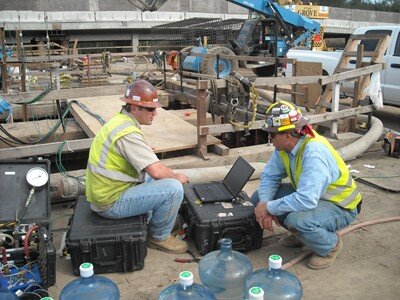
By testing a pile, we get real-world data on its performance. This information helps validate the design, optimize the foundation system, and prevent costly failures. It's a fundamental step in geotechnical engineering that bridges the gap between theoretical calculations and actual site conditions.
Methods of Testing
There isn't just one way to test a pile. The method chosen depends on the project's needs, budget, and schedule. The three main categories are static, dynamic, and rapid load tests.
Static Load Tests are the most direct and traditional method. Think of it as carefully stacking weights on top of the pile and measuring how much it settles. This process is slow and can be expensive due to the need for heavy kentledge blocks or reaction piles to provide the load. However, it's considered the 'gold standard' because it directly measures the pile's capacity.
A test pile is constructed at the beginning of the work and load tested to 200% of the design load in accordance with the standard specification ASTM D 1143.
Dynamic Load Tests are a much faster and more economical alternative. In this method, a large hammer strikes the pile head, and sensors attached to the pile measure the force and velocity of the impact. Engineers analyze this data to estimate the pile's capacity. The standard governing this method is ASTM D4945. While it's an indirect measurement, its speed and cost-effectiveness make it very popular.
Rapid Load Tests offer a compromise between the static and dynamic methods. This technique applies a load to the pile over a fraction of a second, which is slower than a dynamic hammer blow but much faster than a static test. A heavy weight is dropped onto a cushion system that transmits the force smoothly. As outlined in ASTM D7383, this 'quasi-static' approach provides a good balance of accuracy, speed, and cost.
The Importance of Standards
Procedures for pile testing are not arbitrary. They are carefully defined by organizations like ASTM International (formerly the American Society for Testing and Materials). Standards such as ASTM D4945 for dynamic testing and ASTM D7383 for rapid load testing provide clear, repeatable guidelines.
Following these standards ensures that tests are conducted consistently and that the results are reliable and comparable across different projects and locations. This standardization is essential for maintaining high levels of safety and quality in geotechnical engineering.
What is the primary reason for performing a pile load test?
Which pile load testing method is known for being fast and economical, using a large hammer and sensors to indirectly estimate capacity?
Understanding the basics of pile load testing is the first step in appreciating how we build stable foundations for the modern world.