Piezoelectric Energy Harvesting and Smart Microgrid Integration
Transducer Characterization
Modeling Piezoelectric Transducers
To effectively use a piezoelectric transducer in a system like a DC microgrid, we can't treat it like a simple battery. Its electrical output is directly tied to its mechanical properties. The standard way to represent this relationship is with an electrical equivalent circuit called the (BVD model). This model translates the material's physical behavior into electrical components we can analyze.
The BVD model shows that a piezoelectric transducer behaves like a specific arrangement of resistors, inductors, and capacitors.
The model has two parallel branches:
- The Motional Arm: The series circuit of , , and represents the mechanical properties of the material. corresponds to the vibrating mass (inertia), represents its mechanical stiffness (elasticity), and accounts for mechanical losses like internal friction.
- Static Capacitance (): This represents the standard electrical capacitance of the piezoelectric material between its two electrodes, independent of any mechanical motion. You can think of it as a basic parallel-plate capacitor.
Impedance and Resonance
The BVD model immediately reveals a key challenge: piezoelectric transducers are high-impedance sources. Their behavior is dominated by the large static capacitance, , which opposes changes in voltage. This makes efficient power transfer tricky; you can't simply connect the transducer to a low-impedance load and expect good results. It's like trying to fill a bucket with a very thin, high-pressure hose—the potential is there, but the flow is restricted. This is why is a critical step in designing the power conditioning stage of any piezoelectric system.
To maximize power output, we must operate the transducer at its resonant frequency. This is the frequency at which the material naturally wants to vibrate, allowing for the largest mechanical displacement and, consequently, the highest voltage generation. The BVD model defines two key frequencies.
Series Resonance (): The frequency where the motional arm has minimum impedance. At this point, the reactances of and cancel each other out.
Parallel Resonance (): A slightly higher frequency where the entire parallel circuit has maximum impedance.
For energy harvesting, we are most interested in the series resonant frequency, as this is where the mechanical-to-electrical energy conversion is most efficient.
Material Trade-offs
The choice of material is a primary design decision. The two most common materials for energy harvesting applications, PZT and PVDF, have distinct performance characteristics rooted in their electromechanical properties.
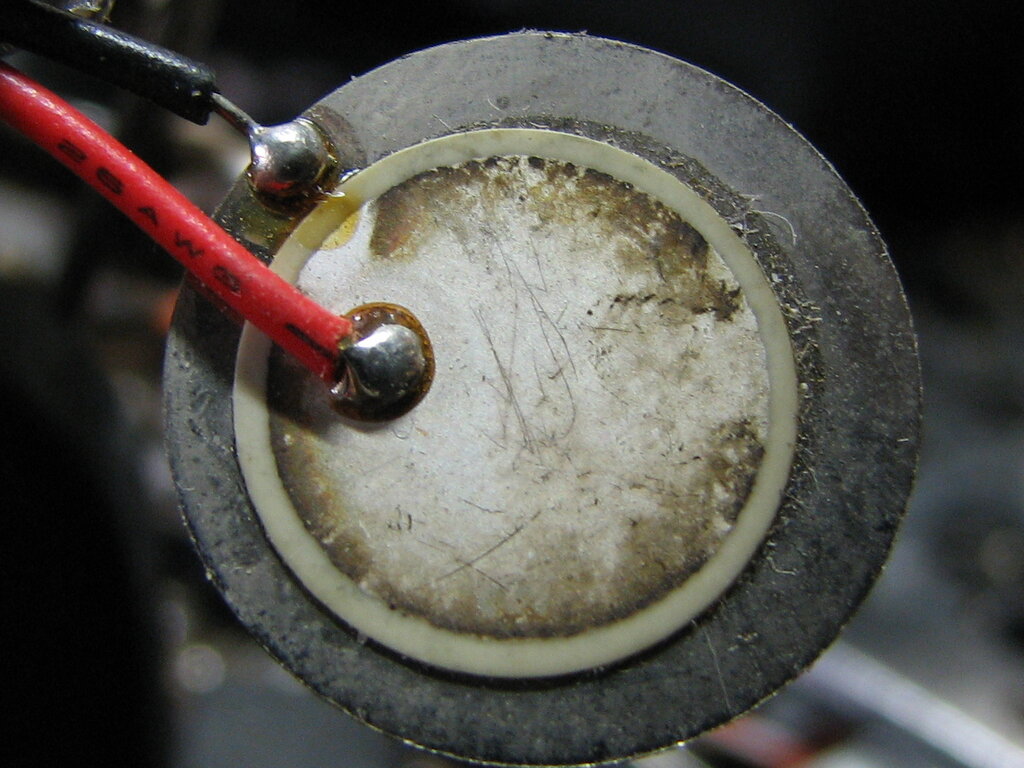
A key metric for comparing materials is the (). This value describes how efficiently a material converts mechanical energy into electrical energy, and vice versa. A higher means better conversion efficiency. The coefficient is often specified with subscripts (e.g., , ) that indicate the direction of the applied force relative to the direction of the generated electric field.
| Property | PZT (Ceramic) | PVDF (Polymer) |
|---|---|---|
| Coupling Coefficient (k) | High (0.5 - 0.75) | Low (0.1 - 0.3) |
| Voltage Constant (g) | Low | High |
| Mechanical Quality (Q) | High | Low |
| Flexibility | Brittle | Highly Flexible |
| Density | High | Low |
Let's break down what this means for system design.
PZT (Lead Zirconate Titanate) is a ceramic. Its high coupling coefficient makes it excellent for applications where maximizing power output is the goal, like in vibration energy harvesters. However, it is stiff, brittle, and dense. It works best under compression and at a specific, high resonant frequency.
PVDF (Polyvinylidene Fluoride) is a flexible polymer. While its coupling coefficient is much lower, it excels in applications requiring conformity to curved surfaces or sensitivity to low-frequency strains, like wearable sensors. Its high voltage constant () means it can generate a high voltage for a given mechanical stress, even if the total power is low.
The choice is a trade-off: PZT offers high power density but is rigid. PVDF offers flexibility and high voltage sensitivity but lower overall power output.
Before we test your knowledge, let's review the key terms.
Ready to apply these concepts?
What is the standard electrical equivalent circuit used to model the electromechanical behavior of a piezoelectric transducer?
In the BVD model, the motional arm consists of a series circuit with , , and . What mechanical property does the capacitor, , represent?
By modeling transducers and understanding their material properties, we can make informed decisions to optimize the performance of our entire energy harvesting system.