PID Controllers and UFDs Explained
PID Controllers
Keeping Systems in Check
Many systems, from a simple home thermostat to a complex spacecraft, need to maintain a specific state. A thermostat's job is to keep the room at a target temperature. A rocket needs to stay on its planned trajectory. In engineering, this target state is called the setpoint. The system's actual state is the process variable.
The difference between the setpoint and the process variable is the error. The goal of a control system is to make this error as close to zero as possible, as quickly as possible. This is where a controller comes in.
A Proportional-Integral-Derivative (PID) controller is one of the most common and effective types of controllers. It's a feedback mechanism that constantly calculates the error and applies a correction to bring the system back to its setpoint. Think of it as the brain of the control loop.
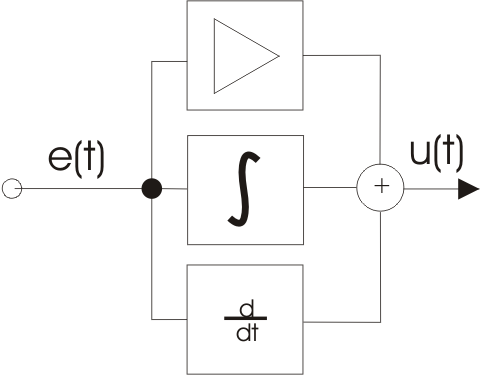
The Three-Part Brain
A PID controller works by combining three different control methods. Each part looks at the error from a different perspective: the present, the past, and the future.
Proportional (P) Control The proportional term responds to the present error. Its output is directly proportional to the current error value. If the error is large, the controller makes a large adjustment. If the error is small, the adjustment is small. It's like pushing a swing: the farther it is from its resting point, the harder you push. The strength of this response is determined by a tuning value called the proportional gain, . While simple, proportional control alone often leaves a small, persistent error, known as a steady-state error.
Integral (I) Control The integral term looks at the past error. It sums up all the past errors over time. If a small steady-state error persists, the integral term will grow larger and larger, eventually forcing the controller to make a stronger correction that eliminates the error. It's like noticing you've been consistently short of your target by a few inches and deciding to aim a little higher to finally get it right. The integral gain, , controls how strongly it reacts to this accumulated error.
Derivative (D) Control The derivative term tries to predict the future error. It does this by looking at the rate of change of the error. If the error is changing rapidly, the derivative term applies a counteracting force to slow it down, preventing the system from overshooting the setpoint. This acts as a damper, reducing oscillations. Think of how you apply the brakes in your car. You don't slam them on at the last second. You start braking gently as you approach a stop sign, anticipating your arrival. The derivative gain, , determines how much this predictive action affects the output.
In short:
- P reacts to the present error.
- I corrects based on the sum of past errors.
- D dampens the response based on the future trend of the error.
The Math Behind the Magic
The PID controller combines the outputs of these three terms to produce a single control action, . The error, , is defined as the difference between the setpoint (SP) and the process variable (PV).
The controller's output is the sum of the proportional, integral, and derivative responses. The full mathematical expression looks like this:
Here:
- is the proportional term.
- is the integral term, which sums the error over time.
- is the derivative term, which calculates the rate of change of the error.
Applications and Challenges
PID controllers are workhorses in the world of automation. You can find them everywhere. In manufacturing, they control the temperature of ovens, the pressure in pipes, and the speed of motors on an assembly line. In aerospace, they are crucial for maintaining the altitude of an aircraft and guiding rockets.
They're popular because they're effective, relatively simple to understand, and don't require a complex model of the system they are controlling. However, they aren't without their challenges.
The biggest challenge is tuning. Finding the right values for the three gains (, , and ) can be tricky. Poor tuning can lead to a system that responds too slowly, overshoots the target wildly, or oscillates uncontrollably. This process often requires a deep understanding of control theory and the specific system's behavior.
Another limitation is that standard PID controllers struggle with non-linear systems—systems where the output isn't directly proportional to the input. For instance, controlling the flow from a valve might be easy when it's half open, but much harder when it's nearly closed or fully open. While advanced versions of PID controllers exist to handle these cases, a basic one might not be sufficient.
In a home heating system, the temperature you set on the thermostat is known as the ______, while the actual current room temperature is the ______.
Which component of a PID controller addresses past errors by summing them up over time, making it particularly effective at eliminating small, persistent steady-state errors?