Pickleball Fundamentals
Introduction to Pickleball
What Is Pickleball?
Pickleball is a paddle sport that combines elements of tennis, badminton, and table tennis. It's played on a court similar to a badminton court, with a slightly modified tennis net. The game is fast-paced, easy to learn, and suitable for all ages and skill levels.
Pickleball, invented in Washington State in 1965, has grown explosively in the United States, especially since the COVID-19 pandemic.
The story goes that after a round of golf one summer day, Congressman Joel Pritchard and his friend Bill Bell returned to Pritchard's home on Bainbridge Island, Washington, to find their families bored. They tried to set up a game of badminton, but couldn't find a full set of rackets. Instead, they improvised with table tennis paddles and a perforated plastic ball. They lowered the badminton net, and pickleball was born. The name is said to have come from either the Pritchard's family dog, Pickles, who would chase the ball, or from the term "pickle boat" in rowing, where leftover oarsmen from other boats are grouped together.
The Court and Equipment
A pickleball court is rectangular, measuring 44 feet long and 20 feet wide, the same size as a doubles badminton court. The net is hung at 36 inches on the ends and 34 inches in the center. The court is striped like a tennis court, with right and left service courts.
A key feature is the 7-foot non-volley zone on each side of the net, commonly called the "kitchen." Players are not allowed to hit the ball out of the air (a volley) while standing in this zone.
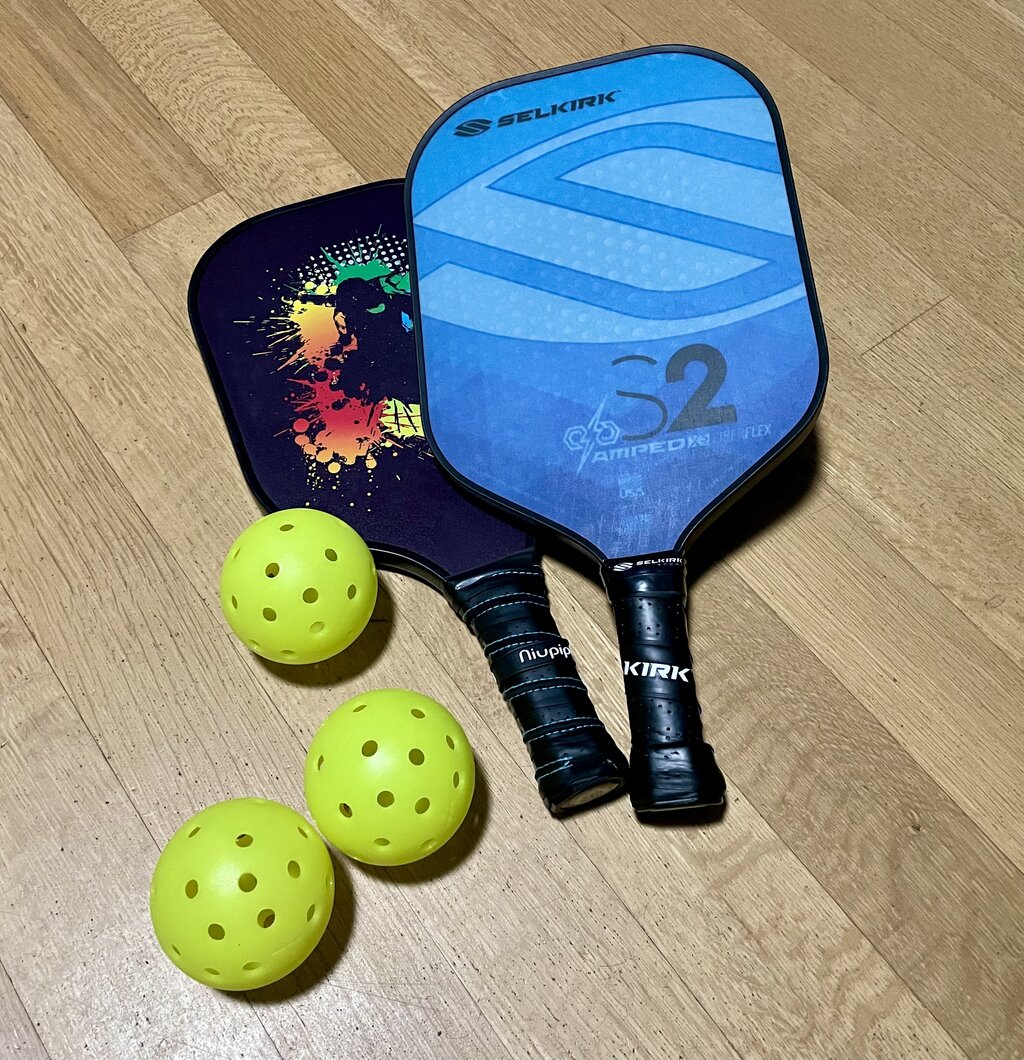
The equipment is simple. Players use solid paddles, which are larger than table tennis paddles and are typically made from wood, composite, or graphite materials. The ball is plastic, lightweight, and has holes, similar to a wiffle ball. This design makes it fly slower than a tennis ball and have less bounce.
Rules and Scoring
The basic objective is to hit the ball over the net in a way that your opponent cannot legally return it. Points are won when the opposing team commits a fault.
Common faults include hitting the ball out of bounds, hitting the net, or volleying from the non-volley zone.
The serve must be hit underhand, with the paddle contacting the ball below the waist. The server stands behind the baseline and hits the ball diagonally into the opponent's service court. Both the serve and the return of serve must bounce once before either team can hit a volley. This is known as the two-bounce rule.
volley
verb
To hit the ball in the air before it has bounced.
Scoring is another unique aspect. Only the serving team can score a point. Games are typically played to 11 points, and a team must win by at least two points.
When playing doubles, the score is called out as three numbers: the serving team's score, the receiving team's score, and the server number (1 or 2). For example, a score of "3-4-2" means the serving team has 3 points, the receiving team has 4, and the second server on the serving team is about to serve.
Ready to test what you've learned? Let's see how well you know the basics.
What is the primary rule associated with the 7-foot non-volley zone, also known as the "kitchen"?
According to the "two-bounce rule" in pickleball, what must happen at the beginning of each point?
With these fundamentals, you have a solid foundation for understanding pickleball. It's a game of strategy, placement, and fun.