Pickleball Fundamentals
Introduction to Pickleball
A Backyard Invention
Pickleball got its start in 1965 on Bainbridge Island, Washington. Three friends—Joel Pritchard, Bill Bell, and Barney McCallum—returned from golfing to find their families bored. They wanted a game everyone could play, so they improvised. They lowered the net on their badminton court, grabbed some ping-pong paddles, and used a perforated plastic ball.
The result was a unique game that combines elements of tennis, badminton, and table tennis. It's easy to learn, which is a big reason for its popularity. The name? It's rumored to have come from the Pritchard family's dog, Pickles, who would chase the ball and run off with it.
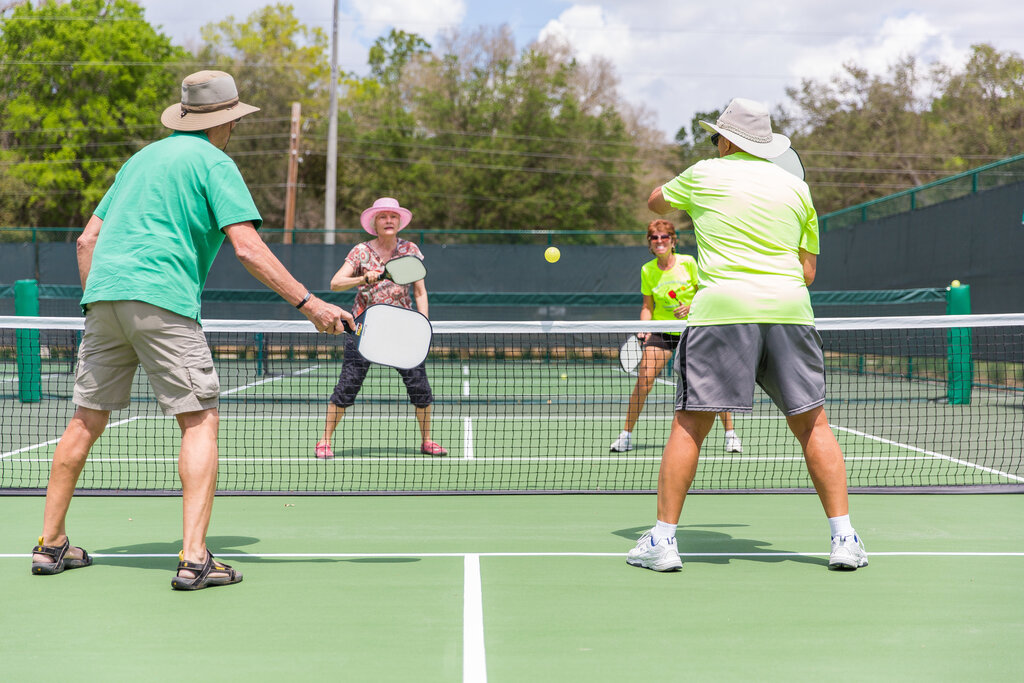
The Court Layout
A pickleball court is the same size as a doubles badminton court, measuring 44 feet long by 20 feet wide. It’s divided by a net that is 36 inches high at the sidelines and 34 inches high in the middle.
The court has a few key areas you need to know:
- The Non-Volley Zone (or "Kitchen"): This is the 7-foot area on each side of the net. Players are not allowed to hit a volley while standing in this zone.
- Service Courts: The serve must land in the diagonal service court on the opponent's side.
- Baseline: The line at the back of the court. You must stand behind it when you serve.
The Basic Rules
The rules of pickleball are straightforward, making it easy for beginners to pick up. Here are the essentials to get you started.
Volley
verb
To hit the ball in the air before it has bounced.
First, the serve must be hit underhand from behind the baseline. The paddle must make contact with the ball below your waist. You serve diagonally across the court, and the ball must land in the service court opposite you, beyond the kitchen.
A core principle of pickleball is the Two-Bounce Rule. After the serve, the receiving team must let the ball bounce once before returning it. The serving team must also let the return bounce once. After these two bounces, players are free to volley the ball or play it off a bounce.
The most unique rule involves the non-volley zone, or "kitchen." You cannot hit a volley while your feet are inside the kitchen or touching the kitchen line. If a volley is hit from this zone, it's a fault. You can enter the kitchen to hit a ball that has already bounced, but you must re-establish your position outside the kitchen before you can hit another volley.
Points are scored only by the serving team. Games are normally played to 11 points, and you must win by at least two points.
Where did pickleball get its start?
What is the primary rule associated with the 7-foot area on each side of the net, also known as the 'kitchen'?
That's it! With these basics, you understand the history, court, and fundamental rules of pickleball. You're ready to grab a paddle and give it a try.