Piano Voicings Masterclass
Chord Voicings
Arranging the Notes in a Chord
A C major chord always contains the same three notes: C, E, and G. But the way you arrange, or voice, those notes can dramatically change the chord's character. Think of it like a recipe with three ingredients. You can stack them, mix them, or spread them out. The ingredients stay the same, but the final dish tastes and looks different each time.
Voicing
noun
The specific arrangement and spacing of the notes within a chord.
Voicings are how musicians add color, texture, and emotion to harmony. A different voicing can make a chord sound bright and happy, dark and mysterious, or full and majestic. They also help create smooth transitions between chords, making a progression feel more connected and melodic.
Position and Inversions
The most basic way to play a chord is in root position. This simply means the root note of the chord (the note the chord is named after) is the lowest-sounding note. For a C major chord, C would be in the bass.
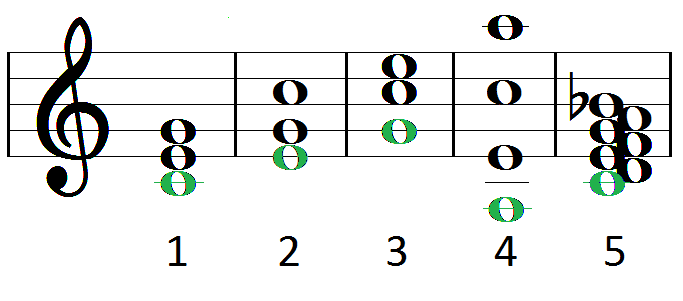
But you don't always have to put the root on the bottom. When you rearrange a chord so that a different note is in the bass, it's called an inversion. Triads (three-note chords) have two possible inversions.
For our C major chord (C-E-G):
- First Inversion: The third of the chord (E) is the lowest note.
- Second Inversion: The fifth of the chord (G) is the lowest note.
| Voicing | Bass Note | Other Notes |
|---|---|---|
| Root Position | C | E, G |
| First Inversion | E | G, C |
| Second Inversion | G | C, E |
Inversions change the harmonic flavor of a chord without changing its fundamental identity. It's still a C major chord, just with a different emphasis.
Open vs. Closed Voicings
Another key aspect of voicing is the spacing between the notes. This is where we get open and closed voicings.
A closed voicing packs the notes as tightly together as possible. For a C major triad, all three notes would fall within the space of a single octave.
An open voicing, on the other hand, spreads the notes out over a wider range, usually more than an octave. You could play the C, then jump up to a G, and place the E even higher. The sound becomes much larger and more resonant.
Closed voicings often sound punchy, clear, and focused. Think of a tight horn section in a funk band. Open voicings sound broad, atmospheric, and rich, like a string orchestra playing a lush chord.
One of the easiest ways to add depth to your piano playing is by experimenting with fuller chord voicings.
Putting It Into Practice
Let's try a simple exercise to feel the difference. Go to a piano or keyboard and find a C major chord (C, E, G).
- Play it in a closed, root position voicing. Play the C, E, and G right next to each other in the middle of the keyboard. Listen to how it sounds.
- Now, try an open voicing. Play the low C with your left hand. With your right hand, play the G above it and the E an octave higher than that. Notice how much bigger and more resonant the chord feels.
Experiment with different chord progressions you know. Try playing the same progression using only closed voicings, and then again with open voicings. The emotional impact will change completely.
What is the term for a chord where the root note (the note the chord is named after) is the lowest-sounding note?
If you play a C major chord (C-E-G) with the note G as the lowest note, what is this arrangement called?
Playing with voicings is one of the fastest ways to make your playing sound more expressive and professional. It's all about taking the same basic chords and finding new ways to present them.