Piano Scales and Chords Fundamentals
Piano Key Identification
Finding Your Way Around
The piano keyboard might look intimidating, but it's built on a simple, repeating pattern. A standard piano has 88 keys: 52 white and 36 black. Once you understand the pattern in one small section, you understand the entire keyboard.
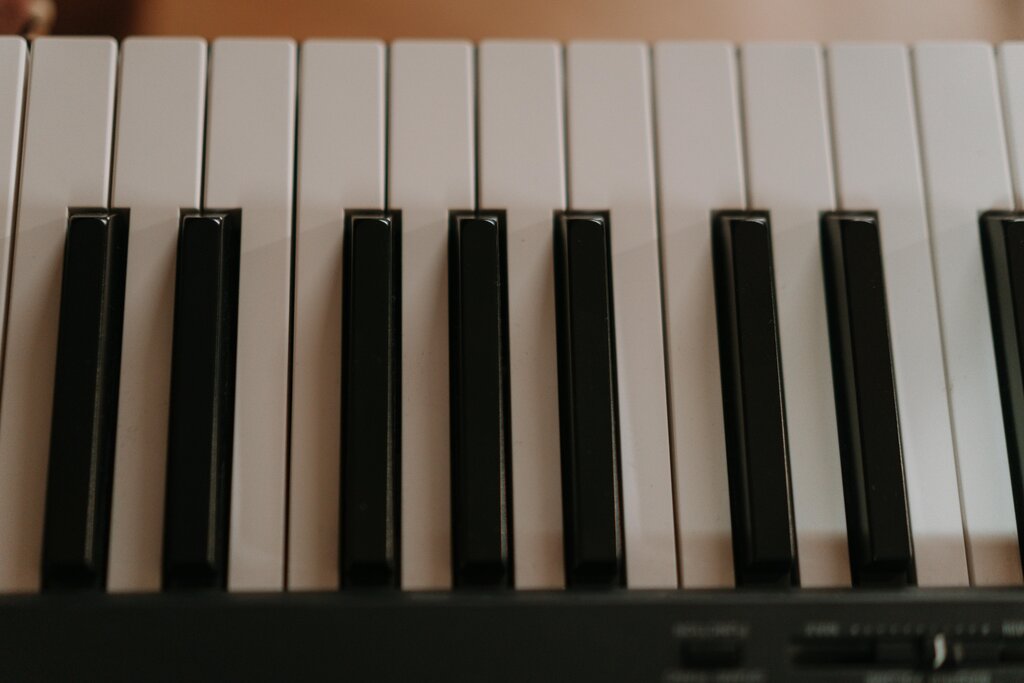
The secret to navigating the keyboard is to look at the black keys first. Notice how they're arranged in alternating groups of two and three. This pattern never changes, all the way up and down the piano.
These groups are your landmarks. Every white key immediately to the left of a group of two black keys is a C. Find all the groups of two black keys, and you've found all the Cs.
Once you find C, you can name the rest of the white keys. The musical alphabet uses only seven letters: A, B, C, D, E, F, and G. After G, the pattern repeats. Starting from any C, the white keys moving to the right are D, E, F, G, A, and B. The next white key will be another C, and the cycle begins again.
The white key to the left of any group of two black keys is always C.
Sharps and Flats
So, what about the black keys? They don't get their own letter names. Instead, they get their names from the white keys next to them. Each black key has two names: a sharp name and a flat name.
A sharp means slightly higher in pitch, and is shown with a # symbol. A flat means slightly lower in pitch, and is shown with a ♭ symbol.
The black key between C and D can be called C-sharp (C#) because it's higher than C. It can also be called D-flat (D♭) because it's lower than D. Both names refer to the exact same key.
| Black Key Location | Sharp Name | Flat Name |
|---|---|---|
| Between C and D | C# | D♭ |
| Between D and E | D# | E♭ |
| Between F and G | F# | G♭ |
| Between G and A | G# | A♭ |
| Between A and B | A# | B♭ |
You might notice there are no black keys between B and C, or between E and F. That's just how the pattern works. It's a key part of what gives music its structure.
Understanding Octaves
The distance from one C to the next C is called an octave. An octave contains all 12 unique keys (7 white and 5 black). The entire piano keyboard is just this 12-key pattern repeated over and over, about seven times.
To tell the octaves apart, pianists use a numbering system. The most famous landmark on the piano is Middle C, which is officially known as C4. It's the fourth C from the left end of the keyboard.
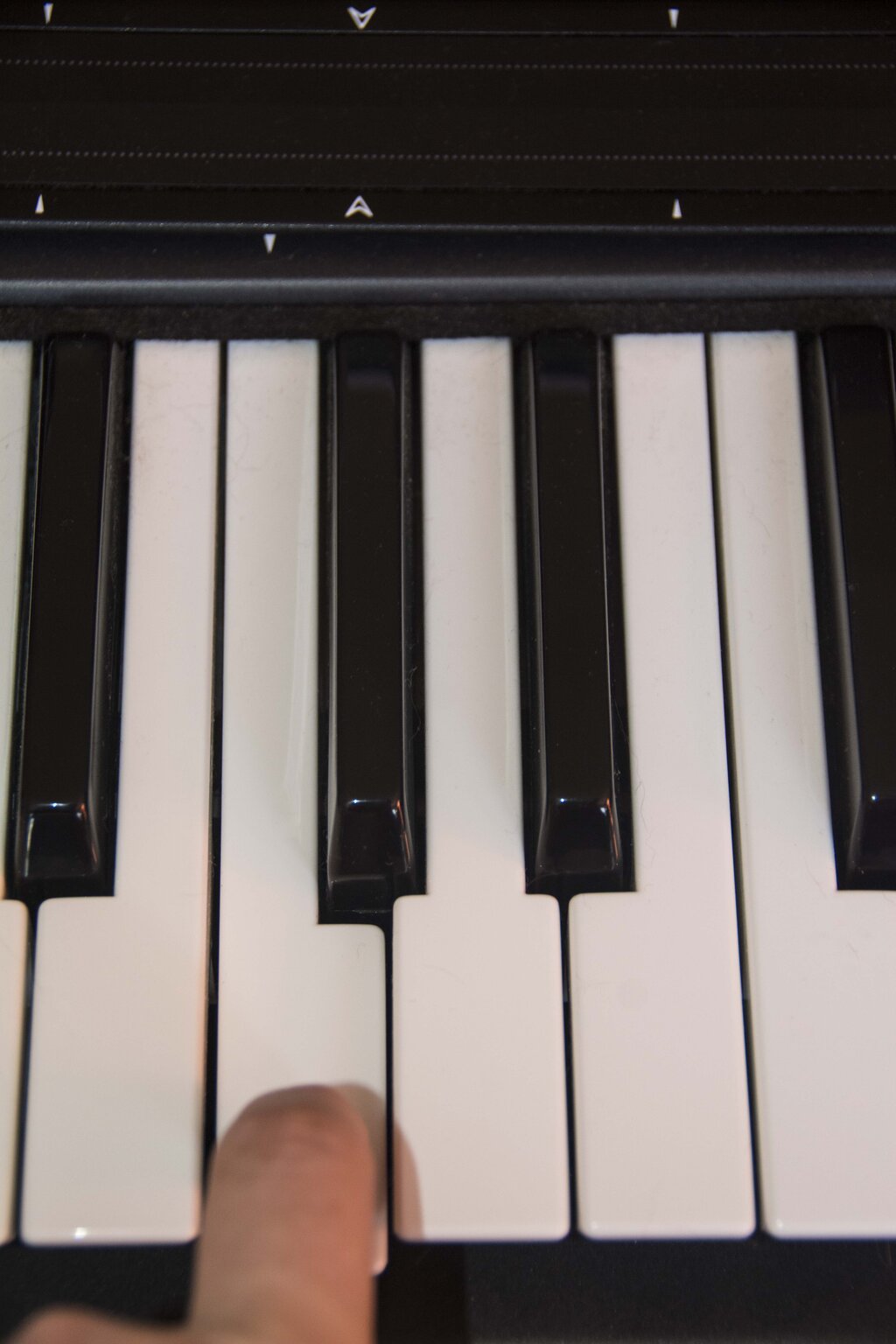
The notes in the octave starting with C4 are all given the number 4: C4, D4, E4, and so on. The next octave up starts with C5, and the octave below starts with C3. This system allows musicians to specify any key on the piano precisely.
Now, let's test what you've learned.
How can you reliably find any 'C' on a piano keyboard?
The musical alphabet goes from A to G. What is the next white key after B?
With these basics, you can now identify any key on the piano. This is the first step toward playing melodies and chords.