Piano Pop Chord Mastery
Basic Piano Chords
The Building Blocks of Music
A chord is simply a group of three or more notes played at the same time. Think of them as the words that make up the sentences of a song. The most basic and common type of chord is a triad, which, as the name suggests, uses three notes.
Triad
noun
A chord made up of three notes, typically a root, a third, and a fifth.
These three notes are stacked on top of each other. The lowest note is called the root, and it gives the chord its name. The other two notes are called the third and the fifth, based on their distance from the root. Let's start with the most common type: the major chord.
Major Chords Sound Happy
Major chords have a bright, full, and happy sound. You hear them everywhere, from pop anthems to nursery rhymes. The C major chord is the perfect place to start because it only uses white keys on the piano: C, E, and G.
To build any major chord, you can use a simple formula based on half steps. A half step is the distance from one key to the very next one, black or white. Start at your root note, count up four half steps to find the third, and then count up another three half steps to find the fifth.
Major Chord Formula: Root + 4 half steps + 3 half steps
Try it with G major. Start on G. Count up four half steps (G♯, A, A♯, B) and you land on B. Then, from B, count up three half steps (C, C♯, D) to get to D. So, a G major chord is G-B-D.
Minor Chords Sound Sad
Minor chords have a darker, more somber quality. They often add emotional depth and melancholy to a piece of music. The formula for a minor chord is just the reverse of a major chord.
Minor Chord Formula: Root + 3 half steps + 4 half steps
An easier way to think about it is to take a major chord and lower the middle note (the third) by one half step. For C major (C-E-G), you would lower the E to an E♭. So, a C minor chord is C-E♭-G.
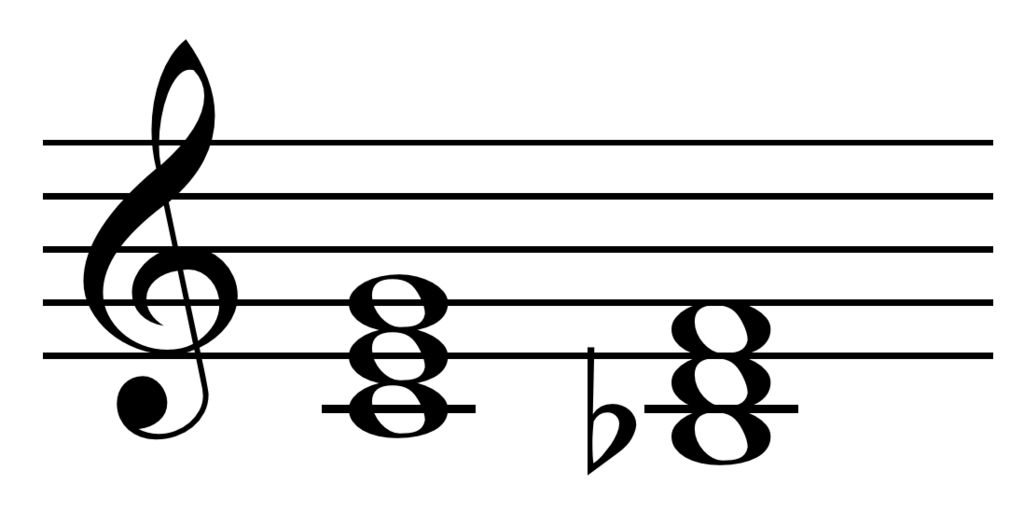
Learning to distinguish the sound of major and minor chords is a key step in training your musical ear.
Flipping Chords Around
You don't always have to play a chord with the root note on the bottom. You can rearrange the notes to create chord inversions. This doesn't change what the chord is, but it changes how it sounds and makes it easier to move from one chord to another.
A triad has three possible positions:
- Root Position: The standard way, with the root on the bottom (C-E-G).
- First Inversion: The root is moved to the top, so the third is on the bottom (E-G-C).
- Second Inversion: The third is moved to the top, so the fifth is on the bottom (G-C-E).
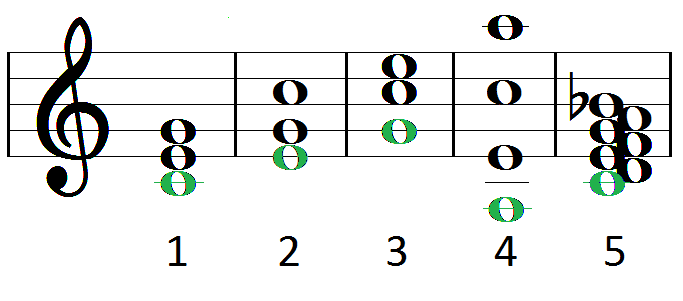
Why bother with inversions? They help create smoother connections between chords. Instead of jumping your hand all over the keyboard, you can often move just one or two fingers to get to the next chord in a song.
Getting Comfortable
To play chords, your hand should be relaxed and curved, as if you're holding a ball. For a simple triad in your right hand, you'll typically use your thumb (1), middle finger (3), and pinky (5). For the left hand, it's the reverse: pinky (5), middle finger (3), and thumb (1).
Practicing chord transitions is all about building muscle memory. Start by picking two chords, like C major and G major. Play C major, hold it for a few seconds, then switch to G major. Go back and forth, slowly at first. Focus on moving all your fingers at the same time. The goal is to make the switch feel smooth and effortless, without having to look down at your hands.
Chords help you build up your hand strength, and they are the building blocks of songs.
Once you feel comfortable, try the same exercise with a C major and an A minor chord. Gradually increase your speed and try different combinations. Consistent practice is the key.
What is the minimum number of notes, played at the same time, required to form a chord?
The notes C, E, and G form a C major chord. If you rearrange them to be G, C, E, what is this called?