Piano Independence
Hand Independence Basics
Training Your Hands to Disagree
Hand independence sounds complicated, but it's not about doing two completely different things at once. It’s about training your hands to perform their roles so well that they become automatic. One hand might hold down a steady rhythm while the other plays a melody. At first, this feels like patting your head and rubbing your stomach. With practice, it becomes second nature.
The goal is to stop thinking about the mechanics of each hand's movement and start feeling the combined musical result. We'll begin with exercises that build foundational coordination, teaching your hands to move independently yet work together.
Start with Symmetry
One of the most effective ways to begin is with contrary motion scales. In contrary motion, your hands start on the same note and move in opposite directions. The right hand goes up the scale, and the left hand goes down. This exercise is powerful because the finger patterns are mirror images of each other, which helps your brain process the movements more easily.
It forces each hand to execute the same pattern but in opposite directions, building symmetrical strength and dexterity. This is a crucial first step before tackling more complex, asymmetrical movements.
To practice this, start with the C major scale.
- Place both thumbs on Middle C.
- Play the scale slowly, with hands moving apart by one note at a time.
- Focus on playing the notes at exactly the same moment.
- Once you reach the top and bottom notes with your little fingers, reverse the motion and come back to Middle C.
Use a metronome and set it to a very slow tempo. The goal isn't speed, but precision and evenness. As you get comfortable, try it with other scales.
Simple Rhythmic Division
After mastering mirrored motion, the next step is to get your hands playing different rhythms. We'll start with the most basic rhythmic relationship: 2 against 1. One hand will play a steady pulse, while the other plays notes that are twice as fast.
This exercise trains your brain to maintain a steady 'anchor' rhythm in one hand while the other performs a more active pattern. It's the foundation for playing almost any piece of music where a melody moves over a simpler accompaniment.
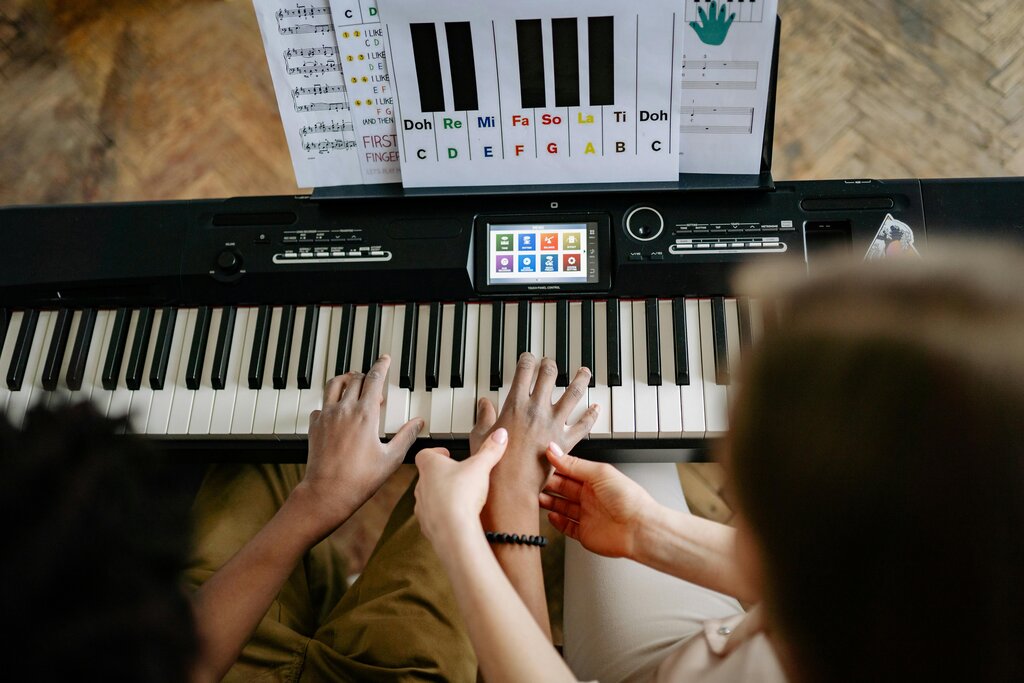
Try this simple exercise on any single note, for example, C.
- Left Hand: Play steady crotchets (quarter notes). Count aloud: "1, 2, 3, 4". Your left hand should play exactly on each number.
- Right Hand: Play quavers (eighth notes), which are twice as fast. Count aloud: "1 and 2 and 3 and 4 and". Your right hand should play on both the number and the "and".
Here is what that looks like in notation.
Once you can hold this pattern steadily, swap the roles. Make your right hand play the slow crotchets and your left hand play the faster quavers. Practicing both ways ensures that neither hand becomes locked into being just the 'steady' one or the 'fast' one. Start on single notes, then try applying the rhythm to your scales.
What is the primary goal of developing hand independence in piano playing?
Why are contrary motion scales a recommended starting point for building hand independence?
These exercises are the building blocks. Mastering them will make more complex coordination feel far more achievable.