Piano Fundamentals for Beginners
Keyboard Layout
The Keyboard's Pattern
Look at a piano keyboard. At first, it might seem like a random sea of white and black keys. But there's a simple, repeating pattern that makes sense of it all. Once you see this pattern, you'll never get lost.

The secret lies with the black keys. Notice how they aren't evenly spaced. They come in groups of two, then a group of three, then a group of two, and so on, all the way up and down the keyboard.
This two-three pattern is your map. Every note on the piano is located by its position relative to these black key groups.
Now let’s use this pattern to name the white keys. The musical alphabet uses seven letters: A, B, C, D, E, F, and G.
Find any group of two black keys. The white key immediately to the left of that group is always C. From there, just move right and go up the alphabet: D, E, F, G, A, B. After B, the pattern starts over with the next C.
The white key to the left of the two black keys is C. The white key to the left of the three black keys is F.
Meet the Octave
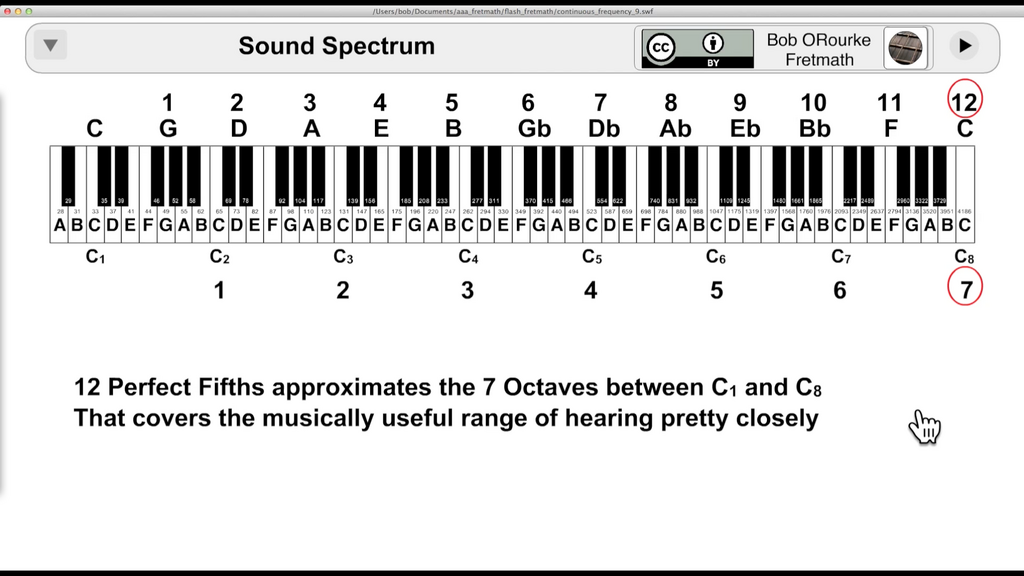
This repeating pattern of 12 keys (7 white and 5 black) is called an octave. If you play a C, and then you play the next C up the keyboard, you've played a note that is one octave higher. It's the same note, but it sounds higher in pitch.
A full-size piano has 88 keys, which spans a little more than seven octaves. This gives it the wide range of notes that makes the instrument so versatile.
Now that you understand the basic layout, let's review the key ideas.
Time to test your knowledge.
What is the repeating pattern of the black keys on a piano keyboard?
How can you locate the white key for the note C?
With this foundational knowledge of the keyboard's geography, you're ready to start finding your way around the notes.