Piano Chord Fundamentals
Basic Chord Construction
The Building Blocks of Chords
At its core, a chord is just a group of notes played together. The specific combination of notes determines the chord's sound and emotional feel. But how do we know which notes to combine? The answer lies in intervals.
An interval is simply the distance between two notes. Think of it like measuring the space between two rungs on a ladder. In music, we measure these spaces in steps. The most important intervals for building basic chords are called thirds. There are two main types:
- Major Third: The distance of four half-steps (or four keys on a piano, counting black and white keys).
- Minor Third: The distance of three half-steps.
These two intervals are the fundamental building blocks that give chords their distinct happy or sad character.
Meet the Triads
The most common type of chord is a triad, which contains three notes. We build triads by stacking thirds on top of a starting note, called the root.
A major triad sounds bright and happy. It's built with a major third on the bottom and a minor third stacked on top. For example, a C major triad consists of the notes C (the root), E (a major third above C), and G (a minor third above E).
A minor triad has a more somber or thoughtful sound. It’s the opposite of a major triad: a minor third on the bottom and a major third on top. A C minor triad uses the notes C (the root), E-flat (a minor third above C), and G (a major third above E-flat). Notice that only one note changes, but it completely alters the chord's mood.
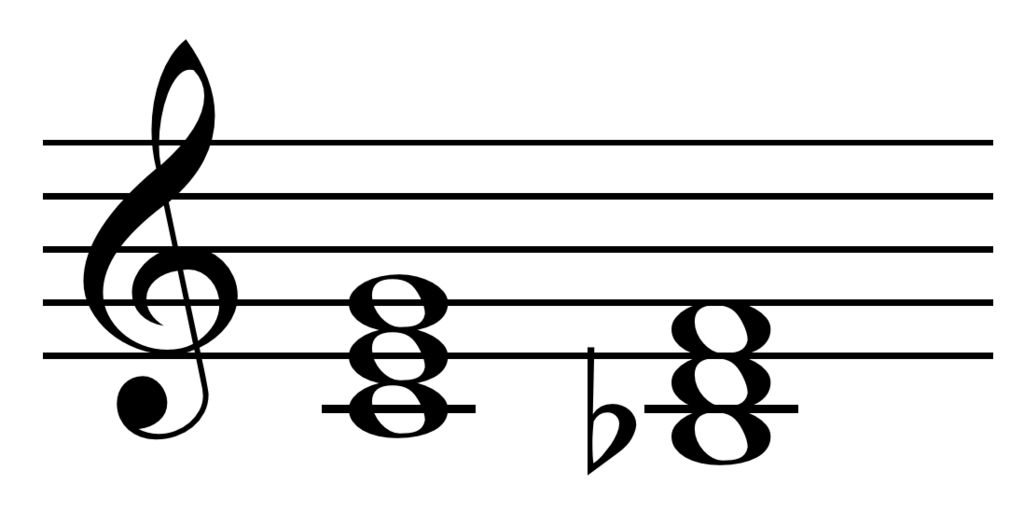
Besides major and minor, there are two other types of triads that add unique flavors to music.
An augmented triad sounds mysterious or unsettled. It's built by stacking two major thirds. So, a C augmented triad would be C, E, and G-sharp.
A diminished triad sounds tense and unstable. It's made of two stacked minor thirds. A C diminished triad would be C, E-flat, and G-flat.
You can think of triads as having different personalities: Major is happy, minor is sad, augmented is dreamy, and diminished is tense.
Adding a Fourth Note
Once you understand triads, you can create richer, more complex sounds by adding one more note. When we add a fourth note—specifically, a seventh above the root—we create a seventh chord. These chords are essential in genres like jazz, blues, and R&B.
Just like triads, seventh chords come in several varieties, each built on a different type of triad and a different type of seventh interval. The dominant seventh chord is one of the most common. It's built from a major triad plus a minor seventh. This combination creates a strong sense of tension that feels like it needs to resolve to a more stable chord.
Other types add different colors. A major seventh chord (major triad + major seventh) sounds relaxed and jazzy, while a minor seventh chord (minor triad + minor seventh) has a smooth, soulful quality.
| Chord Type | Formula | Sound |
|---|---|---|
| Major Seventh | Major Triad + Major 7th | Bright, jazzy |
| Dominant Seventh | Major Triad + Minor 7th | Tense, wants to resolve |
| Minor Seventh | Minor Triad + Minor 7th | Mellow, soulful |
| Half-Diminished | Diminished Triad + Minor 7th | Unstable, complex |
| Diminished Seventh | Diminished Triad + Diminished 7th | Very tense, dissonant |
Understanding how to build these fundamental chords is the first step toward understanding the language of harmony. By learning to recognize their unique sounds and structures, you unlock the ability to play countless songs and eventually create your own.
What is the fundamental interval used to build triads?
How is a major triad constructed from the root note?