Physics Principles and Problem Solving
Fluid Dynamics Fundamentals
Keeping the Flow Constant
Imagine a river flowing steadily. If the river channel narrows, the water speeds up. If it widens, the water slows down. You've probably seen this happen. What you're observing is a fundamental rule of fluid dynamics in action: the conservation of mass.
In fluid dynamics, this idea is captured by the continuity equation. It's a simple but powerful concept that says for an incompressible fluid (like water), the amount of fluid flowing past one point in a pipe must be the same as the amount flowing past another point, regardless of the pipe's size. What goes in must come out.
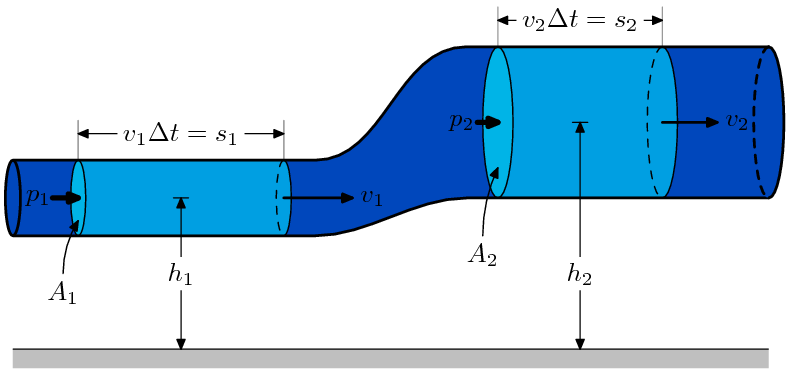
This relationship between the area of the pipe and the speed of the fluid is expressed mathematically.
The product of the area and velocity, known as the volumetric flow rate, remains constant. If the area decreases, the velocity must increase to keep the product the same. This simple equation is crucial for understanding and designing everything from water pipes to blood vessels.
Pressure, Speed, and Height
The continuity equation connects speed and area. But what about pressure? In the 18th century, a Swiss mathematician named Daniel Bernoulli discovered a relationship that connects a fluid's speed, pressure, and potential energy.
Bernoulli's principle states that for a fluid in a steady flow, an increase in speed occurs simultaneously with a decrease in pressure or a decrease in the fluid's potential energy.
Think of it as a form of the conservation of energy, but for moving fluids. The total energy within the fluid flow remains constant. This energy has three components: pressure energy, kinetic energy (from its motion), and potential energy (from its height). If one component increases, another must decrease to keep the total constant.
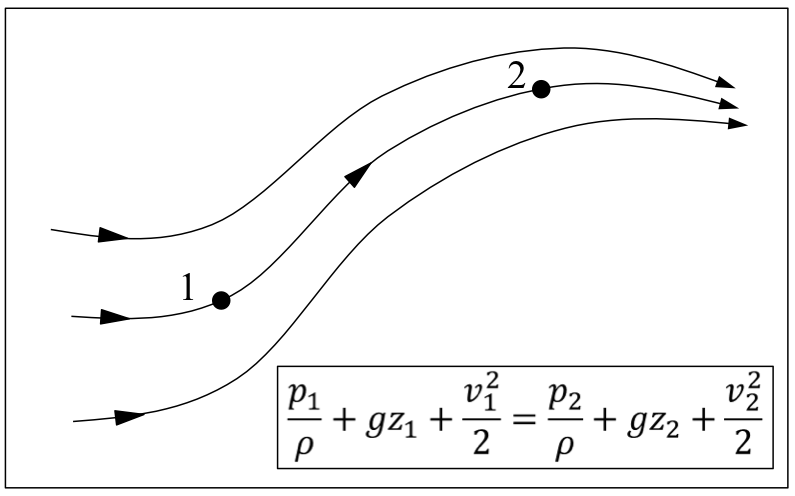
This principle is expressed in Bernoulli's famous equation:
Along a single path of flow, called a streamline, the sum of these three terms will always be the same. If the fluid speeds up, its pressure or height must drop. If the fluid moves to a higher elevation, its speed or pressure must decrease.
How They Work Together
The continuity equation and Bernoulli's principle are often used together. A perfect example is the Venturi tube, a device used to measure fluid speed.
Here's how it works:
-
Continuity: As fluid enters the narrow throat, its cross-sectional area () decreases. According to the continuity equation (), its velocity () must increase.
-
Bernoulli: Now that we know the fluid is moving faster in the throat, we can apply Bernoulli's principle. Since the velocity () has increased, the pressure () must decrease (assuming the tube is horizontal, so height is constant).
This pressure difference can be measured, and because it's directly related to the fluid's speed, the Venturi tube can tell us how fast the fluid is flowing.
This same interplay between pressure and velocity is what generates lift on an airplane wing. The wing is shaped to make air travel faster over its curved top surface than its flatter bottom surface. This higher speed creates lower pressure on top, and the pressure difference between the bottom and top of the wing pushes it upward.
Let's review these core concepts.
Now, test your understanding of how these principles apply.
According to the continuity equation for an incompressible fluid, what happens to the fluid's velocity if the pipe it's flowing through widens?
In a Venturi tube, a fluid speeds up as it passes through the narrow throat. According to Bernoulli's principle, what other change occurs in the throat?
Understanding how mass and energy are conserved in fluids is the first step to analyzing any system where fluids are in motion, from the weather to the flow of blood in our veins.