Physics of Rainbow Formation
Droplet Ray Geometry
The Rainbow's Secret Geometry
A rainbow isn't just a random splash of colour. It’s a precise optical event, created by countless water droplets all doing the exact same thing. To understand how they do it, we need to follow the journey of a single light ray through a single spherical raindrop. It's a path of bending and bouncing that was first meticulously traced by the philosopher and mathematician René Descartes in the 17th century.
Imagine parallel rays of sunlight striking a raindrop. Not all rays are equal. Their path depends entirely on where they hit the droplet. A ray striking the centre behaves differently from one that hits near the edge. This distance from the centre to the point of entry is called the impact parameter.
Let's formalise this. We can define the impact parameter, , as the vertical distance from the centre of the droplet to an incoming ray. The radius of the droplet is . Therefore, the impact parameter can range from (a direct hit to the centre) to (a glancing blow at the very edge).
Finding the Brightest Angle
As a light ray enters the droplet, it refracts. It then travels to the back of the droplet, reflects internally, and travels back to the front, where it refracts again as it exits. The total angle the ray is deviated from its original path depends entirely on the impact parameter, .
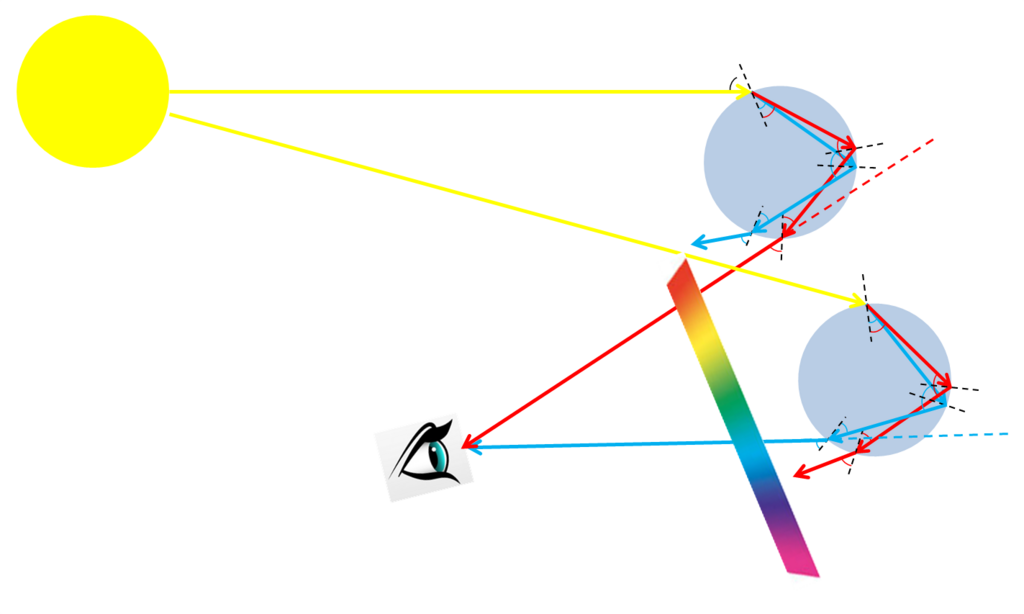
Descartes discovered something crucial when he traced these paths. He found that as the impact parameter increases from zero, the deviation angle first decreases, reaches a minimum value, and then starts to increase again. This special angle is called the minimum deviation angle or the 'rainbow angle'.
Why is this minimum angle so important? Near this point, a large number of incoming rays, all with slightly different impact parameters, get funnelled out at almost the exact same angle. Think of it like traffic bunching up at a bottleneck. This ray clustering makes the light at the minimum deviation angle exceptionally intense. For red light in water, this angle is about 42° from the antisolar point, which is why we see a bright arc of red at that specific angle in the sky.
The magic of the rainbow happens because many light rays exit the droplet at or very near one specific angle, creating a band of concentrated light.
Rays with impact parameters far from this sweet spot exit at a wide variety of other angles. Their light is scattered and diffuse, contributing to the bright area inside the primary rainbow but not forming a sharp, visible band themselves. It's the concentration of rays at the minimum deviation angle that transforms scattered sunlight into a brilliant spectacle.
Which scientist first meticulously traced the path of a light ray through a spherical raindrop to explain the formation of a rainbow?
In the context of a light ray striking a raindrop, what does the 'impact parameter' () refer to?