Physics in Action
Introduction to Physics
The Rulebook for Reality
At its heart, physics is the study of matter, energy, and how they interact. It's the grand instruction manual for the universe, explaining everything from why an apple falls from a tree to how the stars shine. Physicists ask fundamental questions: What is stuff made of? What are the basic forces that govern everything? How did the universe begin, and how will it end?
The scope is vast. It covers the tiniest subatomic particles and the largest clusters of galaxies. Physics is the foundation upon which other sciences like chemistry, biology, and geology are built. Understanding physics means understanding the fundamental rules that everything else must follow.
Physics is the study of the basic principles that govern the physical world around us.
So how do we discover these rules? Physicists don't just guess. They use a systematic process to explore the world.
The Scientific Method
The scientific method is a structured way of investigating phenomena and acquiring new knowledge. It’s a cycle of observation, questioning, and testing that helps weed out bad ideas and refine good ones. It generally follows a few key steps.
This isn't always a rigid, linear process. Sometimes a surprising experimental result leads to a new observation, starting the cycle over. The goal is to develop theories that are consistently supported by evidence. A scientific theory isn't just a hunch; it's a well-substantiated explanation of some aspect of the natural world that has been repeatedly tested and confirmed.
Two Worlds of Physics
The field of physics is often split into two major domains: classical and modern physics. The dividing line is roughly the year 1900.
Classical Physics deals with the world we experience every day. It describes the motion of objects much larger than an atom and moving much slower than the speed of light. Think of throwing a ball, the orbits of planets, or the workings of a simple machine. It includes fields like mechanics, thermodynamics, and electromagnetism.
Modern Physics emerged when scientists began exploring the realms of the very small (atoms and subatomic particles) and the very fast (speeds approaching the speed of light). This includes two revolutionary theories: quantum mechanics and relativity. It explains things like how GPS works, the energy of the sun, and the behavior of particles inside a computer chip.
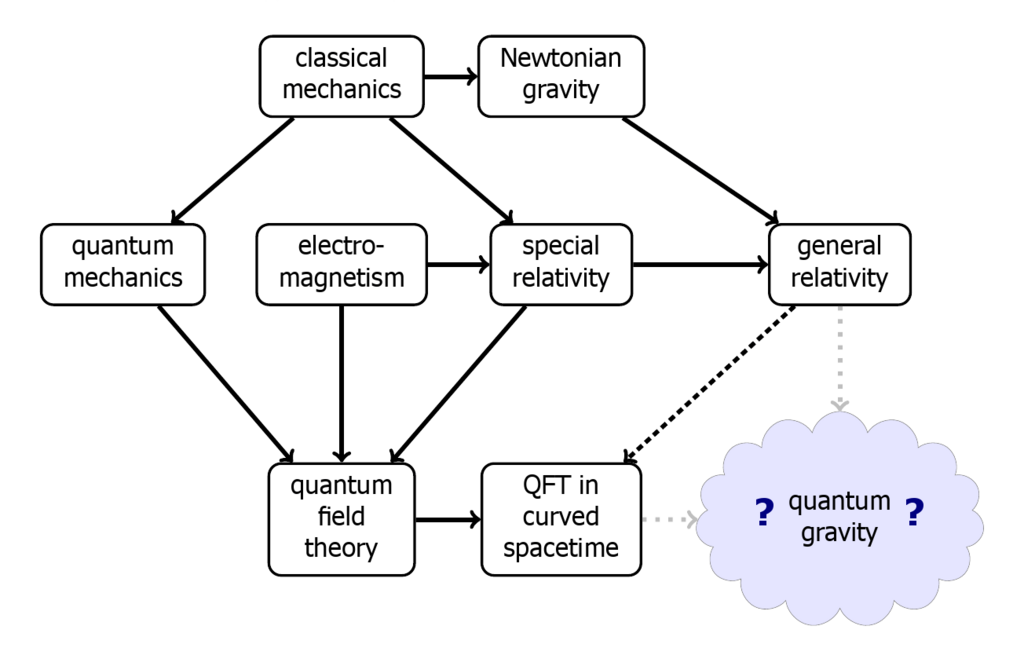
It's important to remember that modern physics didn't prove classical physics wrong. Instead, it showed that classical physics is an excellent approximation of the rules under a specific set of conditions (large scale, low speeds). In a way, classical physics is a special case of the more comprehensive rules of modern physics.
The Language of Measurement
To test hypotheses and build theories, physicists must measure things. To ensure scientists all over the world can communicate their results clearly, they use a standardized system of units called the Système International d'Unités, or SI units.
All physical measurements can be broken down into a few fundamental quantities. These are the basic building blocks of measurement, from which all others are derived.
quantity
noun
A property of a phenomenon, body, or substance that can be expressed in numbers.
The seven base SI quantities are the foundation, but for now, we'll focus on the three most common ones from classical mechanics.
| Fundamental Quantity | SI Base Unit | Symbol |
|---|---|---|
| Length | meter | m |
| Mass | kilogram | kg |
| Time | second | s |
From these fundamental units, we can derive others. For example, speed is a derived quantity, measured in meters per second (m/s). Force is measured in Newtons (N), where . Using a consistent set of units is crucial for making sure our calculations make sense and accurately describe the world.
Let's review these core concepts.
Now, test your understanding with a few questions.
Which of the following best describes the primary focus of physics?
A scientific theory is best described as a well-tested explanation for a set of observations or phenomena, supported by a wide body of evidence.
By combining a reliable method with a precise language of measurement, physics provides a powerful framework for understanding the universe.