Physics for Aerospace Engineers
Mechanics
The Rules of Motion
Mechanics is the study of how things move. It's the physics of pushing, pulling, throwing, and crashing. It's divided into two main areas. Statics is the study of objects that aren't moving, like a bridge holding up traffic. Dynamics is the study of objects in motion, like a rocket launching into orbit. The foundation for all of this comes from three simple but powerful laws discovered by Isaac Newton.
Newton’s first law is about inertia. An object will keep doing whatever it's doing unless something messes with it. If it’s sitting still, it will stay still. If it’s moving, it will keep moving in a straight line at a constant speed.
Think about a satellite in deep space. Once it's moving, it will coast forever in a straight line because there's almost nothing out there to slow it down or change its direction. On Earth, friction and air resistance are always acting to stop things.
The second law is the most famous. It connects force, mass, and acceleration. It tells us that to change an object's motion (to accelerate it), you need to apply a net force. The more massive the object, the more force you need to get the same acceleration. It’s much easier to push a shopping cart than a car.
Here, is the net force applied, is the object's mass, and is the resulting acceleration. This simple equation is one of the most important in all of physics and engineering.
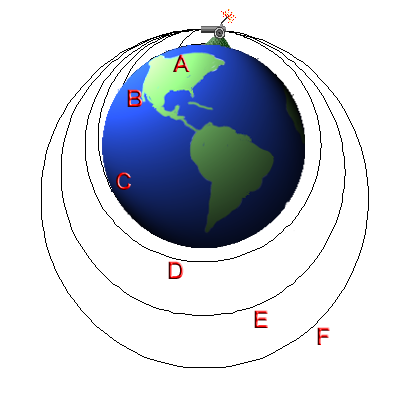
Newton's third law states that for every action, there is an equal and opposite reaction. Forces always come in pairs. When you lean against a wall, the wall pushes back on you with the same amount of force. If it didn't, you'd fall right through it.
A rocket works because of this law. It doesn't push against the air. It throws hot gas out of its engine at high speed (the action). The gas, in turn, pushes the rocket forward (the reaction). This is why rockets work even in the vacuum of space.
Describing Motion
Before we can analyze the forces causing motion (dynamics), we need a way to describe the motion itself. This is called kinematics. It’s the language of movement, using concepts like position, velocity, and acceleration.
Imagine you're driving a car. Your position is your location at any given moment. Displacement is the straight-line distance and direction from your starting point to your ending point. Velocity is your speed in a specific direction. Your speedometer tells you your speed, but your velocity also includes the fact that you're heading north on the highway. Acceleration is any change in your velocity. That means speeding up, slowing down, or even just turning a corner, because turning changes your direction.
Energy and Momentum
Force and acceleration don't tell the whole story. Two other concepts are essential for understanding mechanics: energy and momentum.
Energy
noun
The capacity to do work.
Work in physics has a specific meaning. It's done when a force causes an object to move a certain distance. If you push on a wall but it doesn't move, you've done zero work, no matter how tired you get. Work is the transfer of energy. The energy of motion is called kinetic energy.
The relationship is straightforward: the work done on an object equals the change in its kinetic energy. This is called the work-energy theorem. To get a satellite up to orbital speed, its rocket engines must do a massive amount of work on it, transferring chemical energy from the fuel into kinetic energy of the satellite.
Momentum is another key quantity. It's often described as "mass in motion." A freight train moving slowly and a bullet moving quickly can both have large amounts of momentum.
Here, is momentum, is mass, and is velocity. Like energy, momentum is a conserved quantity. In any collision or explosion, the total momentum of all the objects before the event is equal to the total momentum after. This principle is crucial for analyzing everything from car crashes to the way spacecraft use thrusters to maneuver.
Impulse is the change in momentum. To change an object's momentum, you need to apply a force over a period of time. A small force for a long time can have the same effect as a large force for a short time. This is why cars have airbags. They increase the time of impact, which reduces the peak force on the passenger, even though the total change in momentum (the impulse) is the same.
Putting It All Together
We can use these principles—Newton's laws, kinematics, energy, and momentum—to analyze complex systems. We can study the motion of individual particles or entire rigid bodies, which are objects that don't change shape.
When we study the dynamics of rigid bodies, we consider not just their linear motion (moving from point A to B) but also their rotational motion (spinning or tumbling). This adds concepts like torque (a rotational force), angular velocity (how fast something is spinning), and moment of inertia (the rotational equivalent of mass).
Engineers use these tools to design everything. They ensure buildings and bridges are stable (statics). They calculate the trajectories of spacecraft (dynamics of particles). And they design spinning turbines and robotic arms that can move with precision (dynamics of rigid bodies).
Now let's check your understanding of these core concepts.
The study of objects that are not moving, such as a bridge supporting traffic, is known as:
According to Newton's second law, if you double the net force applied to an object while its mass remains constant, its acceleration will...
Mastering these ideas is the first step toward understanding how we design and control machines that move, from the smallest gear to the largest rocket.