Physics and Electromagnetism
Electromagnetic Induction Fundamentals
The Essence of Induction
You already know that an electric current creates a magnetic field. It’s a fundamental link between electricity and magnetism. But what about the reverse? Can a magnetic field create an electric current? The answer is yes, but with a crucial twist: the magnetic field, or more precisely the magnetic environment, must be changing.
This phenomenon is called electromagnetic induction. It’s the principle behind electric generators, transformers, and even wireless chargers. To grasp it, we first need to understand a concept called magnetic flux.
Think of magnetic flux as a measure of the total number of magnetic field lines passing through a given area. It's not about the strength of the field at one point, but the total 'amount' of field flowing through a surface.
If the magnetic field is uniform and perpendicular to the surface of a wire loop, calculating the flux is simple: you just multiply the magnetic field strength () by the area () of the loop. However, if the field passes through at an angle, we only care about the component of the field that is perpendicular to the loop. This gives us the general formula for magnetic flux.
Faraday's Law of Induction
The key discovery, made by in 1831, was that a voltage, or electromotive force (EMF), is induced in a circuit only when the magnetic flux through it changes over time. A steady, unchanging magnetic field, no matter how strong, won't produce a current on its own. The change is everything.
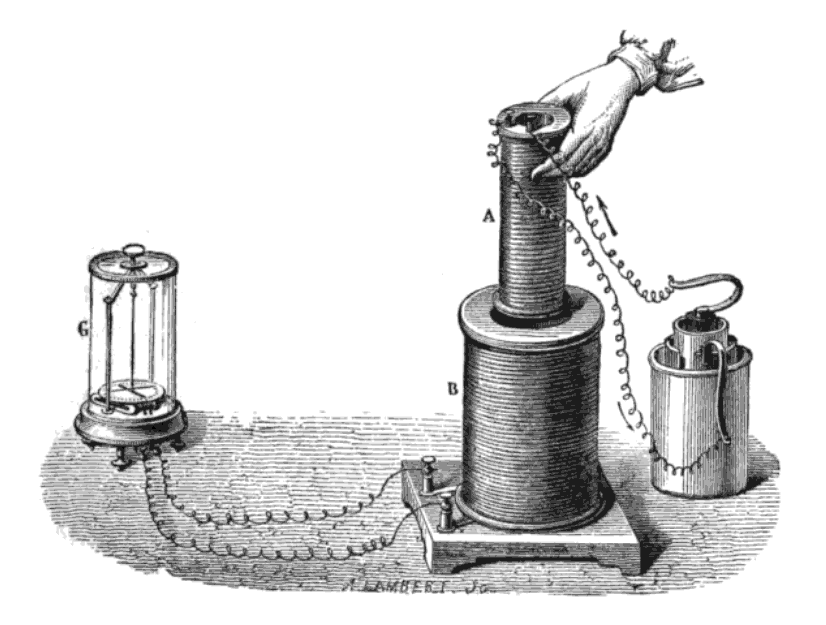
Faraday's Law of Induction quantifies this relationship. It states that the magnitude of the induced EMF in any closed circuit is equal to the rate of change of the magnetic flux through the circuit. If you have a coil with multiple turns of wire, the effect is multiplied.
Notice the negative sign in the formula. It isn't just a mathematical quirk; it points to a deep physical principle about the direction of the induced current, which is described by Lenz's Law.
Lenz's Law and Conservation of Energy
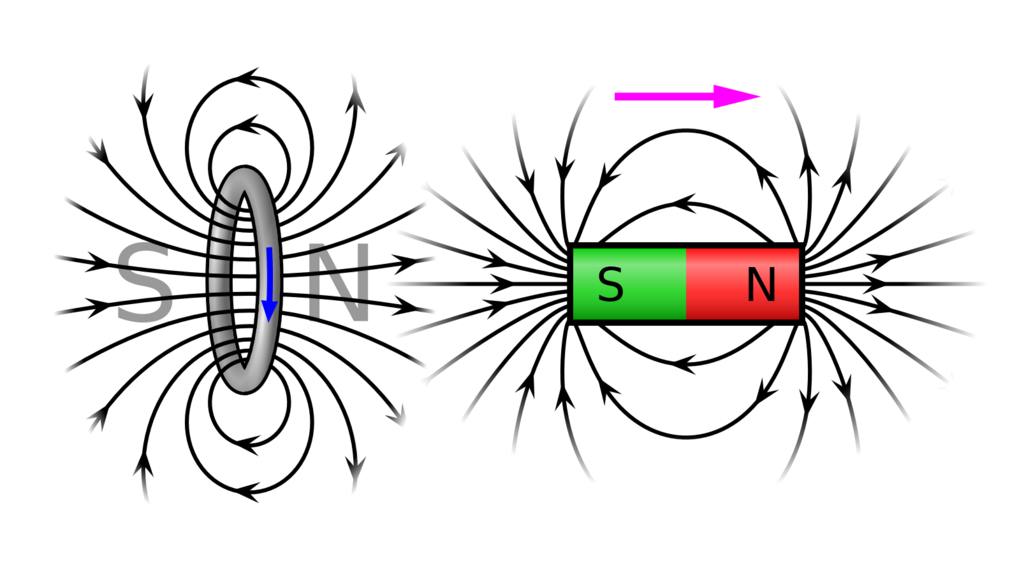
gives the direction of the induced current. It's a consequence of the conservation of energy, and you can think of it as nature's opposition to change. The law states that the induced current will flow in a direction that creates a magnetic field opposing the change in magnetic flux that produced it.
In simpler terms: if you push the north pole of a magnet towards a coil, the coil will induce a current that turns it into an electromagnet with a north pole facing the magnet, pushing it away. Nature resists the change.
Motional EMF
So far, we've discussed changing magnetic fields. But you can also induce an EMF by moving a conductor through a constant magnetic field. This is known as and is a direct application of the Lorentz force on the charge carriers (electrons) within the conductor.
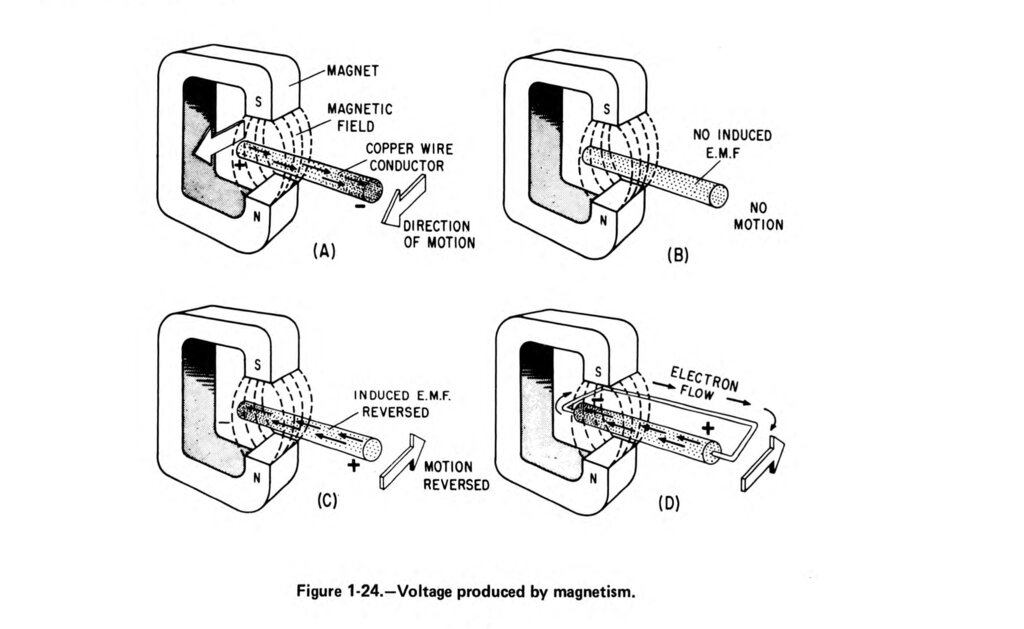
Imagine a straight conducting rod of length moving at a constant velocity through a uniform magnetic field . If the velocity, length, and field are all mutually perpendicular, the electrons in the rod are pushed to one end, creating a voltage.
This principle is the foundation of electric generators, which use mechanical energy to rotate coils of wire in a magnetic field, converting motion into electrical energy. Understanding these rules of induction is the first step to mastering the design of motors, generators, and transformers.