Physical Quantities in Quantum Mechanics
Introduction to Quantum Mechanics
A Different Kind of Reality
In the world we see every day, things are predictable. A baseball flies through the air on a clear path. A car is either parked in the driveway or it's not. This is the realm of classical physics, and its rules make intuitive sense. But when we zoom in to the scale of atoms and the particles inside them, these rules break down. Welcome to the world of quantum mechanics, where things are not always what they seem.
The most fundamental shift in thinking is that quantum objects don't always have definite properties until we measure them. Before you look, a particle might not have a specific location or speed. Instead, it exists in a haze of possibilities.
This idea is called superposition. It means a quantum system can be in multiple states at the same time.
Imagine a spinning coin. While it's in the air, is it heads or tails? In a way, it's a blend of both possibilities. Only when it lands and you look at it—when you 'measure' it—does it settle into one definite state. An electron can be in a superposition of 'spin up' and 'spin down' states simultaneously. It's not one or the other; it's both, until an interaction forces it to 'choose'.
Wave or Particle?
One of the strangest consequences of superposition is wave-particle duality. In classical physics, something is either a particle (a tiny, distinct object, like a grain of sand) or a wave (a spread-out disturbance, like a ripple in a pond). In the quantum world, objects like electrons and photons can be both.
The famous double-slit experiment reveals this bizarre nature. If you shoot tiny particles, like paintballs, at a wall with two vertical slits, you expect to see two lines of paint on the screen behind it. Simple enough. If you send waves through the same two slits, the waves interfere with each other, creating a distinctive pattern of many bright and dark bands on the screen.
So, what happens when we shoot electrons, one by one, at the double slits? At first, they appear on the screen as individual dots, just like particles. But as more and more electrons land, a stunning pattern emerges. They form an interference pattern, as if each single electron passed through both slits at once, like a wave, and interfered with itself.
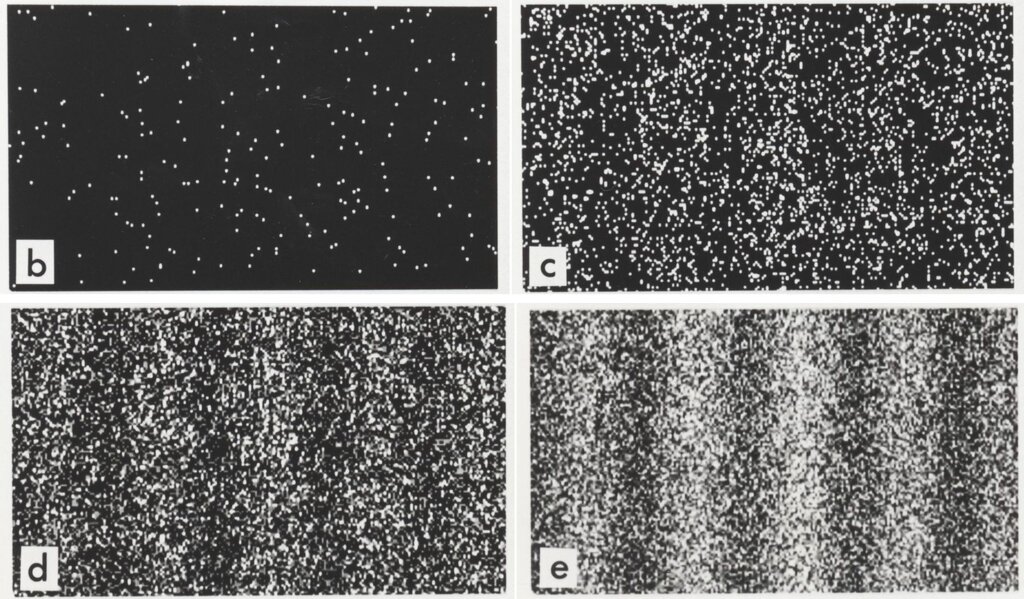
This experiment shows that quantum objects behave like particles when we detect them, but they travel and propagate like waves, exploring all possible paths simultaneously. The act of observation seems to determine their nature.
The Physics of Probability
If a particle can be in many states at once, how can we describe it? We can't pinpoint its exact properties before measuring. Instead, quantum mechanics tells us the probability of finding it in any given state. The universe, at its most fundamental level, runs on chance.
Wavefunction
noun
A mathematical function that describes the quantum state of a system. It contains all the information about the particle, including the probabilities of its possible properties.
Every quantum system is described by a wavefunction, often represented by the Greek letter psi ($ \Psi $). This isn't a physical wave, like an ocean wave. It's a wave of probability. Where the wavefunction's amplitude is high, there's a high probability of finding the particle. Where it's low, the probability is low.
When we measure a particle, its wavefunction 'collapses.' The cloud of possibilities instantly resolves into a single, definite outcome. We can't predict which outcome will occur with certainty, only its likelihood.
This probabilistic nature is not due to a lack of information. It's an inherent feature of the universe. Albert Einstein famously disliked this idea, remarking, "God does not play dice." Yet, experiment after experiment has confirmed that at the quantum level, the universe does indeed rely on the roll of the dice.
Ready to check your understanding of these foundational ideas?
According to the principle of superposition, what is the state of an electron's spin before it is measured?
In the double-slit experiment, firing electrons one by one at the slits results in an interference pattern on the screen behind them. What does this outcome suggest?
Superposition, wave-particle duality, and the probabilistic wavefunction are the pillars of quantum mechanics. They challenge our everyday intuition but provide an incredibly accurate description of the subatomic world.