Physical Properties of Alcohols
Hydrogen Bonding Mechanics
The Molecular Glue
Alcohols stand apart from many other organic compounds because of one small but powerful feature: the hydroxyl (-OH) group. This isn't just a random attachment; it's the source of their most important properties. The key player here is the oxygen atom.
Oxygen is highly an elegant way of saying it's greedy for electrons. In the covalent bond it shares with hydrogen, the electrons aren't shared equally. They spend more time buzzing around the oxygen atom, giving it a slight negative charge (written as ). Consequently, the hydrogen atom is left with a slight positive charge ().
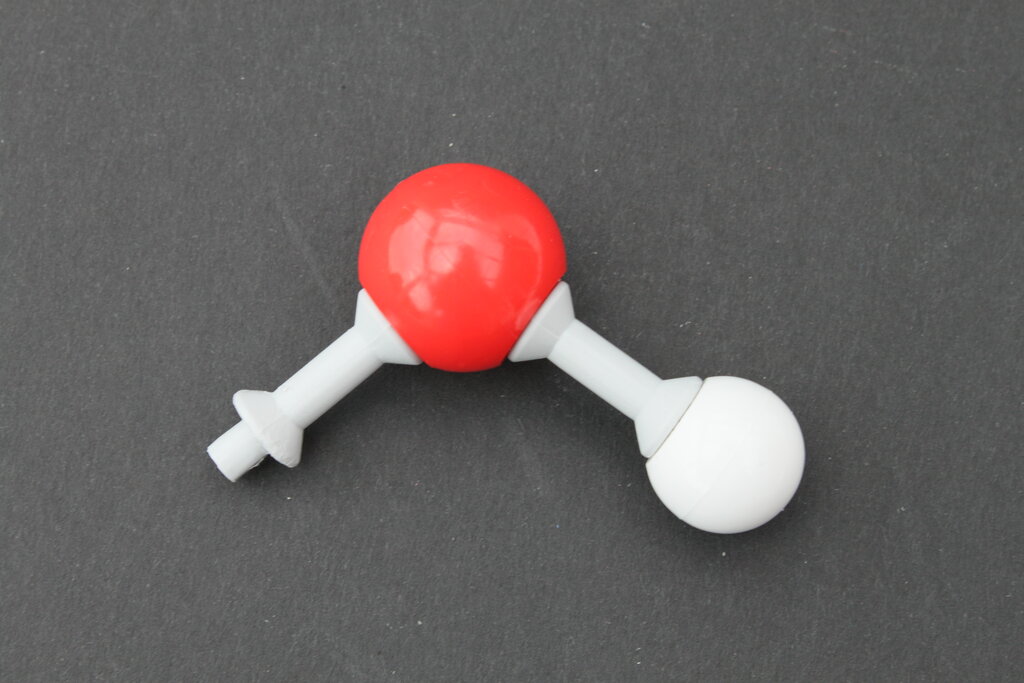
This separation of charge creates a dipole. The molecule now has a positive end and a negative end, much like a tiny magnet.
Dipole
noun
A molecule or a part of a molecule that has a pair of equal and oppositely charged or magnetized poles separated by a distance.
A Special Attraction
When two alcohol molecules approach each other, this polarity leads to a special kind of attraction. The slightly positive hydrogen of one molecule's hydroxyl group is strongly attracted to the slightly negative oxygen of a neighboring molecule. This powerful intermolecular force is called a hydrogen bond.
It's crucial to understand that a hydrogen bond isn't a true covalent bond where electrons are shared. It's an electrostatic attraction, but a particularly strong one. It acts like a form of molecular glue, holding the molecules together more tightly than other, weaker forces.
A Hierarchy of Forces
To appreciate the strength of hydrogen bonds, it helps to see where they fit in the hierarchy of chemical forces. Think of it as a spectrum of strength.
| Force Type | Relative Strength | Description |
|---|---|---|
| Covalent Bond | Very Strong (100) | Atoms sharing electrons within a molecule. |
| Hydrogen Bond | Strong (10) | Attraction between a H and a O, N, or F. |
| Dipole-Dipole | Moderate (1) | Attraction between two permanent polar molecules. |
| Van der Waals | Weak (0.1) | Temporary attractions in all molecules. |
As you can see, covalent bonds—the forces holding the atoms within a single molecule together—are an order of magnitude stronger. But among the intermolecular forces that pull separate molecules toward each other, hydrogen bonding is the champion. It's significantly stronger than standard dipole-dipole interactions and much stronger than the fleeting found in nonpolar molecules like alkanes.
This 'molecular glue' has profound effects. It takes much more energy (in the form of heat) to pull alcohol molecules apart from each other and turn them into a gas. This is why ethanol (molar mass 46 g/mol) boils at 78°C, while propane (molar mass 44 g/mol) boils at -42°C. Despite their similar sizes, the presence of hydrogen bonding in ethanol makes all the difference.
The geometry of the molecule matters, too. For a strong hydrogen bond to form, the hydrogen atom must be positioned almost directly between the two oxygen atoms. This directional nature helps create structured, albeit temporary, networks of molecules in liquid alcohol.
Time to review these concepts.
Let's test your understanding of how these forces shape the properties of alcohols.
What is the primary reason for the polarity of the hydroxyl (-OH) group in an alcohol molecule?
Which of the following best describes a hydrogen bond between two alcohol molecules?
Understanding this single intermolecular force is the key to unlocking the distinct physical and chemical behavior of alcohols.