Physical Chemistry in Human Biology
Thermodynamics
Energy Can't Be Created or Destroyed
The First Law of Thermodynamics is essentially a statement about conservation. It says that energy can't be created out of nothing, nor can it be destroyed. It can only change from one form to another.
Think about the food you eat. The chemical energy stored in a sandwich is converted into other forms inside your body. It becomes thermal energy to keep you warm, kinetic energy to move your muscles, and electrical energy to fire your neurons. The total amount of energy remains the same throughout these transformations.
In thermodynamics, we often talk about the change in enthalpy, represented as . Enthalpy is the total heat content of a system. When a chemical reaction occurs, the change in enthalpy tells us whether heat is released or absorbed.
- If is negative, the reaction is exothermic. It releases heat into the surroundings. The breakdown of glucose in your cells is a great example. It releases energy that your body can use.
- If is positive, the reaction is endothermic. It absorbs heat from the surroundings. Photosynthesis is an endothermic process, where plants absorb energy from sunlight to create glucose.
The Universe Tends Toward Disorder
The Second Law of Thermodynamics introduces the concept of entropy, represented by the letter . Entropy is a measure of randomness, or disorder. The second law states that the total entropy of the universe is always increasing.
Imagine a neatly organized bedroom. Without any effort to keep it tidy, it will naturally become messy over time. Clothes end up on the floor, books get scattered. This is entropy in action. Systems tend to move from a state of order to a state of disorder.
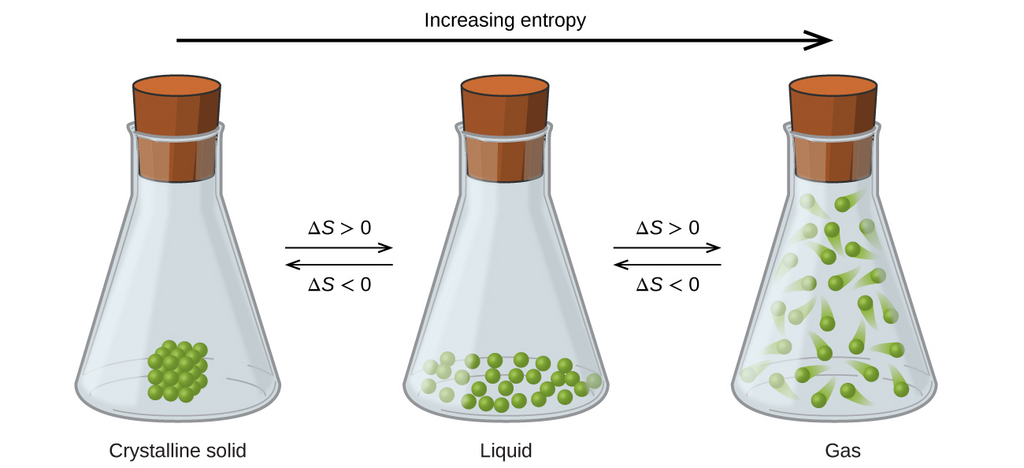
At first glance, living things seem to defy this law. A single cell is an incredibly complex and organized structure. An entire organism is even more so. How can this order exist if the universe is always becoming more chaotic?
The key is that an organism is not an isolated system. It constantly exchanges energy and matter with its environment. To maintain its own internal order, a living thing must increase the entropy of its surroundings. For example, when your body breaks down complex food molecules into simpler ones (like carbon dioxide and water) and releases heat, it is increasing the disorder outside of itself. The total entropy of you (the system) plus your surroundings (the universe) still goes up, perfectly in line with the second law.
Will It Happen on Its Own?
So, we know energy is conserved, and disorder tends to increase. But how can we predict whether a specific biochemical reaction will happen spontaneously? For that, we need to consider both enthalpy () and entropy ().
This is where Gibbs free energy, or , comes in. The change in Gibbs free energy () is the portion of a system's energy that is available to do useful work. It's the ultimate decider for whether a reaction will proceed on its own.
The relationship is captured in one of the most important equations in biochemistry:
Here, stands for the absolute temperature in Kelvin. This equation tells us that the spontaneity of a reaction depends on the balance between the change in heat () and the change in disorder ().
- If is negative, the reaction is exergonic. It is spontaneous and will proceed on its own, releasing free energy that can be used for other tasks.
- If is positive, the reaction is endergonic. It is not spontaneous and requires an input of energy to occur.
- If is zero, the system is at equilibrium. There is no net change in the reaction.
| ΔH | ΔS | ΔG = ΔH - TΔS | Spontaneity |
|---|---|---|---|
| − | + | Always Negative | Spontaneous at all temperatures |
| + | − | Always Positive | Non-spontaneous at all temperatures |
| − | − | Negative at low T | Spontaneous only at low temperatures |
| + | + | Negative at high T | Spontaneous only at high temperatures |
The Balancing Act of Life
If a system at equilibrium has a of zero and can't do any work, what does that mean for a living organism? It means that a living being is fundamentally a non-equilibrium system. Life is a constant struggle to stay away from equilibrium.
Equilibrium, for an organism, is death. When a cell reaches equilibrium with its surroundings, its life processes cease.
To maintain this non-equilibrium state, organisms must constantly take in energy from their environment—sunlight for plants, food for animals. This energy is used to power endergonic () reactions, like building proteins, synthesizing DNA, and moving muscles. Your body cleverly couples energy-releasing (exergonic) reactions, like the breakdown of ATP, with energy-requiring (endergonic) reactions, allowing complex life-sustaining processes to occur.
This constant flow of energy allows us to build and maintain our incredible biological order, all while the universe as a whole marches toward greater entropy.
Let's check your understanding of these core thermodynamic principles.
The First Law of Thermodynamics is fundamentally a statement about the:
If a biochemical reaction has a negative change in enthalpy (), the reaction is: