Photography Composition Techniques
Visual Dynamics
Mastering Visual Tension and Energy
Composition is about more than just rules; it is about controlling how a viewer's eye travels through your frame. In this chapter, we move beyond static balance to manipulate geometry, vectors, and weights, allowing you to choose between creating stability or kinetic energy in your images. By the end, you will understand how to make intentional, powerful decisions that turn ordinary landscapes and street scenes into dynamic visual experiences.
The Gravity of Objects
Once you understand the basic rule of thirds, you can start viewing your frame not as a grid, but as a stage where every object has its own and gravity. Think of your photograph as a physical space. A large, dark building in the corner feels heavy, pulling the viewer’s eye downward, while a small, bright bird in the upper sky feels light, as if it is floating away. This weight is not about the literal mass of the object, but about how much it attracts our attention.
When you place a heavy object in the center, the frame feels grounded and immobile. But as you move that object toward the edge, the 'gravity' shifts. It creates a feeling that the frame might tip over, forcing the viewer's brain to work harder to process the scene. This is where composition stops being about 'correctness' and starts being about feeling.
Visual weight is the perceived force that an element exerts on the viewer’s eye. It determines which parts of the image get noticed first and for how long.
Vectors and Directional Energy
Objects in a frame do not just sit there; they point. In photography, we call these directional paths or leading lines. A vector can be explicit, like a literal road stretching into the distance, or implicit, such as the direction a person is looking. These paths act like arrows that dictate the flow of energy.
When a vector points toward the center, it keeps the viewer's eye locked inside a loop. However, when a vector points toward the edge of the frame, it creates a sense of kinetic energy. It suggests that something is about to happen or that the subject is about to leave the world of the photo. This creates an invisible tug-of-war between the subject and the boundaries of the image.
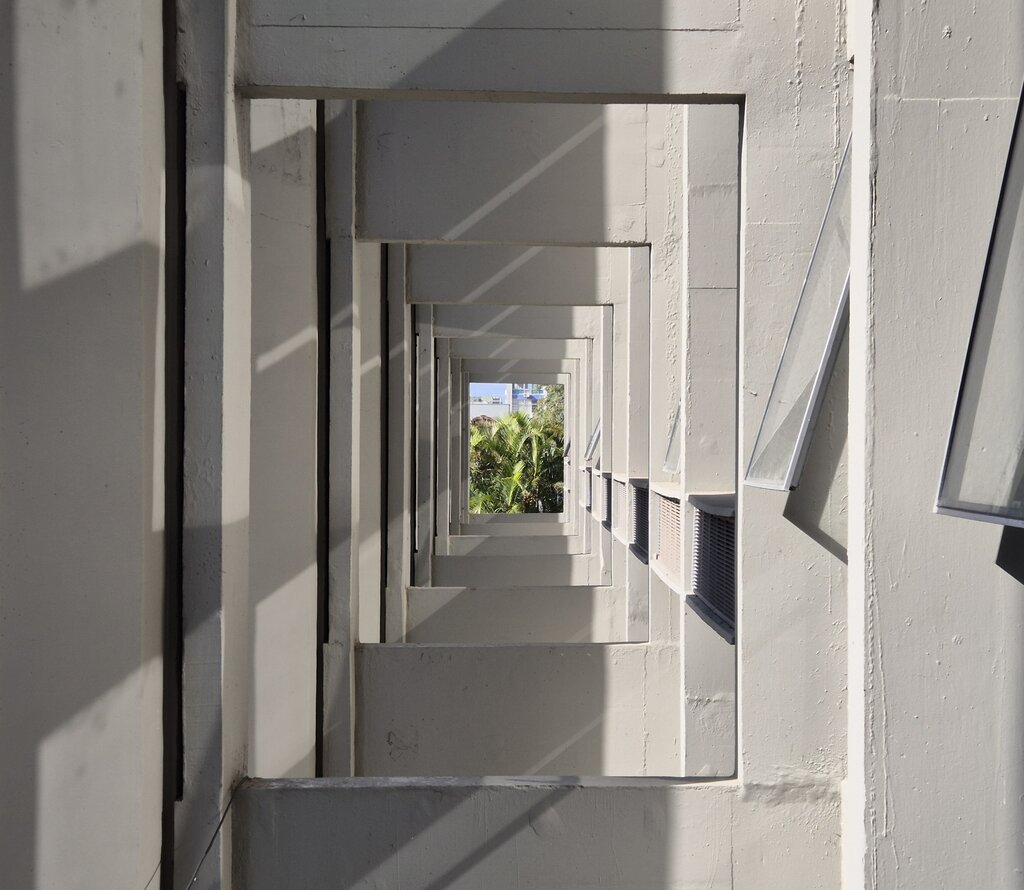
Static Equilibrium versus Dynamic Tension
There is a fundamental trade-off in composition between stability and tension. A centered subject exists in a state of static equilibrium. It feels safe, serene, and final. Think of a formal portrait or a symmetrical building; there is no mystery about where you should look. Everything is balanced perfectly, which can be beautiful, but also sometimes predictable.
Dynamic tension occurs when you break that balance. By placing a subject off-center or aligning elements along a diagonal, you introduce a feeling of movement. The viewer’s brain tries to 'resolve' the imbalance, creating a sense of curiosity. In street photography, if you capture a person walking toward the very edge of the frame, the weight shifts entirely to that side. It feels as if they are escaping, leaving the viewer with a lingering sense of what lies beyond the crop.
| Element | Static Equilibrium (Stability) | Dynamic Tension (Energy) |
|---|---|---|
| Subject Placement | Centered or Symmetrical | Off-center or Edge-heavy |
| Lines | Horizontal and Vertical | Diagonal and Intersecting |
| Viewer Feeling | Calm, Resolved, Secure | Curious, Active, Unsettled |
| Narrative | The story is complete | The story is unfolding |
Understanding these forces allows you to move beyond simple 'good' composition and toward 'intentional' composition. When you know why a diagonal line creates energy or why a heavy object in the corner feels unsettling, you can use those tools to match the mood of your subject. Next, we will explore how these weights and vectors translate into the hidden geometry of the frame.