Pharmacology and Anesthetic Implications of Cardiovascular and Hematological Drugs
Introduction to Pharmacology
What is Pharmacology?
Pharmacology is the study of how substances interact with living organisms to produce a change in function. In medicine, it's about understanding how drugs work, how the body handles them, and how they can be used to treat diseases.
Think of it as the science behind the medicine you take. It's not just about what a drug does, but also about the journey it takes through your body. To understand this journey, pharmacology is often split into two main areas: pharmacokinetics and pharmacodynamics.
Pharmacodynamics describes how drugs exert their effects on the body, often by interacting with cellular receptors, enzymes, or ion channels.
The Body and The Drug
A simple way to remember the two main branches of pharmacology is to think about who is acting on whom.
Pharmacokinetics is what the body does to the drug.
Pharmacodynamics is what the drug does to the body.
Pharmacokinetics
noun
The study of the movement of drugs within the body, including the processes of absorption, distribution, metabolism, and excretion.
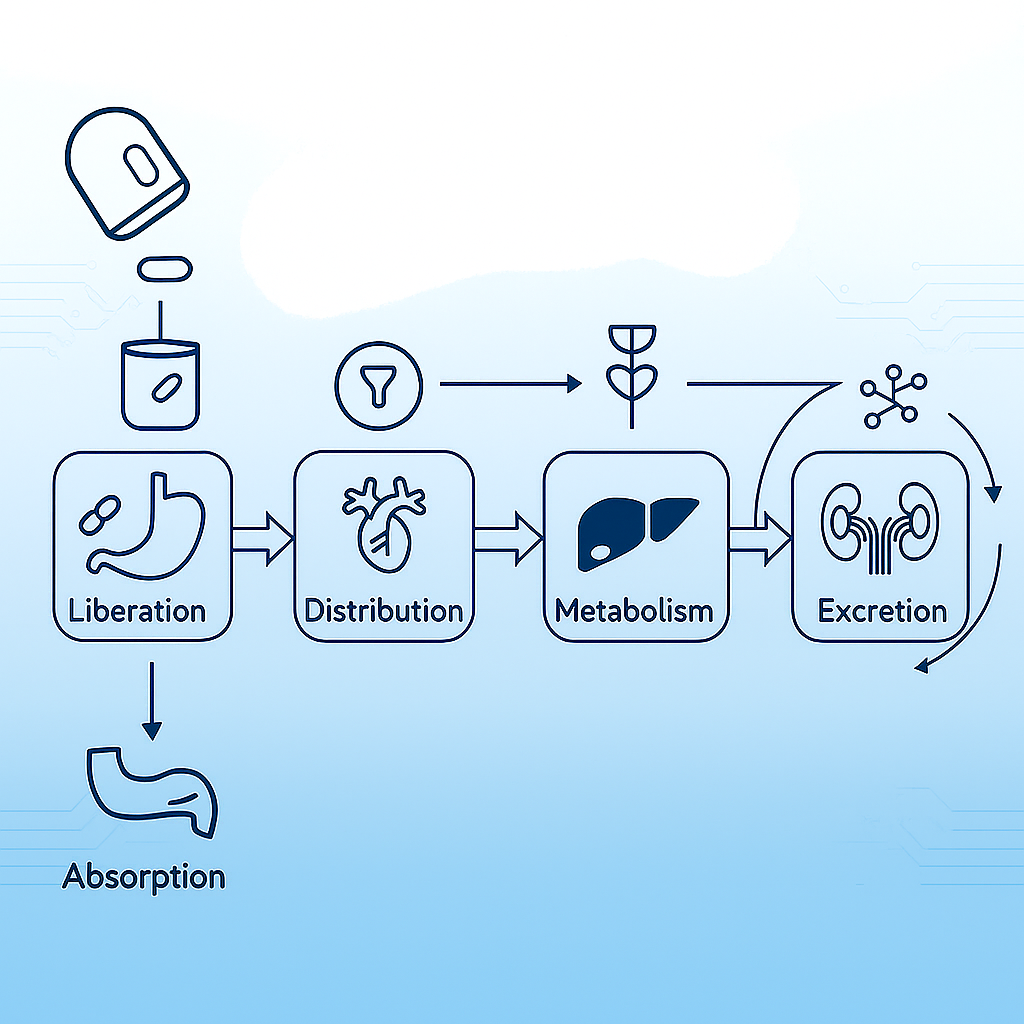
Pharmacokinetics covers the entire journey of a drug from the moment it enters your system until it's gone. This process is often summarized by the acronym ADME:
Absorption: How the drug gets into the bloodstream. Distribution: How the drug is carried to different parts of the body. Metabolism: How the body chemically modifies the drug, often to inactivate it. Excretion: How the body gets rid of the drug.
Pharmacodynamics
noun
The study of the biochemical and physiological effects of drugs on the body and the mechanisms of their action.
Once a drug reaches its destination, pharmacodynamics takes over. This is where the drug gets to work. It involves how the drug interacts with specific targets in the body to produce its intended effect, whether that's relieving pain, lowering blood pressure, or fighting an infection.
How Drugs Work
Most drugs work by interacting with specific molecules in the body, usually proteins like receptors, enzymes, or ion channels. You can think of this interaction like a key fitting into a lock.
A receptor is like a lock on the surface of a cell. When the right molecule, or 'key,' comes along and binds to it, it triggers a specific response inside the cell. Drugs are often designed to be keys that either turn the lock (agonists) or block the lock (antagonists).
- Agonists are drugs that bind to a receptor and activate it, producing a biological response. They mimic the action of the body's natural signaling molecules.
- Antagonists are drugs that bind to a receptor but do not activate it. Instead, they block the receptor, preventing the body's natural molecules from binding and producing a response.
By acting as agonists or antagonists, drugs can increase or decrease specific cellular activities. This targeted approach is the foundation of modern medicine, allowing us to precisely influence biological processes to treat disease.
Ready to check your understanding?
Which statement best describes the difference between pharmacokinetics and pharmacodynamics?
The acronym ADME, used to describe the processes of pharmacokinetics, stands for Absorption, Distribution, _______, and Excretion.
Understanding these basic principles is the first step. With this foundation, we can begin to explore how specific classes of drugs work to treat various conditions.