Peptides Explained
Peptide Basics
The Building Blocks of Life
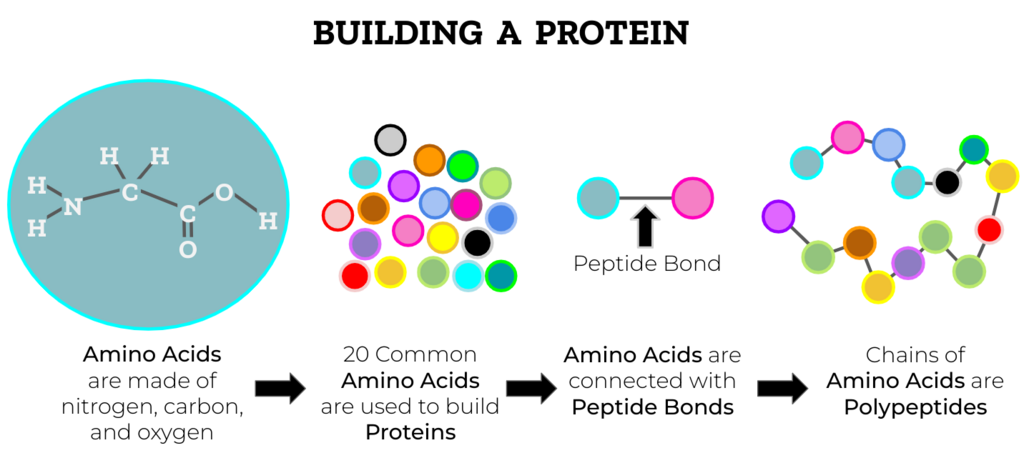
Imagine a set of beads. Each bead is a small molecule called an amino acid. When you string these beads together, you create a chain. In biology, these short chains are called peptides.
Peptides are fundamental to life, playing countless roles in the body. They are made of amino acids linked end-to-end, just like a necklace. The sequence and type of amino acids determine the peptide's unique properties and function.
A peptide is simply a short chain of amino acids. If the chain gets very long, it's called a polypeptide or a protein.
What's the difference between a peptide and a protein? The main distinction is size. Peptides are generally considered to have fewer than 50 amino acids. Proteins are much larger, consisting of one or more long polypeptide chains, often folded into complex three-dimensional shapes. Think of a peptide as a short sentence and a protein as a full-length novel. Both use the same alphabet of 20 common amino acids, but their length and complexity create vastly different stories.
Forging the Peptide Bond
Amino acids don't just stick together randomly. They are joined by a specific type of covalent bond called a peptide bond. This bond forms in a chemical reaction known as dehydration synthesis, or a condensation reaction, because a molecule of water is removed in the process.
Every amino acid has two key functional groups: a carboxyl group (-COOH) on one end and an amino group (-NH₂) on the other. The carboxyl group of one amino acid reacts with the amino group of another. The result is a strong link and the release of one water molecule.
This process can repeat, adding more amino acids to the chain. No matter how long the chain gets, it will always have a free amino group at one end (the N-terminus) and a free carboxyl group at the other (the C-terminus). This directionality is crucial for how peptides and proteins function.
Types of Peptides
Peptides are a diverse group, and we can classify them in several ways. The simplest way is by length. A chain of two amino acids is a dipeptide, three is a tripeptide, and so on. Any chain of more than a few is often called a polypeptide.
We can also classify them by how they are made.
Ribosomal peptides are synthesized in cells through the process of translation. The genetic code in messenger RNA (mRNA) provides the blueprint, and cellular machinery called ribosomes read this blueprint to assemble the amino acid chain. Most peptides and proteins in your body are made this way.
Non-ribosomal peptides are a special class. They are assembled by large enzyme complexes without using an mRNA template. This method allows for a wider variety of building blocks, including non-standard amino acids. These peptides are most common in microorganisms like bacteria and fungi and include many important antibiotics and toxins.
Finally, we can categorize peptides by their function, such as neuropeptides that work in the brain or antimicrobial peptides that fight off pathogens. Their structure dictates their role.
Now let's review these core concepts.
Ready to check your understanding?
What is the fundamental building block of a peptide?
The primary distinction between a peptide and a protein is...
Understanding these fundamentals—what peptides are, how they form, and how they're classified—is the first step to appreciating their incredible diversity and importance in the biological world.