Pedigree Analysis Genetic Inheritance
Introduction to Pedigree Analysis
Mapping Family Traits
Think of a family tree. It shows who’s related to whom, tracing your lineage back through parents, grandparents, and beyond. Now, imagine that same tree could also show who had freckles, or who was colorblind. That’s essentially what a pedigree is: a special kind of family tree that tracks a specific trait through generations.
Scientists and doctors use pedigrees to see how traits are inherited. By looking at the patterns, they can understand the genetic story of a family. This is especially important for studying genetic conditions. A pedigree chart can help answer questions like, "How likely is it that I'll pass this trait to my children?" It turns a family's history into a visual map that helps predict the future.
The Language of Pedigrees
To read a pedigree, you first need to learn its language. It's a simple set of symbols that are used universally, making it easy for any geneticist to understand. Each shape and line has a specific meaning.
Here's what these symbols mean:
- Circles and Squares: A circle represents a female, and a square represents a male.
- Shading: A shaded symbol (either a circle or square) means that person has the specific trait being studied. An unshaded symbol means they do not. We call individuals with the trait "affected."
- Lines: A horizontal line connecting a square and a circle shows a partnership. A vertical line dropping down from that partnership line leads to their children. Siblings are connected by a horizontal line above them.
Generations are labeled with Roman numerals (I, II, III), starting with the oldest at the top. Individuals within each generation are numbered from left to right with regular numbers (1, 2, 3).
| Symbol | Meaning |
|---|---|
| ☐ | Unaffected Male |
| ◯ | Unaffected Female |
| ⬛ | Affected Male |
| ⚫ | Affected Female |
| ◇ | Sex Unknown |
| — | Partnership/Mating |
| │ | Line of Descent |
Reading a Family Story
Let's look at a real-world example. This pedigree tracks an inherited condition across four generations. By applying the rules we just learned, you can read the story of this family.
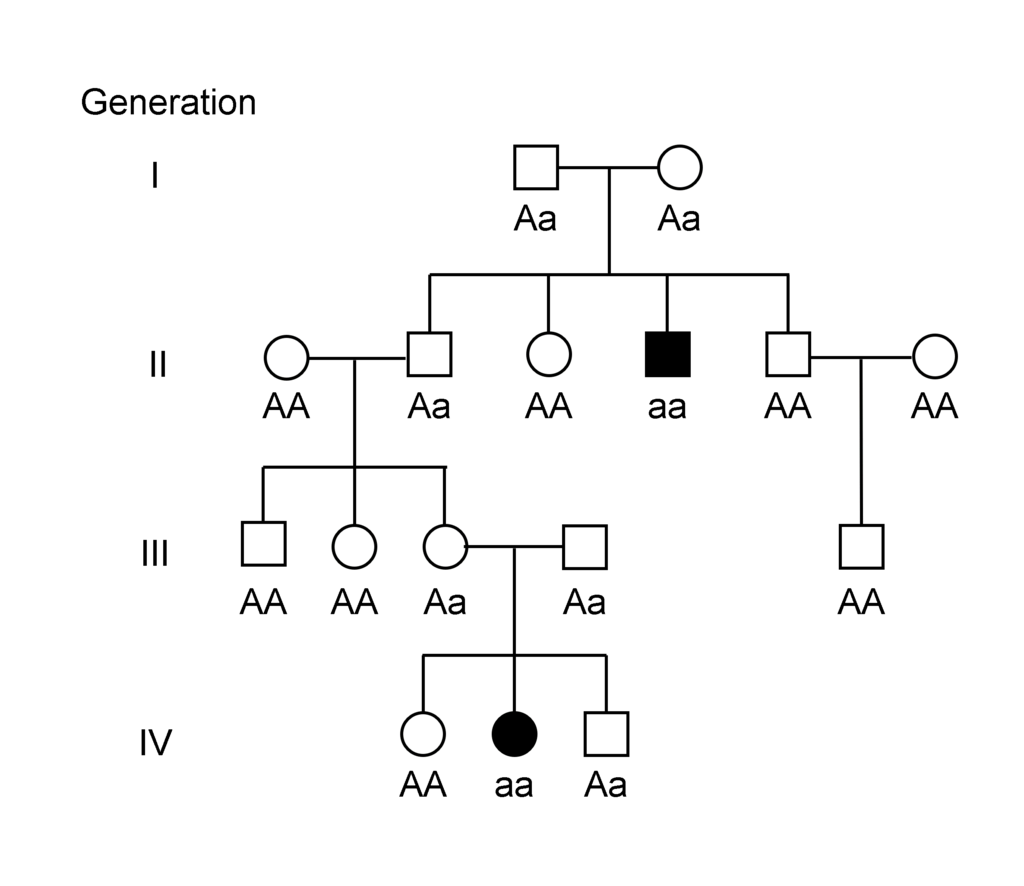
Looking at the chart, you can start asking questions. In generation I, who has the trait? How many children did they have in generation II? Notice how individual II-3 and II-4 are unaffected, but they have an affected child in generation III. Pedigrees make it easy to spot these patterns at a glance.
This kind of analysis is the foundation of genetic counseling. When a couple is concerned about a genetic condition that runs in their family, a counselor will often start by drawing a pedigree. It helps visualize the risk and provides a starting point for discussion about genetic testing and family planning. It’s a powerful tool that translates family history into actionable health information.