Pedaling Through Time The Global History of the Bicycle
Velocipede Engineering
The Direct-Drive Dilemma
The first true bicycle, the 1817 Draisienne, was a simple affair. It was a wooden frame with two wheels, but no pedals. Propulsion was purely by foot power, with the rider pushing off the ground. While a novelty, its core limitation was obvious: it was only as fast as a person could run. The next great leap required a way to transfer power to the wheels without touching the ground.
The solution, arriving in the 1860s, was the velocipede, or ''. These machines introduced pedals attached directly to the hub of the front wheel. This was a direct-drive system. For every single rotation of the pedals, the front wheel made one full rotation. There were no gears, no chains, just a simple crank mechanism. This design had a fundamental and inescapable link between wheel size and speed.
The physics are straightforward. The distance covered in one pedal revolution is equal to the circumference of the wheel. To go faster, you had two options: pedal faster or increase the wheel's circumference. Since human pedaling speed has a natural limit, the only practical way to increase speed was to make the front wheel bigger. Much bigger.
The Penny Farthing
This pursuit of speed led directly to the iconic, and dangerous, 'Ordinary' bicycle, better known as the Penny Farthing. The massive front wheel, sometimes over 5 feet in diameter, allowed for higher speeds but created a host of engineering and safety problems. The rider sat perched precariously high above the center of gravity, making falls common and severe. A sudden stop could send the rider flying headfirst over the handlebars, a dreaded maneuver known as 'taking a header'.
The Penny Farthing was the logical, yet extreme, conclusion of the direct-drive system. Its design was dictated entirely by the physics of speed without gears.
The materials also evolved. The wooden frames of the Draisienne gave way to stronger, yet heavier, wrought iron. This shift allowed for the spindly, high-stress frames of the Penny Farthing but contributed to their bone-rattling ride. The transition to steel tubing, which offered a better strength-to-weight ratio, was still on the horizon.
Steering and Stability
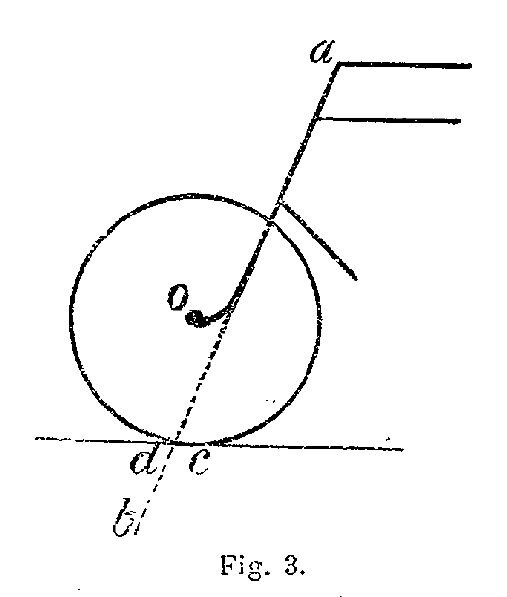
Early bicycle steering was another challenge. The Michaux Velocipede of 1867 featured a steering axis that was nearly vertical. This geometry made the steering extremely responsive, almost twitchy. While it allowed for sharp turns at low speeds, it was unstable at higher speeds, contributing to the machine's difficulty to master. A slight nudge to the handlebars could result in a sharp, unintended turn.
This lack of stability is a core concept in vehicle dynamics known as mechanical trail. Early velocipedes had very little trail, meaning the wheel's contact patch with the ground was almost directly below the steering axis. This configuration makes a vehicle highly maneuverable but difficult to keep in a straight line. It's the mechanical equivalent of trying to push a shopping cart backward. Later designs would rake the front fork forward, increasing the trail and creating a self-centering effect that dramatically improved stability, a principle still used in every bicycle and motorcycle today. Without this geometric refinement and the later invention of the chain drive, the bicycle would have remained a [{
Ready to test your knowledge on the engineering that shaped the first bicycles?
What was the fundamental limitation of the 1817 Draisienne that later designs sought to overcome?
On a velocipede with a direct-drive system, what is the direct relationship between pedaling and the front wheel?
The constraints of the direct-drive system were a powerful catalyst for innovation. The unwieldy but fast Penny Farthing pushed engineers to find a better way to achieve speed, ultimately leading to the chain drive and the modern bicycle.