Pathology and Dynamics of Neoplasms
Molecular Transformation Mechanisms
The Cell's Control System
Normal cells operate under a strict set of rules. They divide, differentiate, and die in a highly regulated process that maintains the body's delicate balance. This cellular society is governed by two key types of genes: proto-oncogenes and tumor suppressor genes. Think of them as the gas pedal and the brakes of a car.
Proto-oncogenes are the gas pedal. They encode proteins that push the cell forward through the growth and division cycle. When a signal comes in—say, from a growth factor—these genes are switched on, telling the cell it's time to divide. Tumor suppressor genes are the brakes. They produce proteins that halt the cell cycle, giving the cell time to repair DNA damage or, if the damage is too severe, initiating programmed cell death.
In a healthy cell, the gas and brakes work in concert, ensuring controlled, orderly growth.
When the Gas Pedal Sticks
Cellular transformation begins when these controls fail. A mutation can convert a proto-oncogene into an oncogene, which is like the gas pedal getting stuck to the floor. The cell receives a constant, unrelenting signal to divide, whether it's appropriate or not.
This can happen in several ways. A point mutation might alter the gene's protein product, making it permanently active. Gene amplification can create hundreds of copies of a proto-oncogene, leading to a massive overproduction of its growth-promoting protein. A chromosomal translocation can move a proto-oncogene to a new location where it falls under the control of a different, highly active promoter.
One of the most commonly mutated proto-oncogenes is Ras, a family of genes involved in transmitting signals from the cell surface to the nucleus. When Ras is mutated, it becomes locked in its "on" state, continuously telling the cell to grow and divide. This often leads to the constitutive activation of signaling pathways like the MAPK/ERK pathway, a critical chain of proteins that relays growth signals.
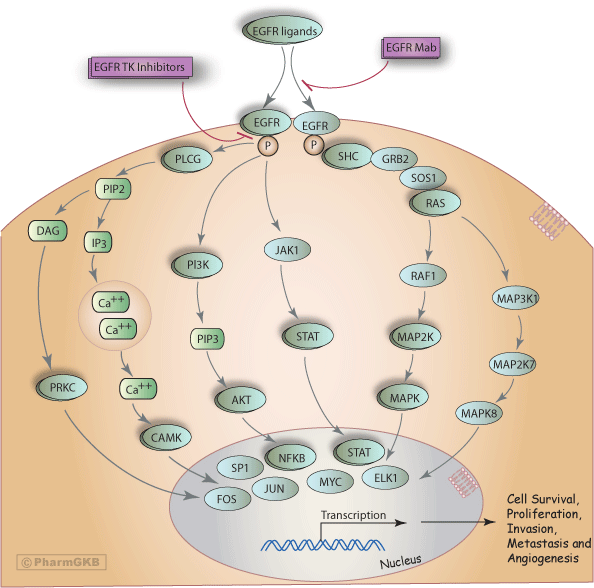
The result is a cell that proliferates uncontrollably, ignoring the normal checks and balances.
Failure of the Brakes
Just as a stuck gas pedal causes problems, so do faulty brakes. Tumor suppressor genes are responsible for halting the cell cycle at checkpoints to allow for DNA repair. If these genes are inactivated, the cell can barrel through these checkpoints, accumulating mutations at a dangerous rate.
The two most famous tumor suppressors are TP53 and RB1. The TP53 gene produces a protein called p53, often dubbed the "guardian of the genome." When DNA damage is detected, p53 can stop the cell cycle and activate repair enzymes. If the damage is beyond repair, p53 triggers apoptosis, or programmed cell death, forcing the cell to sacrifice itself for the good of the organism. The RB1 gene produces the retinoblastoma protein (pRb), which acts as a major gatekeeper for the cell cycle, preventing cells from progressing from the G1 phase to the S phase without the proper signals.
Unlike oncogenes, where a mutation in one copy of the gene is often enough to cause trouble (a dominant mutation), tumor suppressor genes typically require both copies to be inactivated. This concept is known as the "two-hit hypothesis."
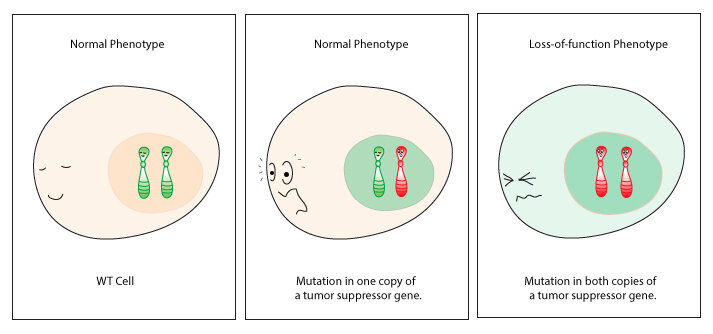
When both TP53 alleles are lost, the cell loses its primary mechanism for dealing with DNA damage. When both RB1 alleles are gone, a critical brake on cell division is removed. Together, these failures pave the way for genomic instability and uncontrolled growth.
The change from a normal cell into a cancerous cell happens over time, as defects in the cell’s DNA maintenance system build up.
Becoming Self-Sufficient
Normal cells need external cues to grow. Cancer cells learn to bypass this requirement. They achieve this through several strategies.
One is autocrine signaling, where a cell produces growth factors that it also has the receptors for. It essentially tells itself to divide, creating a self-sustaining loop of proliferation. Another is paracrine signaling, where cancer cells can induce surrounding normal cells (like stromal cells) to produce growth factors for them.
Furthermore, cancer cells must evade apoptosis. With a dysfunctional p53, they've already lost a key trigger for cell death. They can also upregulate anti-apoptotic proteins or downregulate pro-apoptotic ones, effectively disabling their own self-destruct mechanism. This combination of self-supplied growth signals and a refusal to die is a hallmark of neoplastic transformation.
Now, let's test your understanding of these molecular mechanisms.
In the analogy of a car's control system, what do proto-oncogenes and tumor suppressor genes represent, respectively?
Which of the following mechanisms is NOT a way a proto-oncogene can be converted into an oncogene?
The transformation from a healthy cell to a cancer cell is not a single event but a cascade of failures. By understanding how the genetic gas pedals, brakes, and self-destruct sequences are broken, we gain insight into the fundamental nature of cancer.