Particle Physics and Standard Model
Subatomic Taxonomy
The Particle Zoo
You already know that matter is made of atoms, which are in turn made of protons, neutrons, and electrons. But the story doesn't stop there. Physicists have discovered that protons and neutrons aren't fundamental particles. They are composed of even smaller, more elementary pieces. The theory that organizes this subatomic world is called the Standard Model, and it acts like a periodic table for the most basic building blocks of the universe.
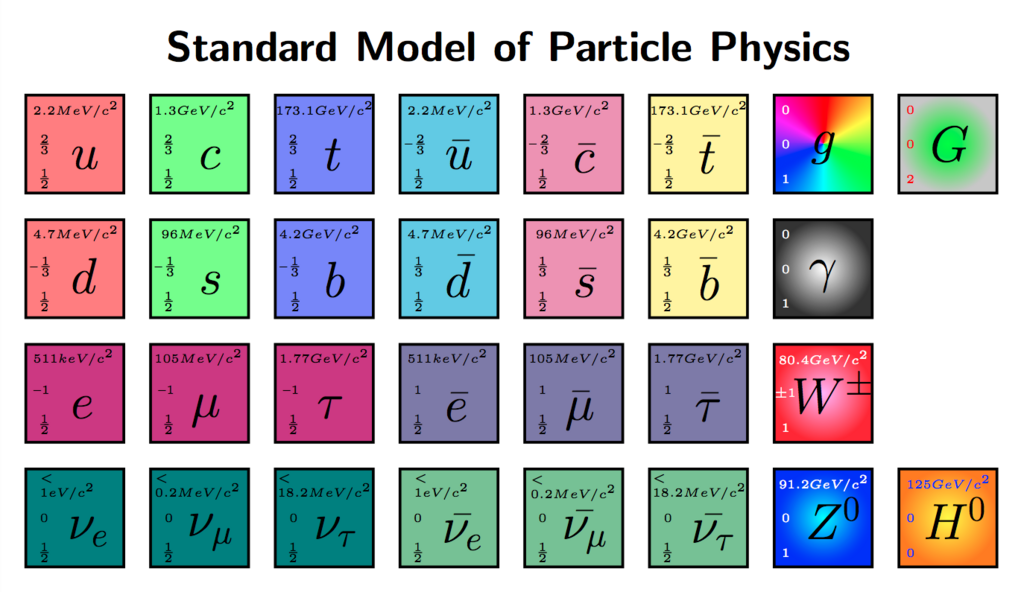
All matter we can see and touch is built from two families of fundamental particles: quarks and leptons. These twelve particles, arranged in three generations, are the true indivisible units of matter.
Quarks: The Social Particles
Quarks are one of the two main classes of matter particles. They come in six types, or "flavors": up, down, charm, strange, top, and bottom. What makes them particularly strange is their electrical charge. Unlike the integer charges of protons (+1) and electrons (-1), quarks have fractional charges.
| Flavor | Symbol | Charge |
|---|---|---|
| Up | u | +2/3 |
| Down | d | -1/3 |
| Charm | c | +2/3 |
| Strange | s | -1/3 |
| Top | t | +2/3 |
| Bottom | b | -1/3 |
Quarks have another property called color charge, which has nothing to do with visible color. It's a name for the type of charge that governs the strong nuclear force, the most powerful force in nature. There are three color charges: red, green, and blue. Just as mixing red, green, and blue light produces white light, quarks must combine in ways that make them "color-neutral."
This rule leads to a phenomenon called color confinement. A single quark cannot be found in isolation. They are always bound together in groups to form composite particles called hadrons.
There are two main types of hadrons. Baryons, like protons and neutrons, are made of three quarks. Protons consist of two up quarks and one down quark (uud), while neutrons have one up quark and two down quarks (udd). The other type, , are more unstable and consist of one quark and one antiquark. Antiquarks are the antimatter counterparts to quarks, possessing the same mass but opposite charge and color charge.
Leptons: The Lone Wolves
The second family of matter particles is the leptons. The most famous lepton is the electron. Unlike quarks, leptons are not affected by the strong nuclear force. They can and do exist on their own.
Like quarks, leptons come in three generations. Each generation consists of a charged lepton and a neutral partner called a neutrino. The charged leptons are the electron, the muon, and the tau. The muon and the tau are essentially heavier, unstable copies of the electron. They quickly decay into lighter particles, including electrons.
Each charged lepton has an associated neutrino: the electron neutrino, the muon neutrino, and the tau neutrino. Neutrinos have no electric charge and have a very, very small mass. Because they only interact through the weak nuclear force and gravity, they can pass through entire planets without hitting anything. Billions of neutrinos from the Sun are streaming through your body every second.
| Generation | Charged Lepton | Charge | Neutrino |
|---|---|---|---|
| 1st | Electron () | -1 | Electron Neutrino () |
| 2nd | Muon () | -1 | Muon Neutrino () |
| 3rd | Tau () | -1 | Tau Neutrino () |
These 12 particles, six quarks and six leptons, along with their antimatter counterparts, form the foundation of all the matter we observe in the universe. In the next section, we'll explore the forces that govern their interactions.