Parent Document Retrieval vs Regular Chunking in RAG
Introduction to Retrieval-Augmented Generation
Giving Models an Open Book
Large Language Models, or LLMs, are powerful. They can write essays, summarize articles, and even generate code. But they have a fundamental limitation: their knowledge is frozen in time. An LLM only knows about the world up to the point its training data ended. It can't look up current events or access private, specialized information. This can lead to outdated or incorrect answers.
Even worse, LLMs can sometimes confidently invent facts, a phenomenon known as hallucination. They create plausible-sounding but entirely false information because they lack a direct connection to a factual knowledge source. How do we fix this?
We give the model an open book to consult before it answers. This is the core idea behind Retrieval-Augmented Generation, or RAG.
RAG is a technique that connects an LLM to an external, up-to-date knowledge base. Instead of relying solely on its internal, pre-trained knowledge, the model first retrieves relevant information from this external source and then uses that information to generate a response. This process grounds the model's answer in verifiable facts, making it more accurate, trustworthy, and relevant.
Retrieval-Augmented Generation (RAG) is an AI framework that connects a language model to an external knowledge repository, allowing the model to fetch and include relevant information when generating an answer.
The RAG Process
A RAG system works in two main phases: retrieval and generation.
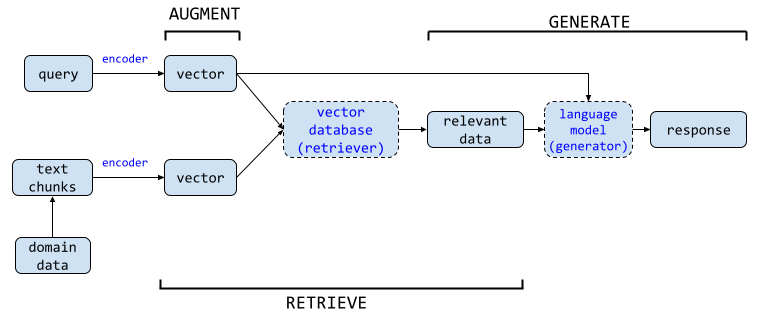
First, the retrieval phase. When you ask a question (the query), the system doesn't immediately send it to the LLM. Instead, it uses your query to search a knowledge base, which could be a collection of company documents, a database of scientific papers, or any other set of specialized information. This knowledge base is often stored in a special format, like a vector database, which makes searching for relevant concepts fast and efficient. The retriever finds the snippets of text or data most relevant to your query.
Next comes the generation phase. The original query and the relevant information retrieved from the knowledge base are combined into a new, more detailed prompt. This augmented prompt is then sent to the LLM. With this extra context, the model can generate a much more accurate and specific answer, directly based on the provided facts.
Why Use RAG?
Integrating a retrieval system with a generative model offers several key advantages.
-
Improved Accuracy: By grounding responses in an external knowledge source, RAG significantly reduces the risk of factual errors and hallucinations. The model is guided by real data, not just its internal patterns.
-
Access to Current Information: LLMs can be updated with the latest information without the need for costly and time-consuming retraining. You simply update the knowledge base, and the RAG system can immediately start using the new data.
-
Transparency and Trust: Because the model's response is based on specific retrieved documents, RAG systems can often cite their sources. This allows users to verify the information and trust the answers they receive.
-
Domain-Specific Expertise: RAG allows you to build applications that are experts in specific domains. A customer service bot can be connected to a knowledge base of product manuals, or a legal assistant can be linked to a library of case law.
These benefits make RAG a popular choice for building powerful, reliable AI applications.
Ready to check your understanding?
What is the primary problem that Retrieval-Augmented Generation (RAG) is designed to solve?
In a RAG system, what happens during the "retrieval" phase?
By connecting generative models to live information, RAG creates more dynamic and dependable AI systems. It's a key technique for moving beyond the static knowledge of standard LLMs.