Parameters and Vectors Explained
Introduction to Vectors
What Are Vectors?
Some quantities can be described with a single number. If I say I'm 5 miles away, you know the distance, but you don't know where I am. I could be 5 miles north, south, or in any other direction.
To give a complete picture, I need to provide both a distance and a direction, like "I'm 5 miles east of you." This combination of magnitude (size) and direction is a vector.
A vector is an object characterized by both a magnitude (or length) and a direction.
Think of giving someone directions. You don't just say "walk for 10 minutes." You say "walk for 10 minutes down that street." The time is a simple quantity, but the instruction for getting somewhere is a vector.
Scalars vs. Vectors
The simple quantities we mentioned, the ones with only magnitude, are called scalars. Temperature, speed, and mass are all scalars. They're just numbers.
Vectors are different. They always have a direction attached. Velocity is a great example. A car's speed might be 60 mph (a scalar), but its velocity is 60 mph heading north (a vector). A force isn't just a push; it's a push in a specific direction.
| Type | Property | Examples |
|---|---|---|
| Scalar | Magnitude only | Speed, mass, distance, temperature |
| Vector | Magnitude & Direction | Velocity, force, displacement, acceleration |
This distinction is crucial. If two forces push on an object, you can't just add their magnitudes. You have to account for the directions they are pushing. Two people pushing a box with the same force can either move it twice as fast (if they push together) or not at all (if they push from opposite sides).
Drawing and Naming Vectors
We represent vectors visually with arrows. The arrow's length corresponds to the vector's magnitude—a longer arrow means a bigger magnitude. The direction the arrow points shows the vector's direction.
In text, we often denote a vector with an arrow over a letter, like , or by making the letter bold, like v.
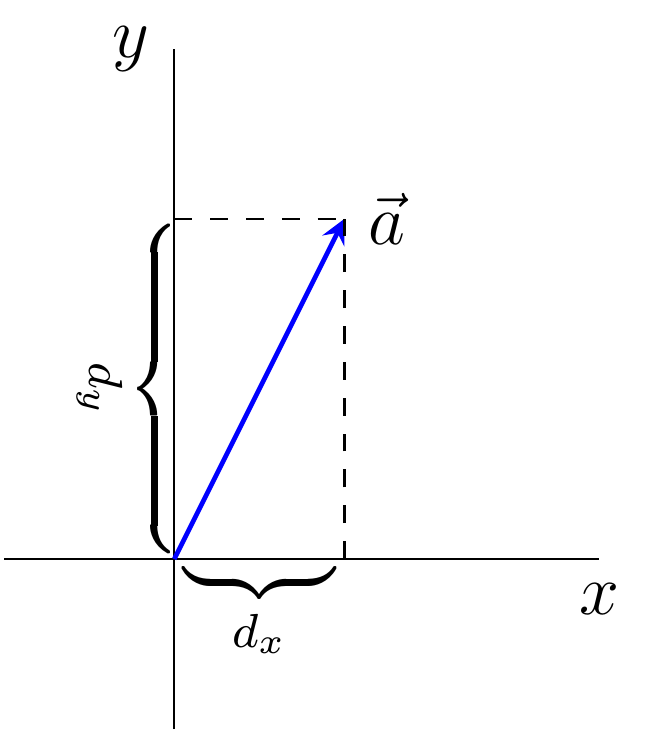
Look at the image above. The arrow starts at the origin (0,0) and points up and to the right. This visual tells us everything we need to know about the vector's magnitude and direction.
Most of the time, we place vectors on a coordinate system. This lets us break them down into parts, which makes them much easier to work with.
Components, Magnitude, and Direction
Breaking a vector down into parts that align with the axes of a coordinate system gives us its components. In a 2D system, a vector has an x-component and a y-component. These tell you how far the vector goes in the horizontal (x) and vertical (y) directions.
We often write a vector as an ordered pair of its components. For a vector , we might write:
Here, is the x-component and is the y-component. This is a very common and useful way to represent a vector.
With the components, we can easily calculate the vector's magnitude. Notice how the vector and its components form a right-angled triangle. We can use the Pythagorean theorem to find the length of the hypotenuse, which is the vector's magnitude. The magnitude of is written as .
What about the direction? The direction is often given as an angle, usually measured counter-clockwise from the positive x-axis. We can find this angle, often called (theta), using trigonometry.
So, by knowing a vector's components, we can figure out its two defining features: its magnitude and its direction. This powerful idea is the foundation for almost everything we do with vectors.