Panpsychism and the Nature of Love
Introduction to Panpsychism
What is Panpsychism?
The universe is full of matter and energy. But what about consciousness? Most people assume it's a special property that only arises in complex biological brains like ours. Panpsychism challenges this idea. It suggests that consciousness, in some very basic form, is everywhere and in everything.
Panpsychism is the view that all things have a mind or a mind-like quality.
This doesn't mean your desk is wondering about the weather. Panpsychists don't argue that inanimate objects have complex thoughts. Instead, they propose that the fundamental stuff of the universe has a mental aspect. Think of it like this: all matter has mass, but only huge collections of matter, like planets, have strong gravity. Similarly, all matter might have a primitive form of experience, but it only becomes complex consciousness in an organized system like a brain.
This basic, universal experience is often called “proto-consciousness.” It's the simple feeling of existence, a raw awareness that's far simpler than human thought or emotion. For a panpsychist, the mind of a rock or an electron is incredibly basic, but it's not nothing.
An Ancient Idea
This concept isn't new. It has roots stretching back to the earliest days of Western philosophy. Ancient Greek thinkers didn't see a sharp divide between the mental and the physical. Thales of Miletus, often called the first philosopher, famously claimed that "all things are full of gods." This is widely seen as an early expression of the idea that the world is alive or has some inner, mind-like nature.
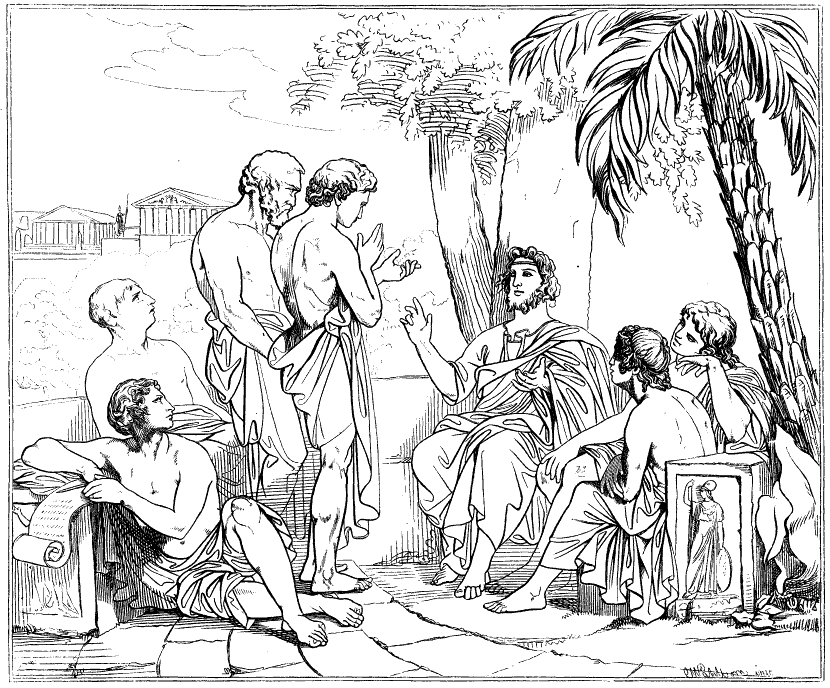
Later, Plato proposed the idea of the anima mundi, or "world-soul." He believed the entire cosmos was a single living creature with its own soul, and that our individual souls were parts of this greater whole.
After fading into the background for centuries, panpsychism saw a revival during the Renaissance and the Enlightenment. Philosophers like Baruch Spinoza and Gottfried Wilhelm Leibniz developed complex systems that treated mind and matter as two sides of the same coin. Leibniz, for instance, argued that the universe is made of fundamental units called “monads,” each of which has a degree of perception.
Later philosophers, like Arthur Schopenhauer, built on these ideas, placing a universal, mind-like "Will" at the core of all reality.
Clearing Up Confusion
Panpsychism is often confused with a few other philosophical positions. While they are related, they describe different ideas about the nature of reality. Understanding the distinctions is key to grasping what makes panpsychism unique.
| Term | Meaning |
|---|---|
| Panpsychism | Consciousness is a fundamental property of all things. Everything has a mind-like quality, however simple. |
| Animism | All objects, places, and creatures possess a distinct spiritual essence or soul. Often associated with religious or spiritual beliefs. |
| Hylozoism | All matter is in some sense alive. It focuses on life as a property of matter, not necessarily consciousness. |
| Pantheism | Reality is identical with divinity. Everything composes an all-encompassing, immanent God. The universe is God. |
So, while animism gives a spirit to a specific river and pantheism sees the entire universe as God, panpsychism makes a more fundamental claim: that the basic ingredients of the universe have an experiential quality. It's less about spirits or divinity and more about the ultimate nature of matter itself.
Ready to check your understanding?
What is the central claim of panpsychism?
The basic, universal experience proposed by panpsychism, far simpler than human thought, is often called __________.
Panpsychism offers a different way to look at our place in the cosmos, suggesting that the divide between our inner world and the outer world might not be as sharp as it seems.