Our Planet Earth
Solar System Formation
From Cloud to Star
Our solar system began as a vast, swirling cloud of gas and dust, a nebula left over from the Big Bang and enriched by previous generations of stars. For millions of years, this cloud drifted through space. Then, about 4.6 billion years ago, something disturbed it—perhaps the shockwave from a nearby exploding star, a supernova.
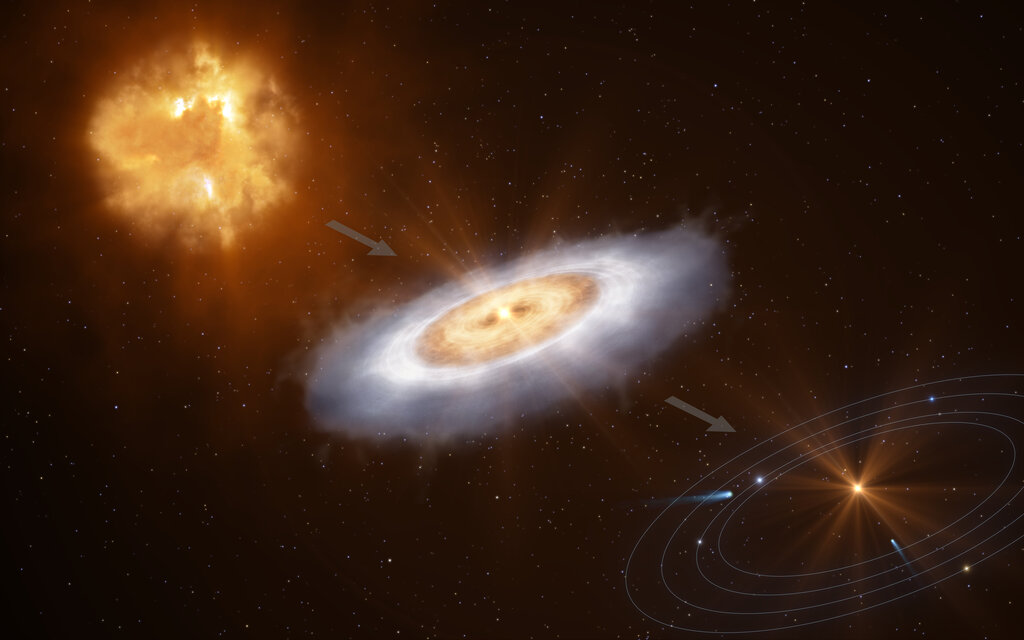
This disturbance caused the cloud to collapse under its own gravity. As it collapsed, it began to spin. Just like a figure skater pulling their arms in to spin faster, the cloud spun more rapidly as it contracted, a principle known as the conservation of angular momentum. This rapid spinning caused the cloud to flatten into a disk, much like a spinning ball of pizza dough.
A Spinning Disk of Dust
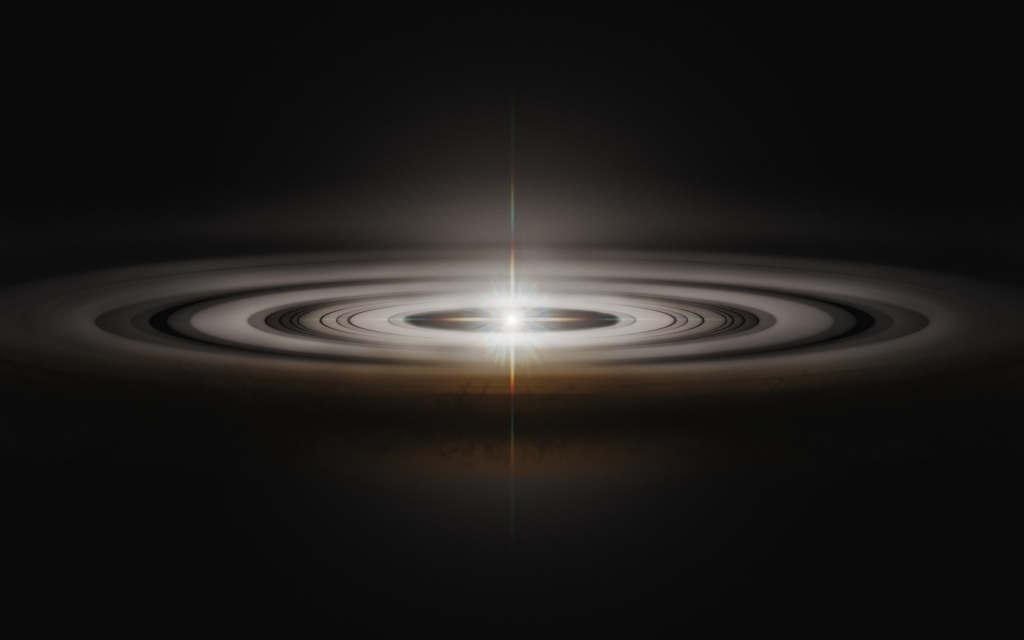
This flattened, spinning disc is called a protoplanetary disk. At its center, material packed together more and more densely. The pressure and temperature skyrocketed, eventually becoming so extreme that hydrogen atoms began to fuse together, releasing an enormous amount of energy. Our Sun was born, and it began to shine.
The disk surrounding the new Sun wasn't uniform. It was incredibly hot near the center and grew progressively colder further out. This temperature difference created a crucial dividing line called the frost line. Inside the frost line, it was too warm for volatile compounds like water, methane, and ammonia to freeze into ice. Only materials with high melting points, like rock and metal, could exist as solids. Outside the frost line, it was cold enough for those compounds to form solid ice particles.
Building the Planets
The tiny particles of dust and rock within the disk began to stick together through a process called accretion. At first, static electricity pulled tiny grains together, forming fluffy clumps. Over time, these clumps collided and merged, growing from pebbles into boulder-sized objects, and then into bodies hundreds of miles across called planetesimals.
Accretion
noun
The process of growth or increase, typically by the gradual accumulation of additional layers or matter.
These planetesimals were the building blocks of planets. Through countless collisions over millions of years, they combined to form larger and larger bodies known as protoplanets. The gravitational pull of the largest protoplanets grew stronger, allowing them to attract more material and sweep their orbits clean.
The location in the disk determined what a planet would become.
Inside the frost line, where only rock and metal were solid, the protoplanets that formed were smaller and denser. There simply wasn't as much solid material available. These became the terrestrial, or rocky, planets: Mercury, Venus, Earth, and Mars.
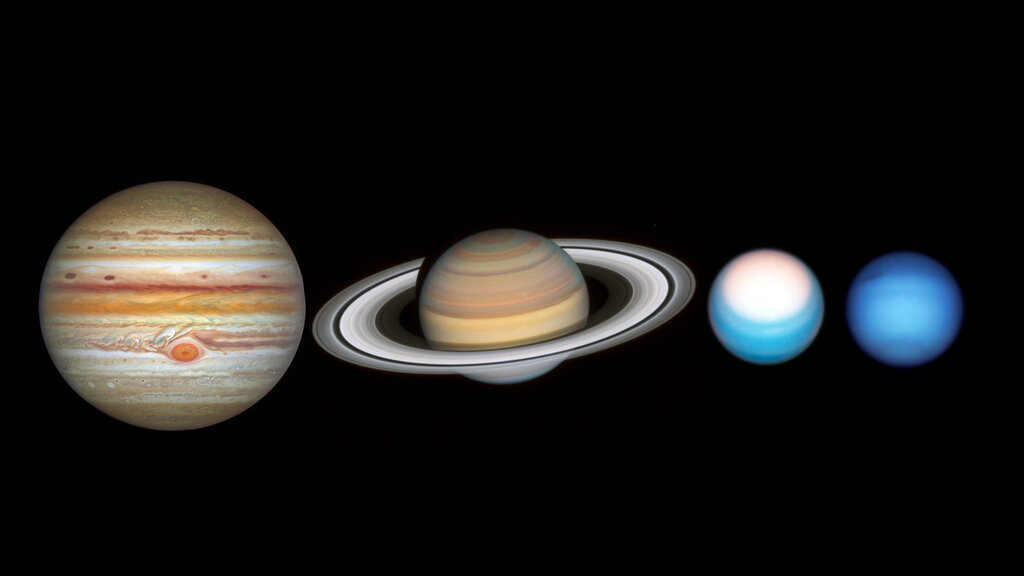
Outside the frost line, the situation was different. Protoplanets could accumulate not only rock and metal but also vast amounts of ice. Because ice was much more abundant, these bodies grew much larger, creating massive solid cores. Their gravity became so powerful that they could pull in and hold onto the light gases, hydrogen and helium, from the surrounding nebula. This is how the gas giants, Jupiter and Saturn, and the ice giants, Uranus and Neptune, were formed.
Eventually, the young Sun's powerful solar wind blew away most of the remaining gas and dust in the disk, ending the main phase of planet formation. What was left was the solar system we know today: a star, a handful of planets, and countless smaller objects, all born from the same cosmic cloud.
Ready to test your knowledge on how our cosmic neighborhood came to be?
What is the name for the flattened, spinning disc of gas and dust from which the Sun and planets formed?
What was the significance of the 'frost line' in the early solar system?