Osmosis Solutions Explained
Introduction to Osmosis
The Silent Dance of Water
Life happens in water. Every cell in your body, from a brain cell to a skin cell, is essentially a tiny bag of water filled with salts, proteins, and other molecules. But this bag isn't sealed shut. It's surrounded by a special barrier called a cell membrane, which acts like a selective gatekeeper.
This gatekeeper is picky. It lets some things pass through easily while blocking others. Tiny molecules like water can slip through, but larger ones like sugar or salt have a much harder time. This property of being selectively
Permeable
adjective
Allowing certain liquids or gases to pass through it.
is the key to understanding one of the most fundamental processes in biology: osmosis.
Osmosis
noun
The movement of water molecules through a selectively permeable membrane from a region of higher water concentration to a region of lower water concentration.
Why Water Moves
Imagine a room divided by a wall with a small cat-door. On one side of the room, you have ten cats and five dogs. On the other side, you have two cats and fifteen dogs. The dogs are too big to fit through the cat-door, but the cats can pass through freely. What happens?
Cats will naturally wander back and forth. But since there are so many more cats on the first side, it's more likely that a cat from that side will wander through the door than one from the other side. Over time, the cats will spread themselves out more evenly between the two rooms. This isn't because they're trying to be fair; it's just a matter of probability. There's a net movement of cats from the crowded side to the less crowded side.
Osmosis works the same way, but with water molecules instead of cats and dissolved substances (like salt or sugar) instead of dogs. Water molecules are always in motion, bouncing around and bumping into each other. When there's a selectively permeable membrane, the water molecules can cross, but the larger solute molecules cannot.
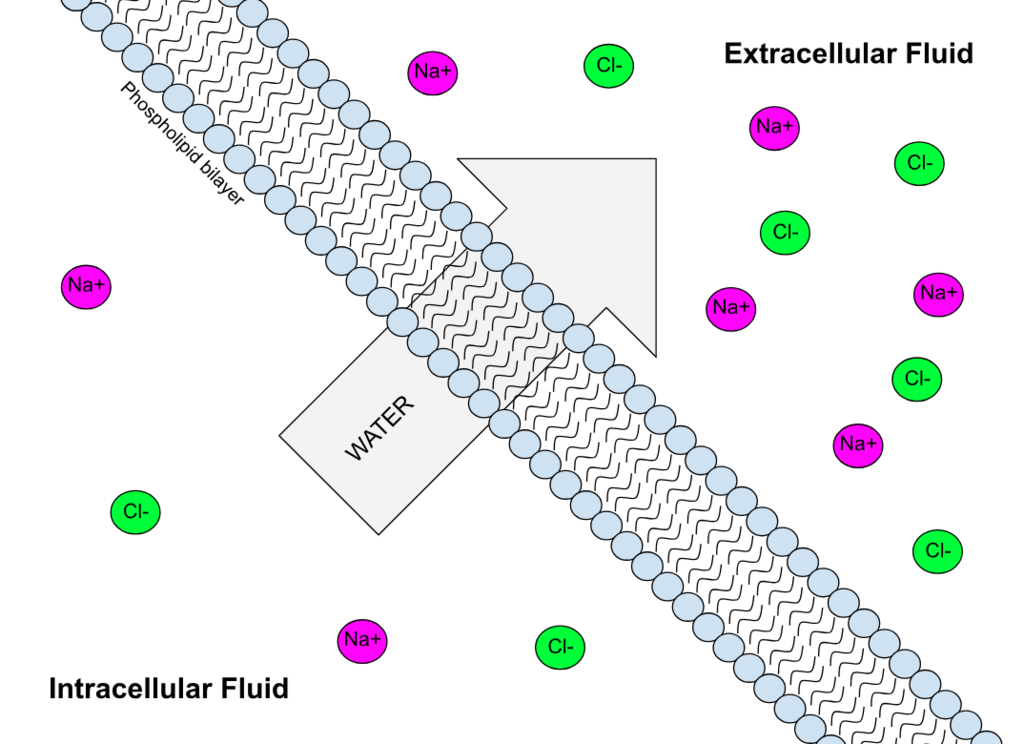
If you have a solution with a lot of water and not much salt on one side of the membrane, and a solution with less water and a lot of salt on the other, the water molecules will move. They will move from the area where they are more concentrated (the less salty side) to the area where they are less concentrated (the more salty side). This passive movement continues until the concentration of water is roughly equal on both sides.
Water moves to dilute. It flows from an area of lower solute concentration to an area of higher solute concentration, effectively trying to even things out.
Crucial for Life
This simple movement of water is vital for countless biological functions. It's how plant roots absorb water from the soil. It's how our kidneys filter waste from our blood. And it's how every cell in our body maintains the delicate balance of water and solutes needed to stay alive, a state known as homeostasis.
Without osmosis, cells couldn't regulate their internal environment. They would either swell up and burst from taking in too much water or shrivel and die from losing too much. Understanding this process is the first step to seeing how cells manage to survive in a constantly changing world.
Ready to check your understanding?
What is the primary role of a cell membrane in the process of osmosis?
Osmosis is the net movement of water from an area of ______ solute concentration to an area of ______ solute concentration.