Origins of Artificial Intelligence
Logic and Computation
From Reason to Rules
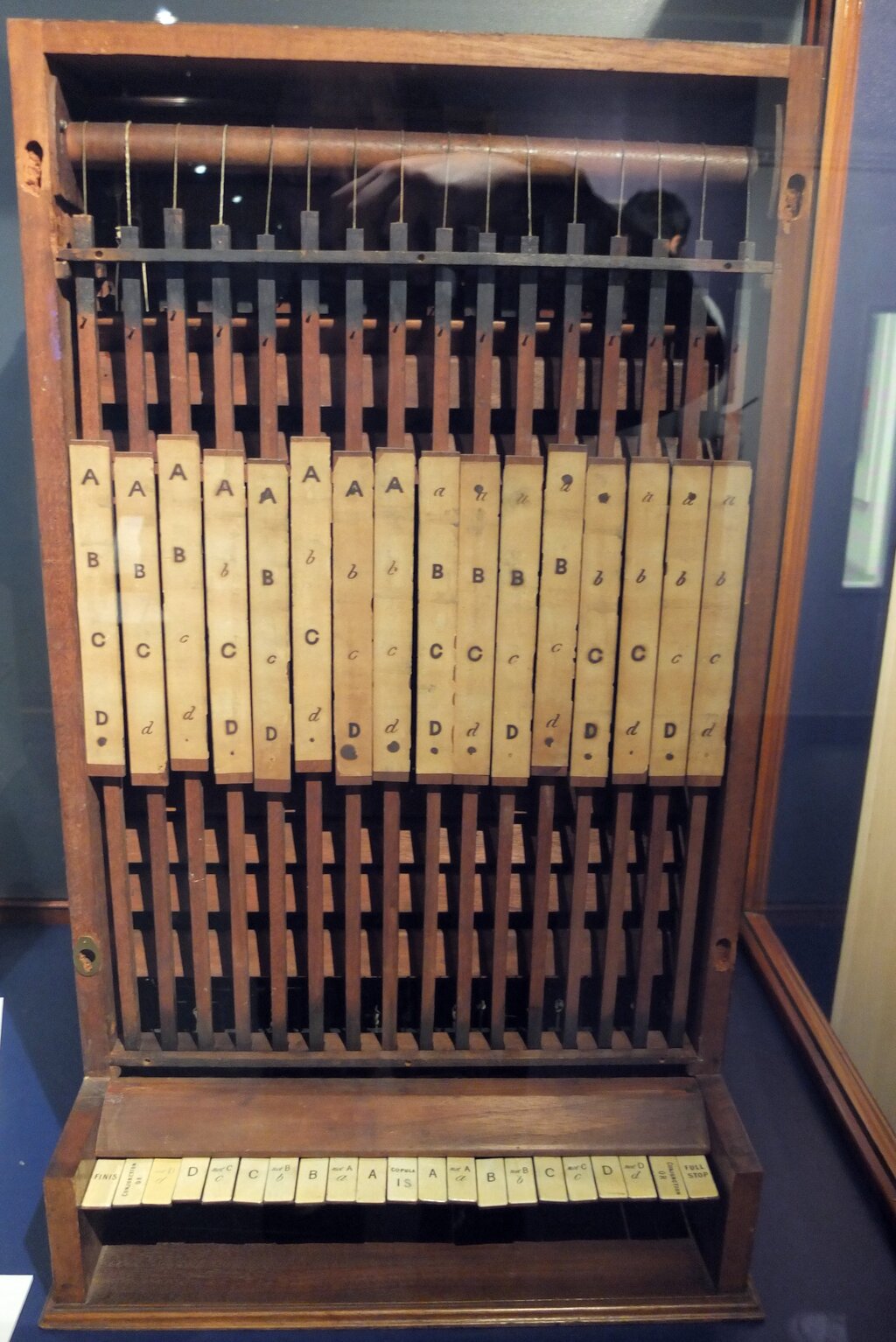
The quest to create artificial intelligence didn't start with silicon chips, but with a philosophical dream: to map the landscape of human thought. In the 17th century, the polymath Gottfried Wilhelm Leibniz envisioned a universal language of reasoning he called the calculus ratiocinator — a system where arguments could be settled by calculation. The idea was simple but revolutionary: if thoughts could be represented by symbols, and the rules of logic could be applied to them, then reasoning itself could be mechanized.
Leibniz imagined a future where two philosophers, instead of arguing, would simply say, "Let us calculate."
This dream remained dormant for nearly two centuries until George Boole provided the mathematical toolkit. In his 1854 book The Laws of Thought, Boole developed an algebraic system for logic. Statements could be reduced to variables like and , and logical operations like AND, OR, and NOT could be manipulated just like numbers. For the first time, logic had a formal, symbolic language. This Boolean algebra laid the groundwork for designing circuits and, eventually, computers that could perform logical operations.
The Limits of Logic
By the early 20th century, mathematicians were brimming with confidence. David Hilbert proposed an ambitious research project known as Hilbert's program, which aimed to put all of mathematics on a single, solid foundation. The goal was to create a formal system that was complete (all true statements could be proven) and consistent (no contradictions could be derived). If successful, this would mean any mathematical problem could, in principle, be solved by the mechanical application of rules.
This dream was shattered in 1931. A young logician named Kurt Gödel published his incompleteness theorems, which dealt a devastating blow to Hilbert's program. Gödel proved that in any consistent formal system powerful enough to describe basic arithmetic, there will always be true statements that cannot be proven within that system. In essence, he used logic to show the inherent limits of logic itself.
This wasn't a dead end, however. It was a crucial clarification. It shifted the question from "Can we prove everything?" to "What are the limits of what can be computed?" This new question would be taken up by a new generation of thinkers.
The Universal Machine
Building on Gödel's work, a British mathematician named Alan Turing wanted to make the idea of a "mechanical procedure" more concrete. In 1936, he conceived of a theoretical device: the . It was a simple, abstract computer consisting of an infinitely long tape, a head that could read, write, and move along the tape, and a finite set of states or instructions. Despite its simplicity, a Turing machine could simulate the logic of any computer algorithm.
Turing used his model to prove the existence of uncomputable problems. The most famous is the —the problem of determining, from a description of an arbitrary computer program and an input, whether the program will finish running or continue to run forever. Turing proved that no general algorithm can solve this for all possible inputs. It's not that we haven't found the solution yet; he proved that one cannot exist.
Around the same time, American logician Alonzo Church independently developed a different formal system called lambda calculus. It turned out that any problem solvable by a Turing machine was also solvable by lambda calculus, and vice versa. This led to the Church-Turing Thesis, which states that any function that can be intuitively defined as "computable" can be computed by a Turing machine. This thesis forms the bedrock of theoretical computer science, linking the abstract idea of computation to a concrete, albeit theoretical, machine.
From Theory to Practice
The path from theoretical models to physical machines was already being paved. Charles Babbage's 19th-century designs for his Analytical Engine were, in essence, mechanical general-purpose computers. But it was the urgency of World War II that accelerated the transition to electronics.
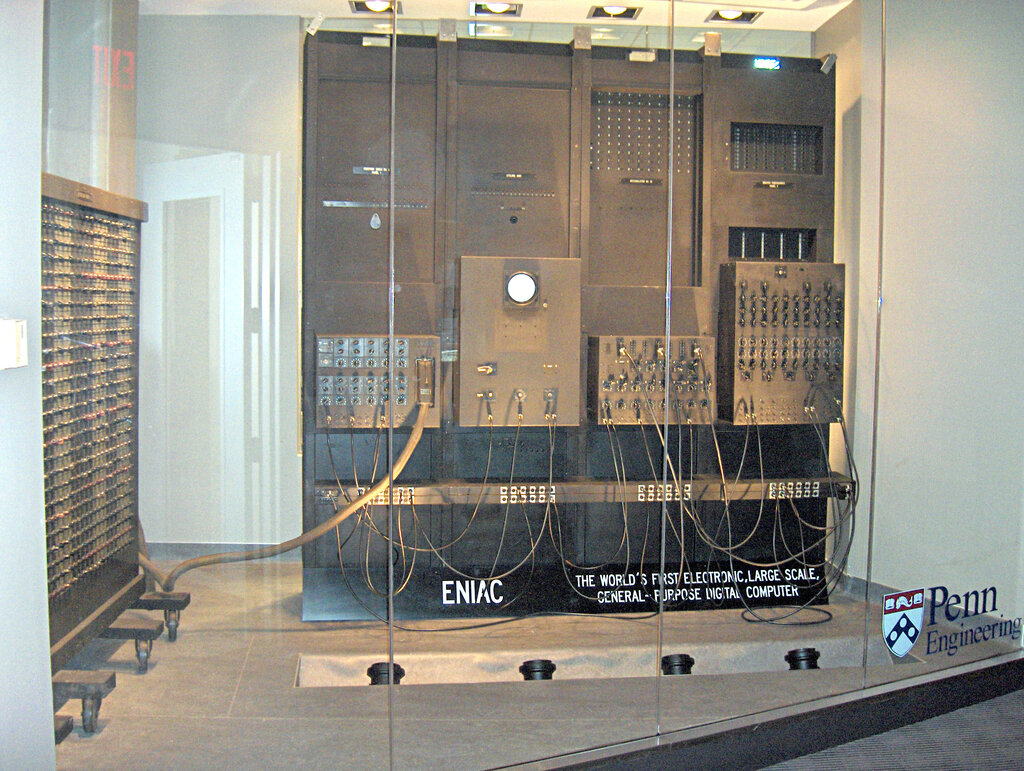
The (Electronic Numerical Integrator and Computer), completed in 1945, was one of the first electronic general-purpose computers. It was a behemoth, filling a room and using thousands of vacuum tubes. While it had to be physically rewired to run different programs, it embodied the core principles of computation. It took inputs, manipulated them according to logical rules derived from Boolean algebra, and produced outputs. The abstract logic of Boole and the theoretical framework of Turing were finally realized in hardware, capable of performing calculations at speeds far beyond human capacity. The age of computation, and with it, the practical pursuit of artificial intelligence, had begun.
The journey from formal logic to the first computers shows that AI is deeply rooted in mathematics and philosophy. The ability of a machine to "think" is fundamentally about its ability to manipulate symbols according to a set of rules.