Organic Mechanisms of Fermentation
Pyruvate Carbonyl Chemistry
Pyruvate's Reactive Center
After glycolysis shatters a glucose molecule, we're left with two molecules of pyruvate. Pyruvate isn't just an endpoint; it's a critical crossroads. Its fate determines the type of fermentation that follows, and its chemical structure is the key to why.
Pyruvate is classified as an alpha-keto acid. This means it has a carboxylic acid group () and, on the carbon atom right next to it (the alpha-carbon), there is a ketone group (). This specific arrangement creates a highly reactive situation. The oxygen atom in the carbonyl group is more electronegative than the carbon, pulling electron density towards itself. This leaves the C2 carbon atom with a partial positive charge (), making it electron-deficient, or electrophilic (electron-loving). This electrophilic carbon is the primary site of action for the next steps in fermentation.
Pathways of Attack
Because the C2 carbon is electrophilic, it's a prime target for a —a reaction where an electron-rich species (a nucleophile) donates a pair of electrons to form a new bond. In the world of fermentation, this attack is what kicks off the transformation of pyruvate.
Two main events can happen at this carbonyl carbon:
- Decarboxylation: The molecule loses its carboxyl group as carbon dioxide (). This is central to alcoholic fermentation. The process isn't spontaneous; it requires an enzyme to facilitate a nucleophilic attack that weakens the bond to the carboxyl group, allowing it to break off.
- Reduction: The carbonyl group is reduced to an alcohol. In lactic acid fermentation, a hydride ion () from the coenzyme NADH acts as the nucleophile, attacking the C2 carbon. A subsequent protonation of the oxygen atom yields lactate.
The specific outcome depends on the enzymes present in the organism. The cell's environment, particularly its pH, influences the protonation states of the molecules involved, which can affect enzyme activity and reaction rates. However, the initial chemistry always hinges on the reactivity of that C2 carbonyl.
An Enzymatic Takedown
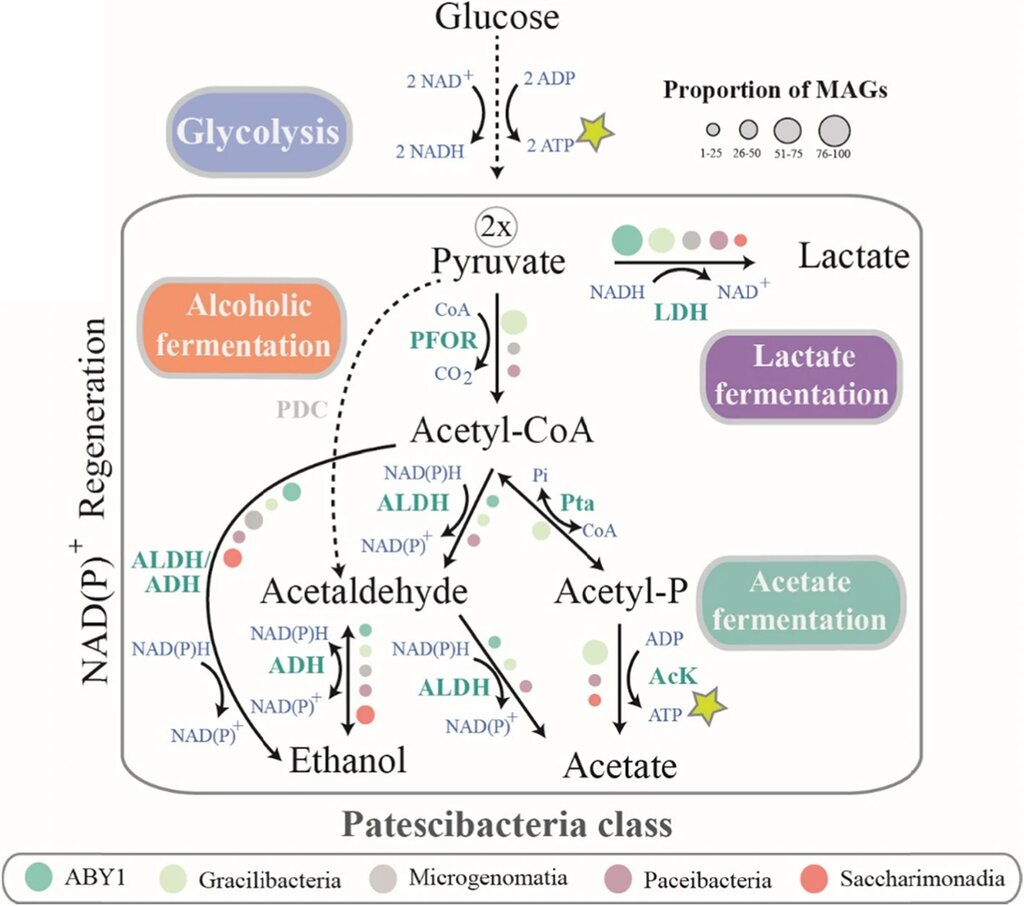
Let's look at alcoholic fermentation, the process used by yeast to make bread and beer. Here, an enzyme called pyruvate decarboxylase directs the first step: converting pyruvate into acetaldehyde and . But the enzyme doesn't act alone. It uses a helper molecule, or coenzyme, called thiamine pyrophosphate (TPP), a derivative of vitamin B1.
The TPP molecule contains a special, slightly acidic proton. The enzyme helps remove this proton, turning TPP into a potent nucleophile. This activated TPP then attacks the electrophilic C2 carbonyl of pyruvate. This attack forms a temporary covalent bond between TPP and pyruvate. This new structure is key because it stabilizes the negative charge that will be left behind when the carboxyl group breaks away as . Without TPP, this reaction would be incredibly slow. Once the is gone, the remaining two-carbon fragment is released as acetaldehyde, and the TPP coenzyme is regenerated, ready for the next pyruvate molecule.
The structure of pyruvate, with its electrophilic carbonyl carbon, makes it a perfect substrate for the bond-breaking and bond-forming reactions essential for fermentation.
What chemical classification does pyruvate fall under?
The C2 carbon of pyruvate is highly reactive and prone to nucleophilic attack because it is __________.