Ordering Food in a Greek Bakery
Greek Alphabet and Pronunciation
The Greek Alphabet
Getting started with Greek means learning its alphabet first. It might look different, but it's the foundation for everything else. Many Greek letters are phonetic, which makes pronunciation more straightforward than you might think.
Learning the Greek alphabet is the first step in mastering the language.
The Greek alphabet has 24 letters. You'll probably recognize some from math and science. Here they are, along with their names and how they generally sound.
| Uppercase | Lowercase | Name | English Sound (Approx.) |
|---|---|---|---|
| Α | α | Alpha | 'a' as in father |
| Β | β | Beta | 'v' as in vet |
| Γ | γ | Gamma | 'gh' like a soft 'g', or 'y' before e/i sounds |
| Δ | δ | Delta | 'th' as in the |
| Ε | ε | Epsilon | 'e' as in bet |
| Ζ | ζ | Zeta | 'z' as in zoo |
| Η | η | Eta | 'ee' as in see |
| Θ | θ | Theta | 'th' as in thin |
| Ι | ι | Iota | 'ee' as in see |
| Κ | κ | Kappa | 'k' as in king |
| Λ | λ | Lambda | 'l' as in love |
| Μ | μ | Mu | 'm' as in man |
| Ν | ν | Nu | 'n' as in no |
| Ξ | ξ | Xi | 'x' as in fox |
| Ο | ο | Omicron | 'o' as in top |
| Π | π | Pi | 'p' as in pen |
| Ρ | ρ | Rho | rolled 'r' sound |
| Σ | σ, ς | Sigma | 's' as in sun |
| Τ | τ | Tau | 't' as in top |
| Υ | υ | Upsilon | 'ee' as in see |
| Φ | φ | Phi | 'f' as in fun |
| Χ | χ | Chi | 'h' as in hue or Scottish loch |
| Ψ | ψ | Psi | 'ps' as in lips |
| Ω | ω | Omega | 'o' as in top |
You might have noticed that the letter Sigma has two lowercase forms. The 'σ' is used at the beginning or in the middle of a word, while 'ς' is only used at the very end.
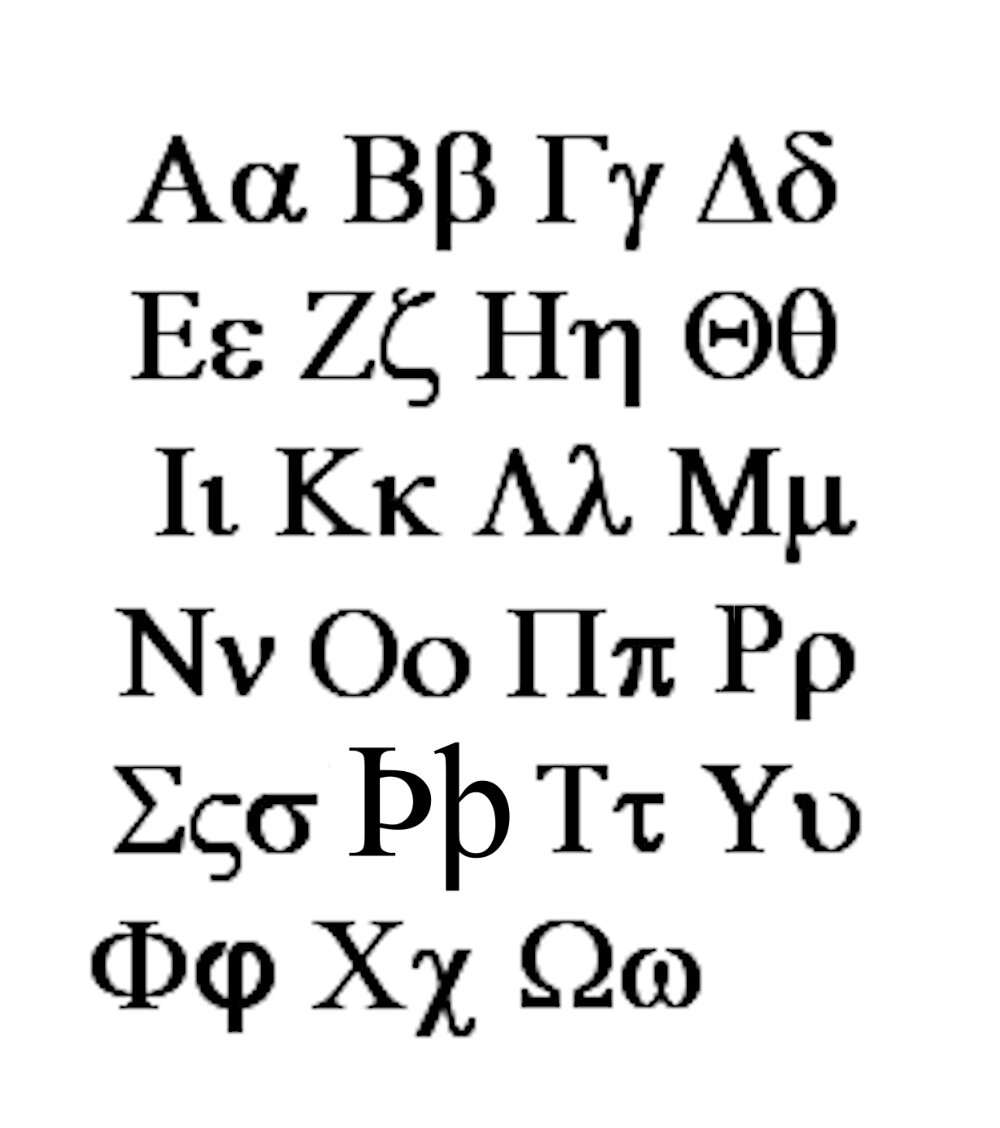
Vowels and Tricky Consonants
Greek has seven vowels: α, ε, η, ι, ο, υ, ω. Notice how many of them make the 'ee' sound (η, ι, υ). Also, 'ο' and 'ω' both make an 'o' sound. This simplifies things quite a bit.
While most consonants are straightforward, a few can be tricky for English speakers.
Gamma (γ) is a soft sound, almost like the 'g' is gargled. Before 'e' and 'i' sounds, it sounds like the 'y' in 'yes'.
Delta (δ) is not a hard 'd' sound. It's a soft 'th' sound, like in the word 'the' or 'this'.
Chi (χ) is a sound that doesn't really exist in English. It's a breathy 'h' sound made at the back of your throat, similar to the 'ch' in the Scottish word 'loch'.
Common Letter Combinations
In Greek, some pairs of letters consistently combine to make a single sound. These are called digraphs. Learning to spot them is key to pronouncing words correctly. Think of them as a 'two for one' deal on sounds.
| Combination | Sound | Example |
|---|---|---|
| αι | 'e' as in bet | Like the vowel ε |
| ει | 'ee' as in see | Like the vowels η, ι, υ |
| οι | 'ee' as in see | Also like the vowels η, ι, υ |
| ου | 'oo' as in moon | Spells the 'oo' sound |
| μπ | 'b' at start of word, 'mb' in middle | Like the English 'b' or 'mb' |
| ντ | 'd' at start of word, 'nd' in middle | Like the English 'd' or 'nd' |
| γκ | 'g' at start of word, 'ng' in middle | Like the English 'g' or 'ng' |
| γγ | 'ng' as in angle | Always has the 'ng' sound |
Let's see one in a word you might find in a bakery.
a type of confection, similar to Turkish delight
Here, the 'ου' combination makes the 'oo' sound. Once you start recognizing these pairs, reading Greek becomes much easier.
Time to check your understanding of these new letters and sounds.
How many letters are in the Greek alphabet?
Which form of the letter Sigma is used only at the end of a word?