Orchid Photosynthesis Explained
Photosynthesis Basics
How Plants Make Food
Plants don't eat the way animals do. Instead, they create their own food through a process called photosynthesis. Think of it as a plant's way of cooking a meal using light as the main ingredient. This process is vital for nearly all life on Earth because it produces the oxygen we breathe.
To make this food, plants need three things: carbon dioxide from the air, water from the soil, and energy from sunlight. The magic happens inside tiny structures in their leaves called chloroplasts. These are like miniature factories powered by the sun.
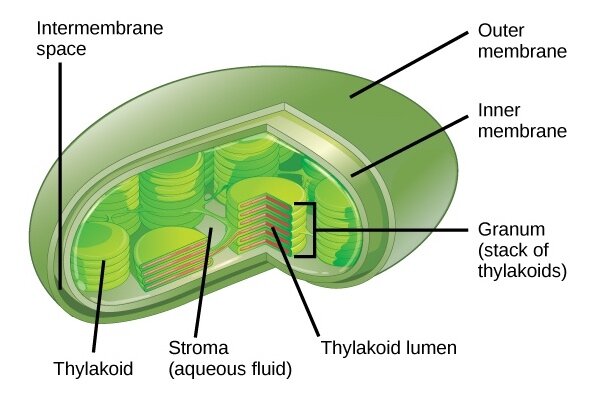
Inside the chloroplasts is a green pigment called chlorophyll. Chlorophyll is what gives plants their color, but more importantly, it's what absorbs sunlight. It acts like a solar panel, capturing the sun's energy and kicking off the entire process. The overall reaction can be summed up with a simple chemical equation.
A Two-Part Process
Photosynthesis isn't just a single event. It's a complex biochemical pathway broken down into two main stages. The first stage needs light to work, while the second stage can happen without it.
Photosynthesis can be divided into two main stages: the light-dependent reactions and the light-independent reactions (also known as the Calvin cycle).
Let's look at the first stage. This is where the initial energy capture happens.
The Light-Dependent Reactions
The light-dependent reactions are the "photo" part of photosynthesis. They happen in the thylakoid membranes within the chloroplasts. When chlorophyll absorbs sunlight, the light energy excites electrons, kicking off a chain reaction.
During this process, water molecules are split apart. This releases oxygen, protons (hydrogen ions), and the energized electrons. The main goal here is to convert the captured light energy into a temporary, usable chemical form. The plant creates two special energy-carrying molecules: ATP (adenosine triphosphate) and NADPH (nicotinamide adenine dinucleotide phosphate). Think of these like rechargeable batteries that are now fully charged and ready to power the next stage.
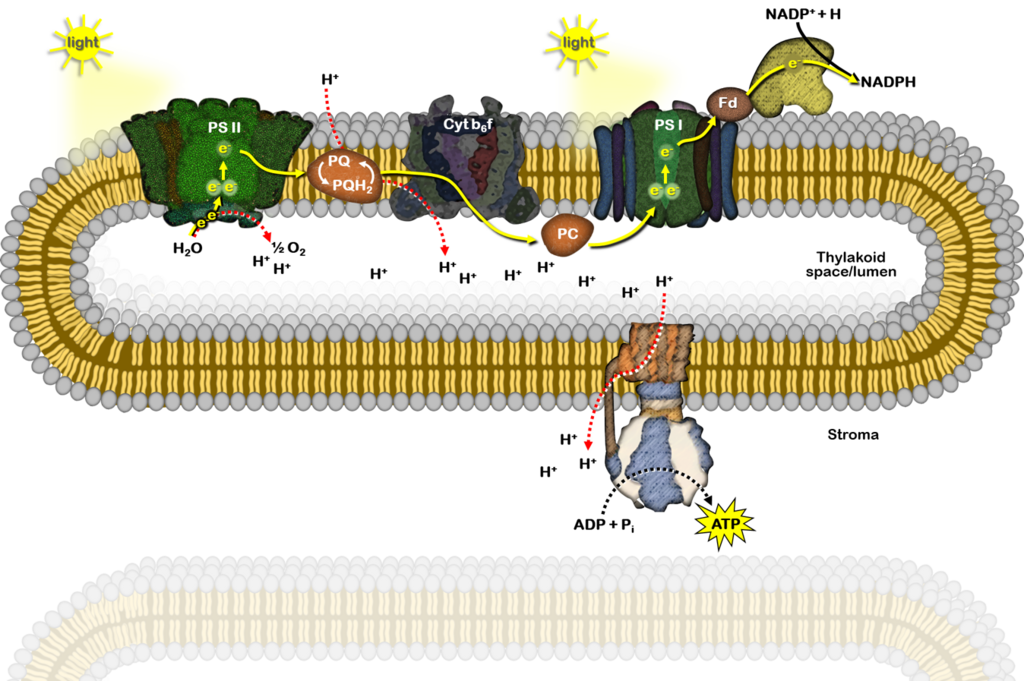
The key takeaways for the light-dependent reactions are: they require light, they split water, they produce oxygen, and they create the energy carriers ATP and NADPH.
The Light-Independent Reactions
The second stage is known as the light-independent reactions or, more commonly, the Calvin cycle. This is the "synthesis" part, where the actual food is built. These reactions take place in the stroma, the fluid-filled space inside the chloroplasts, and they don't directly require light. Instead, they use the energy from the ATP and NADPH created during the light reactions.
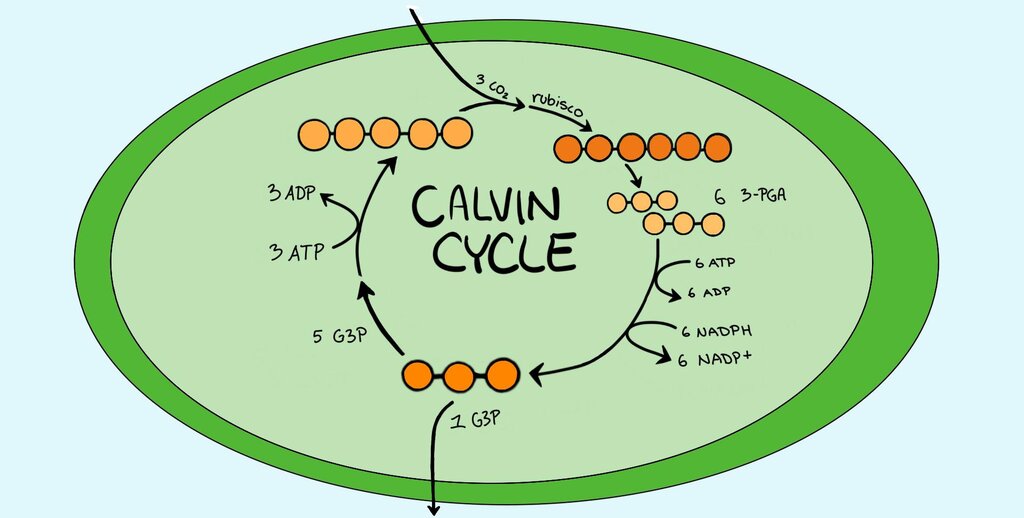
In the Calvin cycle, carbon dioxide from the atmosphere is "fixed," meaning it's captured and converted into organic molecules. Through a series of enzyme-driven steps, the chemical energy from ATP and NADPH is used to transform the carbon dioxide into glucose (sugar). This sugar is the plant's food. It can be used immediately for energy, stored for later use as starch, or used to build other essential molecules like cellulose for cell walls.
Once the ATP and NADPH have been used, they revert to their lower-energy forms (ADP and NADP+) and are sent back to the light-dependent reactions to be recharged. This cyclical process allows the plant to continuously produce food as long as it has light, water, and carbon dioxide.
What are the three essential inputs required for photosynthesis to occur?
What is the primary function of chlorophyll in photosynthesis?