Orbital Mechanics Explained
Introduction to Orbital Mechanics
The Rules of Cosmic Motion
Imagine throwing a ball so fast that as it falls back to Earth, the planet's surface curves away from it at the exact same rate. The ball would never land; it would just keep falling forever. That's essentially what an orbit is, and the study of these paths is called orbital mechanics.
It’s the branch of physics that explains how objects move under the force of gravity. This applies to everything from the Moon circling the Earth to a tiny satellite delivering your internet connection. Orbital mechanics gives us the tools to predict the paths of planets, comets, and asteroids, and to plan the journeys of spacecraft exploring our solar system and beyond.
orbit
noun
A regular, repeating path that one object in space takes around another one.
Understanding these cosmic rules wasn't straightforward. It took thousands of years of observation and a few revolutionary ideas to get it right.
A Shift in Perspective
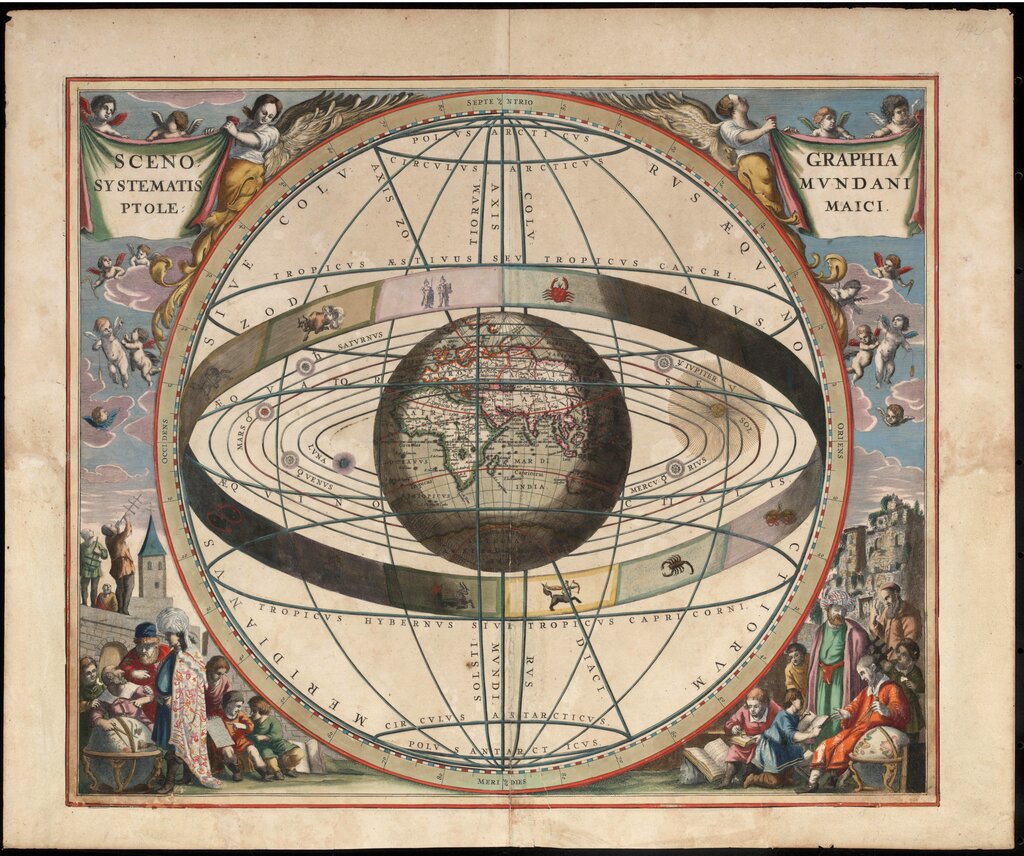
For over 1,400 years, the dominant view of the universe placed Earth at the center of everything. This was the Ptolemaic, or geocentric, model. It made sense based on what people could see: the Sun, Moon, and stars all appeared to revolve around us each day.
To account for the strange motions of planets, which sometimes seemed to move backward in the sky, astronomers developed a complex system of circles-on-circles called epicycles. It was a clever way to make the observations fit the theory, but it was also incredibly complicated.
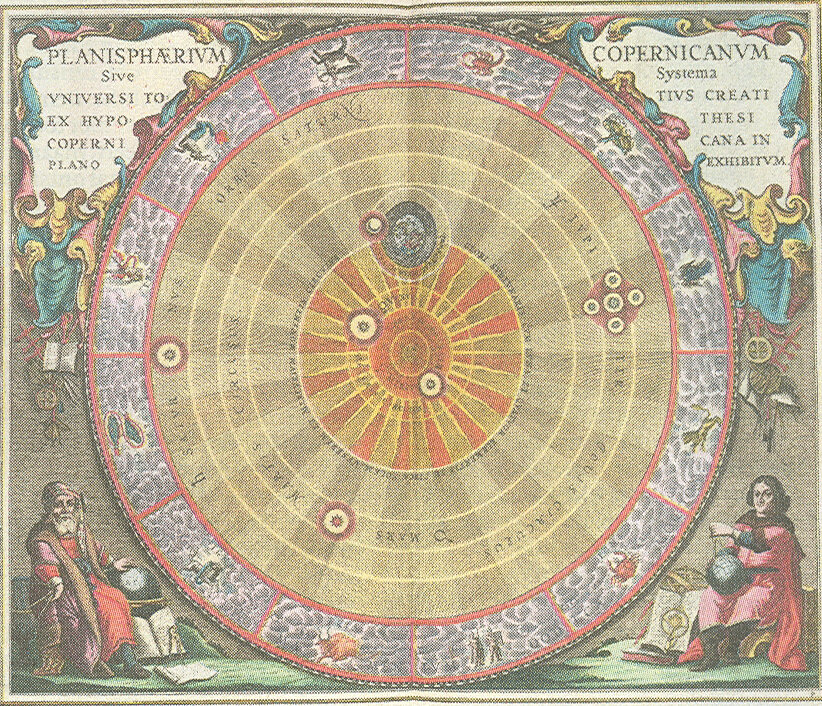
Then, in the 16th century, Nicolaus Copernicus proposed a radical new idea. He suggested that the Earth was not the center of the universe. Instead, he placed the Sun at the center, with the Earth and other planets revolving around it. This is the heliocentric model.
This shift didn't just reorder the solar system; it simplified it. The strange backward motions of the planets were now easily explained by the fact that Earth was also moving, sometimes overtaking other planets in its own orbit. The heliocentric model paved the way for a true understanding of why planets move the way they do.
Mapping the Cosmos
To describe the position of a spacecraft or planet, we need a map. But how do you make a map of something as vast as space? It all starts with a reference frame, which is just a point of view from which you make measurements.
If you're on a moving train, your coffee cup might seem stationary relative to you. But to someone standing on the platform, your cup is speeding by. You and the person on the platform are in different reference frames. In space, we might use the center of the Earth, the center of the Sun, or even the center of the galaxy as our reference point.
Once we have a reference point, we can create a coordinate system. On Earth, we use latitude and longitude. For the cosmos, astronomers use a similar system by projecting Earth's grid onto the sky. They imagine a giant, hollow ball surrounding the solar system, called the celestial sphere. By extending Earth's equator and poles out to this sphere, they create a celestial equator and celestial poles, giving every star and planet a fixed address.
This system helps us track objects and predict their movements with incredible accuracy.
Paths Through Space
The words "orbit" and "trajectory" are often used interchangeably, but they have distinct meanings in orbital mechanics.
An orbit is a stable, repeating path an object takes around a central body, like a planet or star. This path is the result of a precise balance between the object's forward momentum and the gravitational pull of the central body. The Moon is in orbit around the Earth, and the Earth is in orbit around the Sun. These are closed paths.
A trajectory is a more general term for any path an object follows through space. An orbit is one type of trajectory. But a trajectory can also be an open path, meaning the object doesn't come back. For example, a comet flying through the solar system from interstellar space follows a trajectory, but it may not be in orbit if it's moving fast enough to escape the Sun's gravity and never return. A spacecraft traveling from Earth to Mars also follows a trajectory.
Every orbit is a trajectory, but not every trajectory is an orbit.
This distinction is key. Mission planners for a Mars rover are calculating a trajectory to get from one point to another. Astronomers tracking a newly discovered asteroid are determining its orbit to see if it will remain a stable member of our solar system.
What is an orbit?
The geocentric model of the universe, which was the dominant view for over 1,400 years, placed which celestial body at the center?
These basic concepts—the models of the solar system, reference frames, and the nature of paths through space—form the foundation of orbital mechanics. They allow us to navigate the cosmos and understand the elegant dance of the celestial bodies.