Optimizing RAG Pipelines
Introduction to RAG
Giving Models an Open Book
Large language models (LLMs) are powerful, but they have a fundamental limitation: they only know what they were taught during their training. Their knowledge is vast but static, like a brilliant student who has memorized a whole library but can't access any new books or the internet. This can lead to outdated or completely made-up answers, a problem often called "hallucination."
Retrieval-Augmented Generation, or RAG, is a technique designed to solve this problem. It gives an LLM access to external, up-to-date information before it generates a response. Think of it as giving that brilliant student an open-book test. Instead of just relying on memory, the student can now look up the relevant facts in a trusted textbook to formulate the best possible answer.
Retrieval-augmented generation (RAG) effectively addresses issues of static knowledge and hallucination in large language models.
By connecting the model to a live, curated knowledge source, RAG ensures the answers are not only creative and well-written but also accurate and grounded in specific, verifiable data. This makes the models more reliable for real-world tasks where facts matter.
The RAG Process
RAG works in a straightforward, three-step process. It's a pipeline that takes a user's question, finds relevant information, and uses that information to create a high-quality answer.
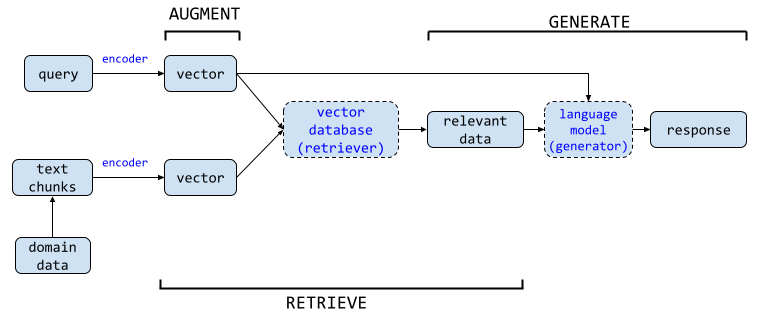
1. Retrieval First, when you ask a question (a "query"), the system doesn't immediately go to the LLM. Instead, it searches an external knowledge base for information relevant to your query. This knowledge base could be a collection of company documents, a product manual, a set of scientific papers, or any other private data source. The goal is to find specific snippets of text that are most likely to contain the answer.
2. Augmentation Next, the system takes the relevant text snippets it found and combines them with your original query. This combined text is called an "augmented prompt." It gives the LLM all the context it needs to answer your question accurately. The original query might be simple, like "What are our Q3 sales goals?" The augmented prompt would be more detailed, including the original query plus the actual sales goal data retrieved from an internal document.
3. Generation Finally, the augmented prompt is sent to the LLM. The model uses this rich, context-aware prompt to generate its final response. Because it has the exact information it needs, the LLM is far less likely to hallucinate and much more likely to provide a correct, helpful answer based on the provided data.
In short: RAG finds the right facts, adds them to your question, and then lets the LLM craft an answer based on those facts.
Why RAG Matters
The most significant benefit of RAG is its ability to reduce hallucinations and improve factual accuracy. LLMs are trained on a massive, general dataset from the public internet. They don't have access to your company's private files, the latest news, or specialized technical documents. RAG bridges this gap, allowing models to work with specific, current, and proprietary information.
This makes LLMs far more useful in professional settings. Instead of a generic chatbot, you can have a specialized assistant that understands your team's internal processes, a customer support bot that knows every detail of your product catalog, or a research tool that can synthesize information from the latest scientific findings.
hallucination
noun
The tendency of an AI model to generate false, nonsensical, or factually incorrect information that was not present in its training data.
RAG also provides transparency. A standard LLM gives you an answer without showing its work. With a RAG system, you can often see the exact sources that were used to generate the response. This allows users to verify the information and builds trust in the system's output.
| Application | Description |
|---|---|
| Customer Support | A chatbot answers customer questions using the company's official product manuals and help articles. |
| Enterprise Search | An employee asks about company policy, and the system retrieves the answer from internal HR documents. |
| Healthcare | A doctor gets a summary of the latest research on a specific condition, pulled from a database of medical journals. |
| Financial Analysis | An analyst asks for a summary of a company's performance, and the RAG system pulls data from the latest earnings reports. |
Ready to test your understanding of these core concepts?
What is the primary limitation of standard Large Language Models (LLMs) that Retrieval-Augmented Generation (RAG) is designed to address?
In the RAG process, what is the 'Augmentation' step?
By grounding language models in real, verifiable data, RAG makes them more trustworthy and powerful tools for a wide range of applications.