Optical Instruments Engineering
Optical Principles
Light's Path
Light travels in straight lines, but its path can be changed. The two most fundamental ways this happens are through reflection and refraction.
Reflection is what happens when light bounces off a surface. Think of a ball bouncing off a wall. The angle at which it hits is the same as the angle at which it bounces off. Light does the same thing. This is called the Law of Reflection. The angle of incidence (the incoming angle) equals the angle of reflection (the outgoing angle). This simple rule is why you can see your reflection in a calm lake or a mirror.
Refraction is a bit different. It's the bending of light as it passes from one medium to another, like from air into water. This happens because light travels at different speeds in different materials. A straw in a glass of water looks bent because light from the straw refracts as it leaves the water and enters the air on its way to your eyes.
The relationship between the angles and the properties of the materials is described by Snell's Law.
Waves at Work
While we often think of light as traveling in straight rays, it also behaves like a wave. This wave nature gives rise to two important phenomena: diffraction and interference.
Diffraction is the tendency of light waves to spread out as they pass through a small opening or around a sharp edge. It's why you can hear someone talking in another room even if you can't see them; sound waves diffract around the doorway. Light does this too, but because its wavelength is so small, the effect is much more subtle.
Interference occurs when two or more light waves meet. If the peaks of the waves align, they combine to create a brighter light. This is called constructive interference. If the peak of one wave aligns with the trough of another, they cancel each other out, creating a dark spot. This is destructive interference.
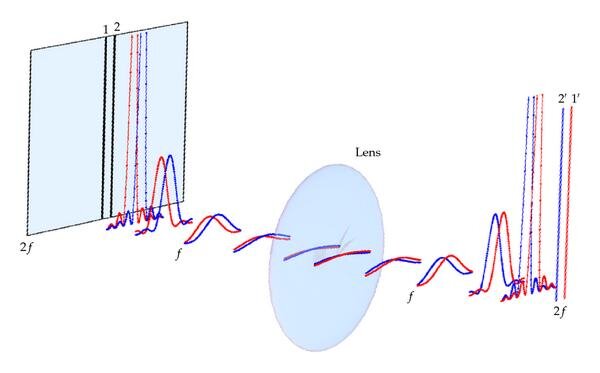
These wave properties are fundamental to understanding the limits of optical instruments. For example, diffraction ultimately limits the resolution of a telescope or microscope, determining the smallest detail they can distinguish.
Focusing Light
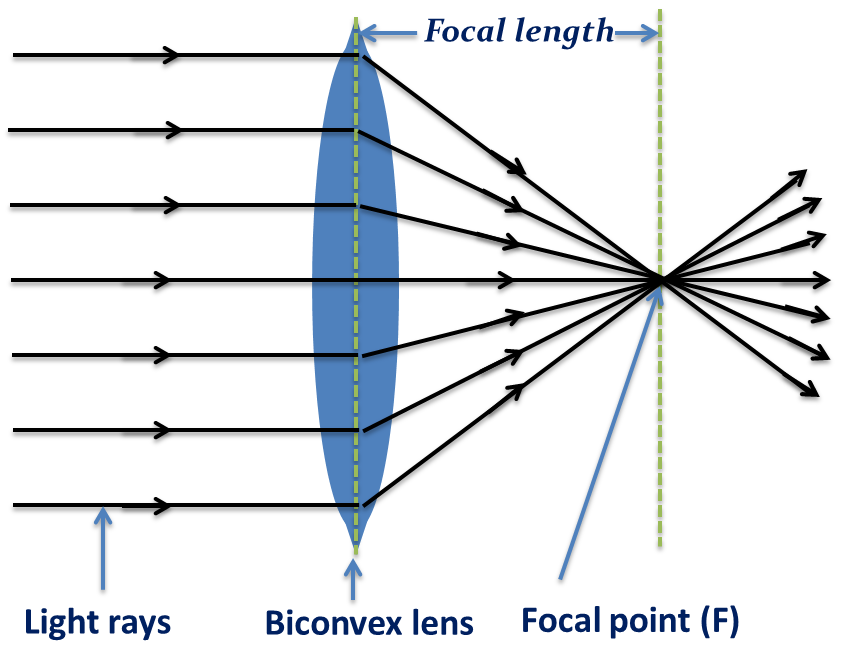
Lenses and mirrors are the workhorses of optical instruments. They use refraction and reflection to manipulate light and form images. A curved lens, for example, refracts light to bring it to a focus. A curved mirror does the same thing through reflection.
The relationship between an object, its image, and the focal length of a lens or mirror is described by a simple but powerful equation.
By choosing lenses or mirrors with specific focal lengths and placing them at precise distances, we can create instruments that magnify tiny objects or gather light from distant stars.
When Images Go Wrong
The equations we've seen describe an ideal world. In reality, lenses and mirrors have imperfections that cause images to be distorted. These distortions are called optical aberrations.
One common type is spherical aberration. This occurs because a simple spherical lens doesn't focus all incoming light rays to a single point. Rays hitting the edge of the lens are bent more than rays hitting the center, resulting in a blurry image.
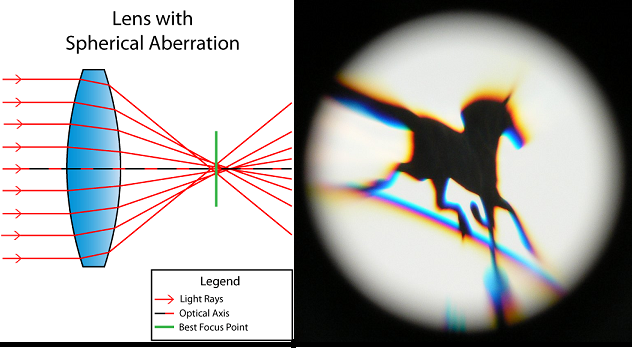
Another common issue is chromatic aberration. This happens because a lens refracts different colors of light by slightly different amounts. Think of how a prism separates white light into a rainbow. A simple lens does this too, causing colored fringes to appear around objects, especially in high-contrast areas.
Designing high-quality optical instruments involves carefully correcting for these and other aberrations, often by using multiple lenses made of different types of glass.
According to the Law of Reflection, if a light ray strikes a flat mirror at an angle of 30 degrees to the normal (the line perpendicular to the mirror's surface), at what angle will it reflect relative to the normal?
Why does a straw placed in a glass of water appear to be bent at the water's surface?