Oppenheimer The Man and The Bomb
Introduction to J. Robert Oppenheimer
The Making of a Mind
Julius Robert Oppenheimer was born in New York City in 1904 to a wealthy family. His father was a successful textile importer, and his mother was a painter. Growing up in a household that valued art, culture, and intellectual curiosity, young Robert developed a wide range of interests, from mineralogy to French poetry. He was a gifted but intense student, known for his quick mind and broad knowledge.
He entered Harvard University to study chemistry but soon found himself drawn to the new, revolutionary ideas emerging in physics. He excelled, graduating in just three years. To continue his studies, he sailed for Europe, the center of the physics world at the time.
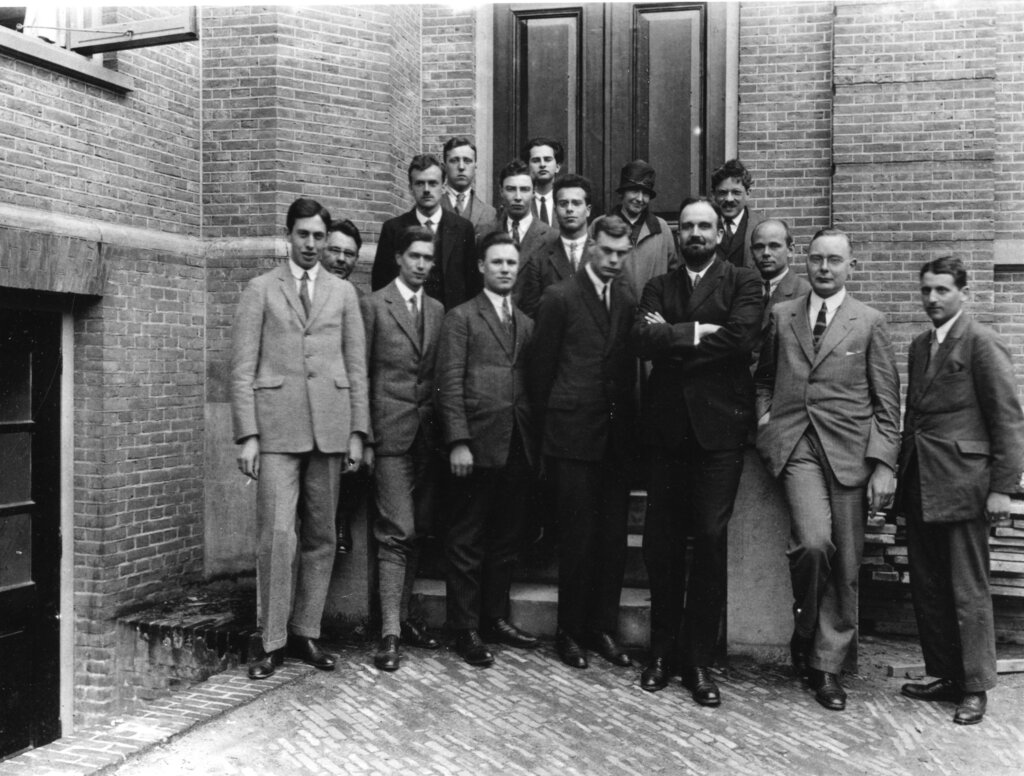
His first stop was Cambridge University's prestigious Cavendish Laboratory. However, Oppenheimer quickly discovered he was not suited for the hands-on, meticulous work of experimental physics. He found his true calling in theoretical physics, which deals with the mathematical models and abstract concepts of the universe. He moved to the University of Göttingen in Germany, a hotbed for the development of quantum mechanics, where he studied under Max Born and earned his Ph.D. at the age of 23.
Bringing Quantum Ideas to America
When Oppenheimer returned to the United States in 1927, he was one of the few American scientists fluent in the strange new language of quantum mechanics. He accepted dual professorships at the University of California, Berkeley, and the California Institute of Technology (Caltech). He quickly established himself as a charismatic and brilliant teacher, attracting a generation of the country's best young physicists. He essentially founded the American school of theoretical physics, translating the complex European theories for a new audience.
His lectures were a blend of intellectual rigor and philosophical insight. He had a unique ability to make the most abstract concepts feel immediate and important.
Ideas at the Edge of Science
Oppenheimer's research spanned a wide range of topics in the new physics. He worked on quantum electrodynamics, nuclear physics, and spectroscopy. But his most significant contributions involved applying quantum mechanics to astrophysics.
One of his most important works was the Born-Oppenheimer approximation, a technique that simplifies the calculation of molecular behavior by separating the motion of the atomic nuclei from the motion of the much lighter electrons. This made it possible to solve quantum equations for molecules that were previously far too complex.
Even more groundbreaking was his work on the life and death of stars. With his students, he explored the processes of stellar collapse. In 1939, he and Hartland Snyder published a paper describing how a massive star could collapse under its own gravity, creating an object so dense that not even light could escape. They had, in effect, predicted the existence of black holes, decades before astronomers had the tools to find them. This early work laid the foundation for much of modern astrophysics, showcasing a mind comfortable with the most extreme possibilities of the universe.
At which European university did J. Robert Oppenheimer earn his Ph.D. in theoretical physics?
The Born-Oppenheimer approximation was a significant contribution to which field?